SOUND PATTERNS
A Structural Examination of Tonality, Vocabulary, Texture,
Sonorities, and Time Organization in Western Art Music
by PHILLIP MAGNUSON

COMPOSITION BASICS
CHOOSING A MUSICAL VOCABULARY
A pretty girl is like a melody...
You need to have a system for the generation of pitch before you begin writing music. Some composers will just begin writing, but it helps to define your method first if you are inexperienced. There are endless choices; a few things to consider:
- You can use traditional systems, such as major/minor scales, or modes. The advantage is that they are easy to come up with; the disadvantage is the same...they are so familiar that they don't always allow a personal voice.
- You can use some more unusual systems, such as various pentatonic scales, the whole tone scale, or the octatonic scale. The advantage is that they provide a fresh view of the pitch vocabulary. See the appendix in this text on non-traditional scales.
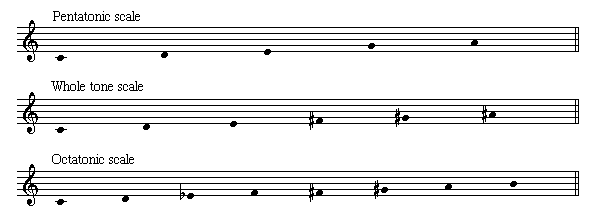
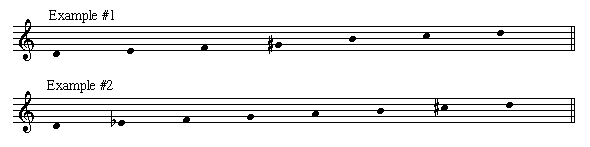
- You can make up your own unique scales or pitch collections, such as these examples. There is no disadvantage to this, since they can provide you with a fresh new voice, and you can change them at any time to comply with your idea of what works well.
- Relate your pitch system to the text. For instance, if there is a strong ethnic slant to the text, you may elect to use a pitch system which fits into that style, such as the blues scale below.

- Choose a system that appeals to you, yet at the same time provides you with an aural challenge. Analyze the melodic and harmonic characteristics. For the purpose of illustration, a phrygian (old church mode) hexachord (6 adjacent notes) will be used:

Copyright � 2008-2009 by Phillip Magnuson.
Content on this website is licensed under a Creative Commons License.