Triads & Inversions
Many different kinds of chords are used in 12TET music, but the most basic, common form is the triad.
Tertial Harmony
In most 12TET music, chords are constructed using major and minor thirds, a system called tertial harmony. Diminished and augmented thirds, which sound like major seconds and perfect fourths, respectively, are not considered part of this system of harmony.
Triads
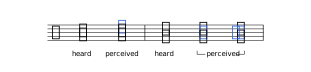
Tertial chords of many sizes — triads, tetrads, pentads, and so on — are common in 12TET music, but listeners often perceive the first three notes of a chord as foundational, and remaining notes as adding specific color. Dyads are often perceived as missing a third note, which is often aurally "filled in" by the listener.
Types of Triads
Using major and minor thirds, there are four possible types of triads: diminished, minor, major and augmented.
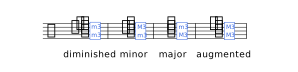
Major and minor triads are often perceived as being consonant, and diminished and augmented triads are generally heard as dissonant.
Beginning with the a diminished triad, all three other triad types can be constructed by changing one note by a half step.

Voicing
As long as they contain the three specific pitch classes, triads can be written in any order and with any kind of spacing. A single pitch class may be included in more than one octave, a process called doubling. The type of arrangement used is call the chord's voicing. When the notes are spread out widely, the chord is said to have an open voicing, and when the notes are placed close together it is called closed voicing.

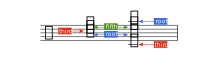
Theorists often write triads and other chords in closed position stacked in thirds, a special voicing called basic form. The notes in a chord, or chord tones, are labeled based on their location when the chord is in basic form: the bottom note is called the root of the chord, the middle note is called the third, and the top note is called the fifth. These labels are used to describe members of the chord even when the chord is written in other voicings.
Inversions
Changing a chord's voicing can affect its sound. The aspect of voicing that has the most significant affect on the chord's sound is the chord's inversion, which is determined by what chord tone is the bass, or the lowest note in the chord.
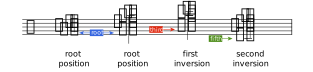
Triads can be in three different inversions:
- When the chord has the root in the bass, the chord is in root position. Root position is usually considered the most stable and consonant arrangement of the chord.
- When the chord has the third in the bass, the chord is in first inversion. First inversion usually sounds consonant, but with less finality than root position.
- When the chord has the fifth in the bass, the chord is in second inversion. Second inversion tends to sound unstable, as though it should resolve to a different chord.
Inversions are determined only by the chord note present in the bass; the structure, spacing and doubling of the rest of the chord has no affect on the chord's inversion.
Triads & Inversions: Summary
- Tertial harmony is a system of chords constructed with major and minor thirds.
- A triad is a chord consisting of three notes, comprising two major or minor thirds.
- There are four possible triads in tertial harmony:
- A major triad consists of a major third on bottom and a minor third on top.
- A minor triad consists of a minor third on bottom and a major third on top.
- A diminished triad consists of two minor thirds stacked together.
- An augmented triad consists of two major thirds stacked together.
- Major and minor triads are often perceived as being consonant, and diminished and augmented triads are usually heard as bring dissonant.
- Triads can be written using doubling, and in various voicings.
- Open voicing features chord tones spread out across a larger range.
- Closed voicing features chord tones grouped more closely together.
- Basic form arranges the chord as compactly as possible, without using any doubling.
- A triad's inversion is determined by which chord tone is the bass.
- If the chord's root is in the bass, the chord is in root position.
- If the chord's third is in the bass, the chord is in first inversion.
- If the chord's fifth is in the bass, the chord is in second inversion.