Set Theory


Systems of analysis are often designed to align with particular genres of music; when they do not align, the results can sometimes be unhelpful or frustrating. As composers of the twentieth century explored beyond tonal musical genres, theorists found new ways to classify and understand that music.
Purpose
Tools like Roman numeral analysis and neo-Riemannian theory can be very useful for understanding music written using tertial harmony. However, these tools are not designed for other musical styles which use techniques like quartal harmony or atonality.
Set theory is a branch of mathematics which center around groups of numbers, or sets. Theorists will sometimes use these same concepts to classify and better understand a wider variety of chords. While we often simply refer to this type of analysis as set theory, it is more properly labeled musical set theory to differentiate it from the broader mathematical field.
The primary goal of set theory is to classify chords by the element that most fundamentally affects their sound: the intervals present in the chord.
Set Theory Basics
Because set theory is mathematical in nature, theorists have a standard method for representing and working with musical pitch in a numeric form.
Pitch Class Sets
Set theory represents pitch as a pitch class: a representation of a note independent of octave. Whereas F#4 and F#2 are considered to be different pitches, they belong to the same pitch class: F#.
Rather than using the customary letter names and accidentals, we refer to the notes as numbers, where C is always 0.
| C | C# | D | D# | E | F | F# | G | G# | A | A# | B |
| 0 | 1 | 2 | 3 | 4 | 5 | 6 | 7 | 8 | 9 | 10 | 11 |
Collections of pitches — chords — are referred to as sets and are notated as a series of numbers, separated by commas and placed in square brackets.
![A chord containing B3, E flat 4, F sharp 4, B4, D5 and C sharp 6, with its corresponding pitch class set, [1,2,3,6,11].](images/twc10-02.svg)
Inversion
In the context of set theory, a set's inversion refers to a "mirror image" of the intervals which make up the set. If a set contains a major third, for example, the set's inversion will contain the inversion of that interval, a minor sixth.
Mathematically, the easiest way to determine a set's inversion is to retain any 0s in the set, and subtract each of the other numbers in the set from 12.
![A diagram showing how a set, [0,3,6,10], is inverted. Each number is shown with an arrow moving downward from it. The arrow under 0 points to a 0 in the new set. The other three arrows go through a box marked `12 minus X` and point to the numbers 9, 6, and 2 respectively, so the inverted set reads [0,9,6,2].](images/twc10-03.svg)
Normal Form
A set's normal form is the most compact ordering of the set.
To determine ordering and compactness for a set, it is most useful to think of the pitches not in a line but in a circle — like on an analog clock face, but with a 0 in place of the 12.
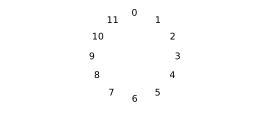
A set is considered to be correctly ordered when the numbers read clockwise around the circle. Sets can "wrap around" the circle: [8,10,4,5], for example, is considered to be ordered correctly.
A set is considered to be most compact when it traverses the least possible distance around the circle. If there are multiple possibilities which traverse the same distance, the set that starts with the smallest intervals is considered the most compact.
![A diagram the different possibilities of correctly ordering [2,6,8,10]. [8,10,2,6] and [10,2,6,8] traverse too much distance around the perimeter of the circle. [2,6,8,10] and [6,8,10,2] traverse the same amount of distance, but [6,8,10,2] has a smaller starting interval and is thus the most compact option.](images/twc10-05.svg)
Prime Form
A set's prime form is found by taking the most compact of a set's normal form and the normal form of its inversion, and transposing the result to start on 0.
For example, Figure 6 illustrates the process of finding the prime form for a chord containing the notes D, F, A and Bb.
![A diagram showing how to find prime form for [2,4,9,10]. First we find the inversion, [10,8,3,2]. We find the normal form of the original set; [9,10,2,4] is the most compact ordering. Then we find the normal form of the inversion; [8,10,2,3] is the most compact. Between those two, [9.10.2.4] is most compact because it starts with the smallest interval, so we transpose it to start on 0, yielding [0,1,5,7] as the prime form.](images/twc10-06.svg)
Prime form is one of the basic levels of categorization in set theory, and chords which have the same prime form will have a similar degree of consonance or dissonance in an equal-tempered system.
There are 224 possible prime forms in 12-TET, including the null set, [], and the dodecachord, [0,1,2,3,4,5,6,7,8,9,10,11].
Interval Analysis
Because a set's component intervals determines the character of the chord it represents, theorists have devised different ways of describing sets that generally correspond to the set's prime form.
Interval Vector
Rather than labelling prime form by the pitches in a set, the interval vector lists the intervals which are present. Possible intervals are listed in order of size from smallest to largest, from minor second to tritone. Intervals larger than the tritone are counted as their inversion; for example, a minor sixth is counted as a major third.
A set's interval vector is shown in parenthesis, with the tally of each intervals separated by commas.
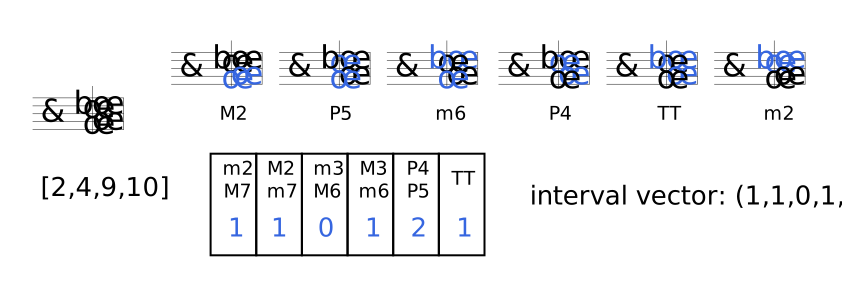
While there are 224 possible prime forms, there are only 201 possible interval vectors: some pairs of prime forms, such as [0,1,4,6] and [0,1,3,7], share the same interval vector.
Hanson Analysis
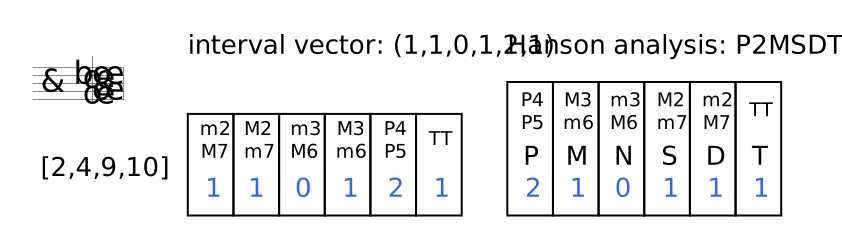
Like the interval vector, Hanson analysis — named for American theorist and composer Howard Hanson — lists the number of each interval in the set. However, Hanson analysis uses letters to indicate each type of intervals, and orders them from relative consonance to dissonance: P for perfect fourths, M for major thirds, N for minor thirds, S for major seconds, D for minor seconds, and T for tritones. Multiple numbers of intervals are indicated with a superscripted numeral, and letters are omitted when no intervals of the corresponding type are present.
Forte Number
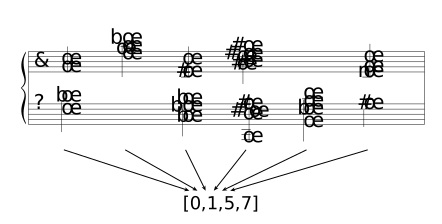
American theorist Allen Forte cataloged the possible prime forms, giving each one a two-part number known as the Forte number. The first of these numbers represents the number of pitches in the set, and the second represents an order given by Forte. There is no standard method for calculating the Forte number of a set; theorists simply consult a chart of Forte numbers to find them.
Some Forte numbers include a "z" before the second number; this indicates a set which has the same interval vector as another set, such as sets 5-z17 and 5-z37.
![The chord from Figure 6, D3, E3, A3, B flat 3, is shown with its prime form, [0,1,5,7]. Shown is a page representing the Forte number chart; an inset is shown with columns of sets alongside Forte numbers, like a tax table. Highlighted is the Forte number for [0,1,5,7]: 4-16.](images/twc10-10.svg)
Applications
Because it can be used to describe any combination of notes in 12-TET, set theory can be a useful tool for analyzing the harmonic element of music for which other systems of harmonic analysis are unsuited.
Analyzing chords for prime form can sometimes provide additional harmonic insight to pieces which are atonal in nature.
![Measures 1, 2, 6, 7, 9, 10 and 11 of Elisabeth Lutyens' Bagatelle, Op. 48, No. 1. Chords from this atonal piece are analyzed as sets: set [0,1,4,5] appears in measure 1 and 6, set [0,1,6] appears in measure 1, 7, and 10, and set [0,1,4,7] appears in measures 2, 9 and 11.](images/twc10-11.svg)
Set Theory: Summary
- Musical set theory is a system of analyzing all possible chords in 12-TET.
- Musical set theory draws from a broader system of mathematics, set theory, which involves operations on groups of numbers.
- The goal of set theory is to classify chords by levels of consonance or dissonance, as determined by the intervals present in a given chord.
- Set theory analysis requires a sequence of operations on a chord.
- Determining a chord's pitch class set involves finding the pitch classes present in a chord and listing them as numbers from 0 to 11, where 0 is C and 11 is B.
- Pitch class sets are shown in brackets, with individual notes separated by commas.
- Determining a pitch class set's inversion is done by subtracting each number in the set by 12. Any 0s present in the original set are retained.
- To determine the normal form of a set, the pitches are listed in ascending order, allowing numbers to "wrap around" from 11 to 0. The most compact ordering — the order which covers the least amount of distance, and which has the smallest intervals at the beginning — is then selected.
- Determining prime form of a set requires finding the normal form of the set and the normal form of the inversion of the set, selecting which of them are most compactly ordered, and transposing the result to begin on 0.
- A set's prime form can be expressed in a few different ways.
- A set's interval vector is determined by counting all the possible intervals present in the set. Intervals larger than a tritone should be inverted, and the tally is then shown in the format (m2, M2, m3, M3, P4, TT).
- Hanson analysis is another form of listing a set's component intervals. Instead of being ordered by size, the order is by consonance: P4, M3, m3, M2, m2, TT. The presence of each intervals is indicated by a letter — P, M, N, S, D, T, respectively — with the presence of multiple intervals indicated by a superscripted number.
- Theorist Allen Forte cataloged all the possible prime forms in 12-TET and assigned each set a label. Identifying a set's Forte number simply requires looking up the value on Forte's list of sets.