Microtonality
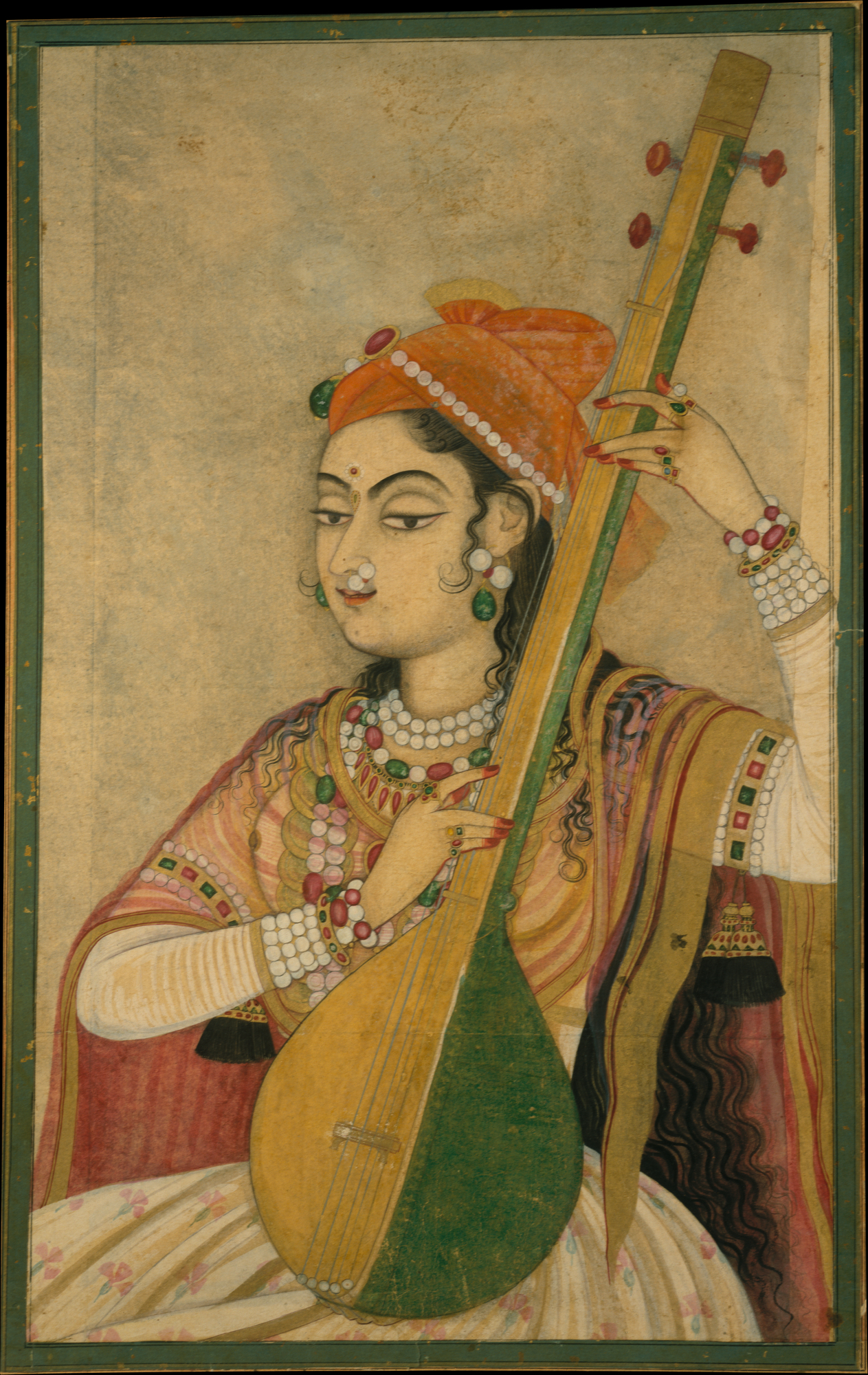
Twelve-tone equal temperament, or 12-TET, is considered a standard tuning for professional musicians in many fields, including the commercial recording industry, However, many tuning systems exist in the music of today and the music of the past, and even within 12-TET musicians commonly incorporate techniques which vary from the standard. Together, especially as seen from the perspective of 12-TET music, this is referred to as microtonality.
Microtonality within 12-TET
Composers and performers will sometimes incorporate types of microtonality within an otherwise conventional tuning system.
Pitch Bending
Most instruments allow for the performers to bend the pitch of a note as an expressive technique, either by changing the embouchure on wind instruments or using fingering techniques on string instruments. Common pitch bend techniques include scoops, where a note is preceded by an upward pitch bend, and falls, where a note is followed by a pitch bend downward.
While most keyboard instruments do not support pitch bending, one notable exception is the synthesizer. Most synthesizers have a pitch bend wheel at the left end of the keyboard which, when operated, sends MIDI signals to adjust the pitch of the currently playing sound up or down. This control is often combined with the adjacent modulation wheel, which sends a similar message to control the amount of vibrato in the sound.
Portamento
Whereas a glissando in an indication to quickly move up or down the diatonic or chromatic scale, a portamento involves moving through all possible pitches between two notes rather than playing only discrete pitches.
Some instruments have designs that facilitate portamentos. String instruments which lack frets, including violin, viola, cello, double bass, are capable of portamento over the range of a single string. Trombones can perform portamentos over the range of a perfect fifth — the pitch range of the trombone's slide — below specific notes. Other instruments, such as timpani, slide whistle and water gong, can perform portamento over various limited ranges.
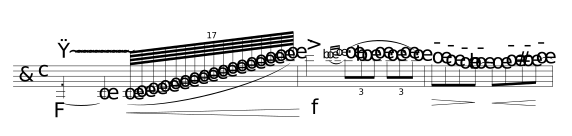
Some performers are able to create portamento effects on instruments designed to perform discrete pitches. For example, the opening clarinet figure of American composer George Gershwin's 1924 piece Rhapsody in Blue was originally written as a glissando, but is commonly performed as a portamento through the use of embouchure pitch-bending and half-hole fingering.
Interval Alteration
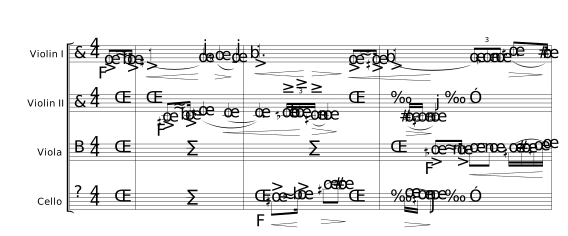
Musicians will sometimes alter specific intervals to create certain harmonic effects. In vocal works, and most especially barbershop quartet music, singers will often sing major triads and seventh chords with a slightly flat third and slightly sharp fifth, changes which more closely match the actual ratios present in the harmonic series. By removing the accommodations made to create equal temperament, these chords resonate more and project farther.
Detuning
Music which is played in a way that is deliberately out-of-tune, often to be deliberately dissonant. When a the pitch and tempo of a recording or sample is altered, it represents manipulation by an external force — like a tape player powering up or a DJ scratching — and creates a layer of separation between the listener and the recording.
In some cases, an instrument might deliberately be detuned to create a specific effect. A honky-tonk piano is a piano where one or more of the strings for each key is slightly out of tune, creating slight dissonances over the range of the instrument.
Beyond 12-TET
While it pervades many cultures, 12-TET is only one possible tuning system, and even the cultures which currently view it as a standard have only done so since the 18th century.
Quarter-tones
Quarter tones result from dividing the smallest interval in 12-TET — the half-step or semitone — in half, resulting in a 24-TET system. In this system, in addition to regular sharps and flats, there are one-quarter and three-quarter variants of each accidental.

The symbols shown in Figure 4 are common, but not standardized; composers often include an explanatory note in the score to aid the performer.
Quarter-tone music can only be performed on instruments capable of producing the requisite pitches. Quarter-tone piano music requires two pianos, often arranged so their keyboards are at a right angle to each other, with one piano tuned one quarter-tone flat.
Historical Systems
Many tuning systems have existed throughout musical history. The earliest musical culture we have found records of is Ancient Greece, where lute tunings varied from one piece to another. There were several common tuning systems, and theorists like Plato surmised that different tunings affected the listener in both immediate and long-term ways. This system of beliefs was called the doctrine of ethos.
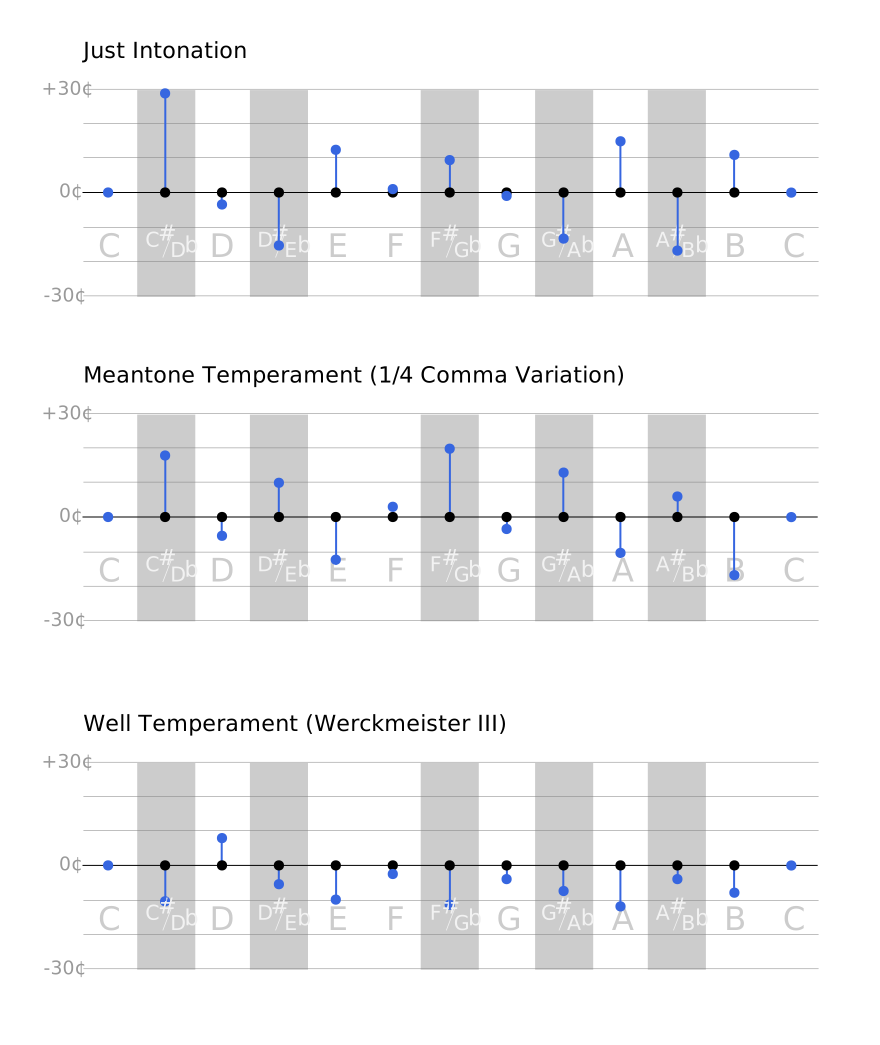
Eventually, as the twelve-note system became standard, musicians and instrument makers experimented with different temperaments, systems designed to balance preserving the ratios present in the harmonic series with allowing the use of multiple keys. For example, if an instrument is tuned so that the notes in the C major align with the intervals in the harmonic scale — an arrangement known as just intonation — a piece in F# major will be very out-of-tune; systems like mean-tone temperament, well temperament and equal temperament solved this problem by different degrees.
Folk Music Tunings
Many musical cultures use different tuning systems in their traditional folk music, especially those which center around instruments unique to their culture or nationality. For example, folk music theory in several cultures in southwest Asia and the Middle East center around the maqam, which is a musical scale with a specific tuning based upon just intonation. These structures are used to describe music which is sung or played on instruments like the oud.

Microtonality: Summary
- Microtonality describes music which uses pitches outside twelve-tone equal temperament (12-TET).
- Some microtonal techniques work within the system of 12-TET.
- Pitch bending is an expressive technique that involves changing the pitch of an established note within a strict tuning system. This can be done with embouchure, fingering, or a synthesizer's pitch bend wheel.
- Portamento is a smooth movement between two pitches that moves through all the frequencies in between them.
- Interval alteration is the use of altered scale degrees, like a raised 3 or lowered 5, in order to take advantage of stronger harmonic resonances.
- Detuning is the deliberate use of out-of-tune notes as a special effect.
- Other microtonal techniques exist independently of 12-TET.
- Quarter tones are intervals half the size of semitones, and create a 24-TET system.
- Historical tuning systems range from ancient lyre tunings, which varied from theorist to theorist, to temperaments, which compromised harmonic resonance in order to facilitate music played in different keys without retuning.
- Indigenous cultures often use varied systems of tuning which are reflected in folk music and instruments within those cultures.