Composing Using Systems

The process of writing music is usually a deeply human act, involving emotion, lived experience and aesthetics. Some composers have experimented with removing the human component of composition to various degrees, by devising systems in which music is created based on non-human systems.
Serialism
Serialism is a system of musical composition in which a series of musical elements — a set of different pitches, for example — is used as a seed for a piece of music. A serialist system will usually have specific rules for how music is generated from the seed, specifically which aspects of the composition are prescribed by the system and which are left to composer discretion. In most cases, serialist systems are designed to propogate characteristics of the seed through the entire piece.
Twelve-Tone Row
Perhaps the most well-known serialist system was devised in 1923 by Austrian composer Arnold Schoenberg. Though the composer labeled the system a "method of composing with twelve tones which are related only with one another," theorists commonly refer to this system as twelve-tone row composition.
Twelve-tone row composition serializes pitch, and is a means of creating a purely atonal composition by ensuring that all twelve notes of the chromatic scale are used equally. The process is built upon a single series which contains all twelve tones of the chromatic scale only once. The order of this series is determined by the composer, but should avoid any tonal structures like major or minor triads.
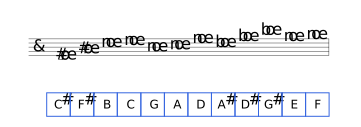
The composer then constructs a composition using variations of the original or prime row: an inversion of the row, in which the component intervals are inverted to create a new, similarly atonal, row; a retrograde of the row, consisting of the notes in the original played in reverse order, a retrograde inversion, a reversal of the inverted form, and all possible transpositions of each of these four forms.
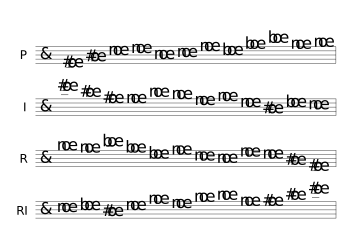
Theorists find it useful to determine and label these 48 variations of the row using a matrix, where the prime row appears along the top, the inversion appears down the left side, and transpositions of each are used to complete the diagram. Rows are labeled with the letters P, I, R, and RI, along with a number representing the transposition from the original.
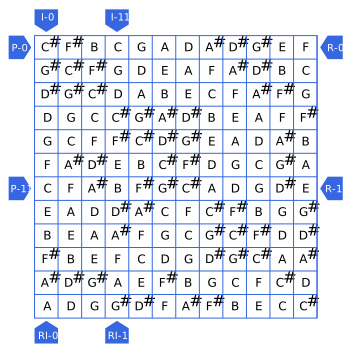
The twelve-tone row system uses the following guidelines to ensure atonality, preserve the character of the original row and to facilitate future analysis:
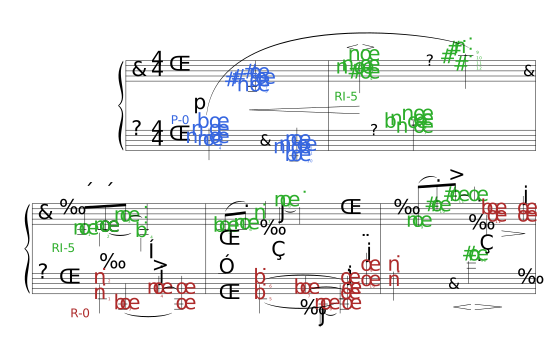
- The composition must begin with a statement of P-0, but thereafter may use any rows in any order. It is not required to use all the rows in the matrix.
- The notes within a row must be played in the prescribed order. Chords may be created from consecutive notes in a row.
- Notes may be repeated before moving on to the next note in the row.
- Rows may overlap one another, or pass between different instruments or ranges.
- Only complete rows may be used.
While the use of pitches are subject to these rules, other elements of music, such as rhythm and dynamics, are not; in fact, in Schoenberg's own works, musical elements other than pitch are similar to the works of Classical or Romantic composers.
Integral Serialism
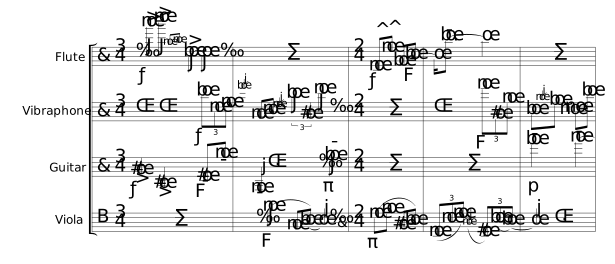
The expansion of serialism to include elements other than pitch is commonly referred to as integral serialism. Pieces in this genre might serialize rhythms or note lengths, dynamics, or articulations. Systems for these elements may be simple, such as rotating through a certain set of items, or may involve the creation of matricies and other complex calculations.
Generative Music
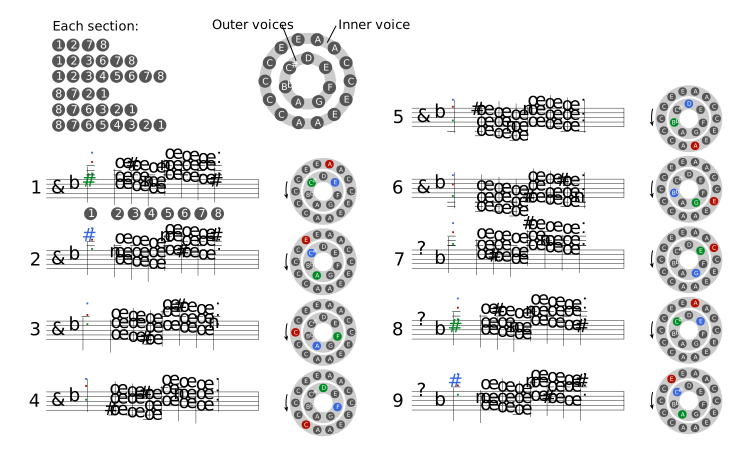
In serial composition, the system generates a catalog of elements, but the composer still decides which elements to include and how to include them. In generative music, the composer designs a starting configuration and system by which that configuration changes, so that the composition proceeds only according to the system.
Stochastic Music
When a composer combines a generative process with an element of randomness, the result is called stochastic music. Because the random values are subject to a specific generative process, this type of system effectively deals with probabilities, and often incorporates Markov chains — systems where the probabilities of one event are based upon the result of the previous event. For example, a piece where a random pitch is independently selected for each note is aleatoric, but a piece where each note moves by a random interval from the previous note is stochastic.
One of the most notable composers of stochastic music — and, in fact, the person who coined the term itself — was Greek composer Iannis Xenakis, who wrote several pieces based upon the statistical probabilities of natural processes: his work Pithoprakta, for example, is based on Brownian motion, the statistical calculations which govern the movement of molecules in a gas.
Composing with Systems: Summary
- Serialism is the use of a series of musical elements to generate a composition.
- Twelve-tone Row is a system for serializing pitch created by Arnold Schoenberg for the purpose of ensuring complete atonality.
- The first step in the system is to create a prime row of all twelve pitches which is free of tonal implications.
- Other versions of the row can be created by inverting each interval (inversion), reversing the order of the notes (retrograde), or combining these two techniques (retrograde inversion).
- Further versions of the row can be created by transposing each of the four versions to other pitches.
- All versions of the row can be shown in a matrix, with the original row at the top and the inversion down the left hand side.
- Compositions are created by combining complete rows in any order. Chords can be created from consecutive notes, rows can overlap or pass between parts, and notes can be repeated before moving on to the next pitch in the row.
- Integral serialism involves the serialism of multiple musical elements, such as dynamics, rhythm, or articulation.
- Generative music is the composition of a piece by creating an initial state and a system by which parts follow set rules.
- Stochastic music is a type of generative music that incorporates randomness, and often includes the use of Markov chains.