Harmonic Analysis
When analyzing chords, music theorists find it useful to use naming systems which not only describe the chord type but also how that chord relates to the current key.
Macroanalysis
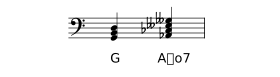
A very common way of labeling chords is by using the chord's root and chord type, such as G major or Ab diminished seventh. This method is called macroanalysis. Unlike tonal harmonic analysis, macroanalysis does not provide any information about the role the chord plays in the context of the current key.
Traditional Macroanalysis
For music before 1900, music theorists usually use Roman numeral analysis, which is described below. However, in some cases — such as when there is no clear tonal context — they will sometimes use a single letter to represent the chord's root, with symbols, numbers, and letter case used to demonstrate the chord's type according to the following table.
| Type of chord | Letter Case | Symbol | Example |
|---|---|---|---|
| Triads | |||
| major triad | upper | C | |
| minor triad | lower | c | |
| diminished triad | lower | o | co |
| augmented triad | upper | + | C+ |
| Seventh Chords | |||
| major seventh chord | upper | 7 | C7 |
| minor seventh chord | lower | 7 | c7 |
| major-minor seventh chord | upper | b7 | Cb7 |
| half-diminished seventh chord | lower | ø7 | cø7 |
| fully diminished seventh chord | lower | o7 | co7 |
| augmented seventh chord | upper | +7 | C+7 |
Because music in the Euroclassical tradition tends to avoid augmented-major seventh chords, minor-major seventh chords and most extended harmonies, traditional macroanalysis does not have a complete or consistent vocabulary of symbols for these chords.
Lead Sheet Chord Symbols
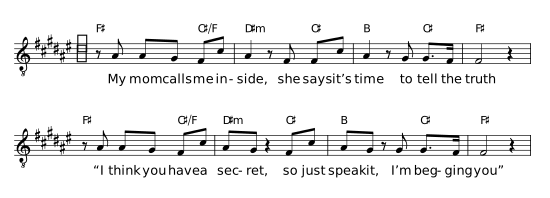
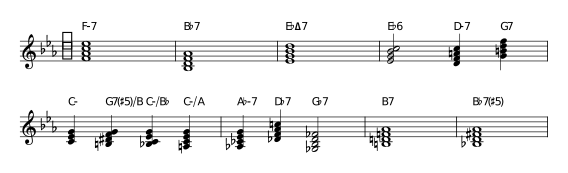
Lead sheet chord symbols is a system of macroanalysis used most commonly used in popular music and related styles. In general, when a single letter is shown, it denotes a major triad on that root, and if a letter is followed by a 7, it denotes a major-minor seventh chord on that root.
Extended harmonies — ninths, elevenths and thirteenths — are shown with a 9, 11 or 13, respectively. These chords are built on a major-minor seventh chord using notes from a major tonality: specifically, a M9, P11 and M13 above the root.
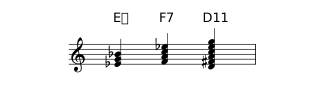
Additional symbols can be added to the chord in a few different ways. The following symbols alter specific notes by half-steps from their default positions:
| Symbol | Effect |
|---|---|
| M or Δ | raise seventh from m7 to M7 |
| - or m | lower third from M3 to m3 |
| + | raise fifth from P5 to A5 |
The following symbols indicate different chord types:
| Symbol | Effect |
|---|---|
| o | diminished triad (m3, d5) |
| ø7 | half-diminished seventh (m3, d5, m7) |
| o7 | fully diminished seventh (m3, d5, d7) |
| +7 | augmented-minor seventh (M3, A5, m7) |
Further alterations not shown above are indicated with accidentals and numbers listed in parenthesis after the chord symbol. These can include notes within the chord or additional notes added above the chord; for example, BM9(b9,13) indicates a B major seventh chord with an added C natural as the ninth and G# as the thirteenth.
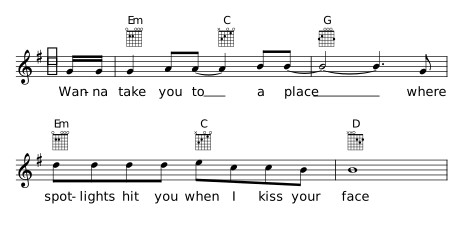
Lead sheet chord symbols are usually written above the staff they apply to, aligned with the beat where the chord occurs. In some editions of sheet music, they are accompanied by fretboard diagrams to facilitate guitar accompaniment.
Tonal Analysis
Other methods of harmonic analysis consider the chord's role within the current key; for example, a C# major chord played in the context of F# major — where it provides a sense of tension because the chord is built on the dominant scale degree — has a different effect than when it is played in the key of C# major, where it provides a sense of resolution.
In these methods, chords are sometimes named using the scale degree of their root: for example, in the key of D minor, a G minor chord would be called the subdominant triad, and a B minor seventh chord would be called the submediant seventh chord. More commonly, the chords are referred to by numbers, such as "the four chord" or "the six chord."
When tonal analysis is used to describe music in staff notation, the chord symbols are usually written below the lowest staff, vertically aligned with the notes or chords they describe.
Nashville Number System
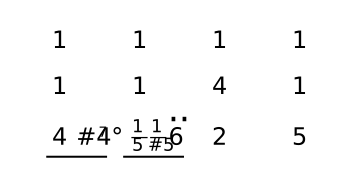
Tonal context can be indicated simply by replacing the note names in macroanalysis with the number of the associated scale degree. This system is often referred to as the Nashville Number System, and is popularly attributed to American singer Neal Matthews Jr., who used the system in his work with the gospel group The Jordanaires. This system usually uses the same suffixes to show chord type as shown in figure 3 above. Conventions vary, but in general, chords shown without any additional markings are implied to last a full measure. Chords grouped with a box or an underline last one beat each by default; dots above a chord symbol are used to show chord lengths of two or more beats.
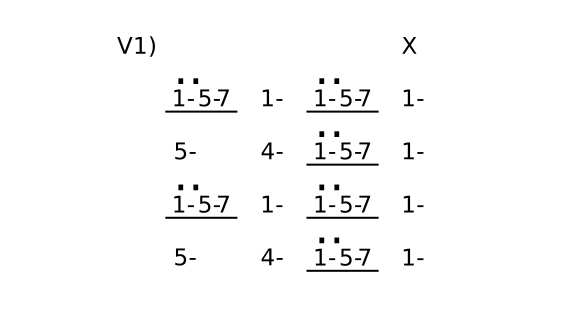
While the Nashville Number system has some common use among commercial music performers, most lead sheets and other forms of harmonic notation in popular music use macroanalysis.
Roman Numeral Analysis
The system of tonal harmonic analysis most commonly used with music before 1900 is Roman numeral analysis, which indicates scale degree using Roman instead of Arabic numerals. In this system, chord type is indicated using the same symbols, numbers and letter case as in traditional macroanalysis.
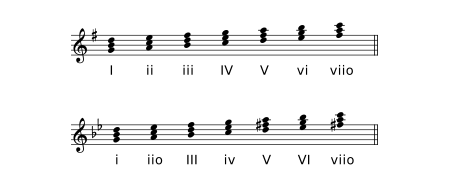
Roman numeral analysis is generally based on whatever scale or mode is considered diatonic in the piece being analyzed.
Inversions
In addition to indicating the root of each chord, most systems of harmonic analysis also show the inversion of the chord as well.
Lead Sheet Chord Symbols
When using lead sheet chord symbols, inversions are typically shown by indicating the note appearing in the bass of the chord. Because the note is separated from the chord symbol with a slash, these chords are sometimes called slash chords. For chords in root position, the chord symbol is written with no slash or bass note.
Nashville Number System
The Nashville Number System uses the same approach as lead sheet chord symbols, indicating the bass note of the chord after a slash; rather than using the note name, however, the bass note is indicated by the note's scale degree number.
Roman Numeral Analysis and Traditional Macroanalysis
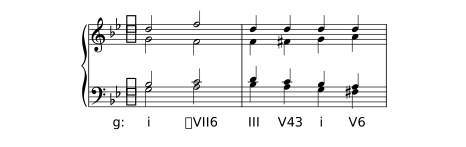
In Roman numeral analysis and traditional macroanalysis, inversions for triads and seventh chords are not indicated by showing the bass note, but by a system of numbers that represent diatonic intervals above the bass. To determine these intervals, octaves, compound intervals and doubled notes are not considered, and certain intervals are traditionally omitted.
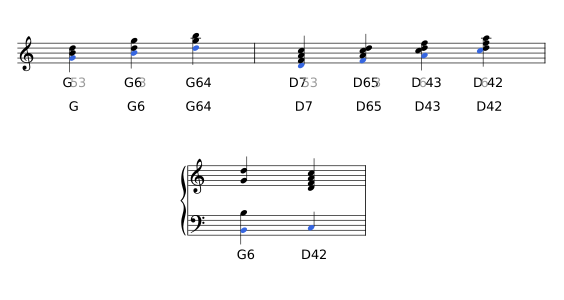
When extended harmonies are used in the Euroclassical tradition, they are nearly always used in root position; as a result, there is no standard practice for showing inversions for extended harmonies in Roman numeral analysis or in traditional macroanalysis.
Harmonic Analysis: Summary
- Macroanalysis labels chords by their root and chord type.
- Traditional macroanalysis has a vocabulary of chord symbols for triads and seventh chords common in the Euroclassical tradition.
- Lead sheet chord symbols show alterations from major triads and major-minor seventh chords to show chord type.
- Lead sheet chord symbols sometimes include fretboard diagrams to facilitate guitar reading.
- Tonal analysis labels chord by their harmonic role within the context of a key.
- The Nashville Number System is a system sometimes used in commercial music styles which labels chords with arabic numbers that correspond to the scale degree of the each chord's root.
- Roman numeral analysis is used often in music before 1900 which labels chords with Roman numerals according to the scale degree of the the chord's root.
- Systems of harmonic analysis generally indicate the inversion of the chord being analyzed.
- Lead sheet chord symbols and the Nashville Number System show inversion by showing the chord symbol and the root of the chord separated by a slash or horizontal line.
- Traditional macroanalysis and Roman numeral analysis indicate inversion using a system of numbers that correspond to the simple intervals above the bass note present in the chord.