Tonality, Scales & Chords

Just as a melody is defined by what pitches it contains, the character of a piece or even a musical language is influenced greatly by which pitches are used and how they interact with one another.
Scales
Because the interval between two frequencies can be divided endlessly, there are an infinite number of possible pitches. A tuning system is a set of discrete pitches that serve as a pitch vocabulary for a particular style of music. For example, the fingering system of a modern clarinet is designed to play the chromatic scale, which divides the octave into twelve equal intervals, while .
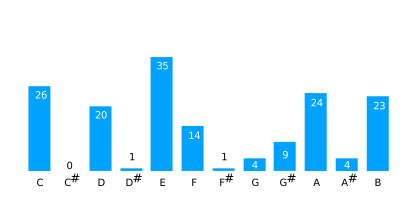
Individual pieces of clarinet music, however, do not always make use of all twelve notes, and often use certain notes more than others to create a specific sound. The subset of pitch classes that are used or emphasized in a piece is called a diatonic set, or — more commonly — a scale.
Scales are generally notated as a sequence of pitches written from lowest to highest pitch. Musicians will often perform these ordered sequences as etudes to improve dexterity, but in the context of music theory the term "scale" refers only to the group of notes, without consideration for order or direction.
Analysis
The scale of a piece being used can be determined simply by analyzing which notes it uses most often. Notes which are used commonly in the piece are considered to be part of the scale and are classified as diatonic notes; notes which are used only rarely are called non-diatonic, meaning not part of the scale.
Of course, a piece of music might use certain notes somewhat often, making them difficult to classify — as such this type of analysis can be subjective and vary from theorist to theorist.

Scale Classification
Theorists generally classify scales based on their cardinality: the number of different pitch classes that the scale contains. Other types of classification include identifying what kinds of intervals the scale contains, and how the scale relates to other scales with similar characteristics.
Chords
When multiple pitches are intentionally sounded at the same time, the result is called a chord. In many cases, the individual pitches of a chord blend in such a way that listeners hear a unified sound rather than two independent ones.
Consonance & Dissonance
When the relationship between the notes in a chord align in a pleasing or satisfying way, we consider the chord to be consonant, and when the notes clash with one another that adds tension to the sound, we call the chord dissonant. There are different degrees of consonance and dissonance, and how they are perceived can vary between listeners, musical languages or cultures, or even among time periods.
In some situations, there may be a feeling of satisfaction when a dissonant chord is followed by a consonant chord, a process called chord resolution. Music will often have longer sequences of chords which move gradually toward a final resolution; these sequences are called harmonic progressions.
Chord Classification
There are many different ways to classify different chords, and music theorists often work with systems of analysis to describe chords in particular musical languages.
As with scales, one of the most basic methods of chord classification is to identify the number of pitch classes in the chord. A chord with two pitch classes is called a dyad or simply an interval, and higher number collections are referred to as triads, tetrads, pentads, hexads, and so on.
Chords which are built from notes in a musical work's scale are called diatonic chords; chords which use one or more notes not in a piece's scale are called chromatic chords.
The relationship within the notes of a chord — specifically, the relative distances between each note in the chord — define the chord's type, which gives it a unique sound.
Tonality
When a piece of music uses a particular scale in its melodies and chords, it creates an aural context that can influence the listener's expectations. A piece in which certain notes or chords are perceived to lead into other notes or chords is called tonal.
Tonic
In most tonal pieces, one specific pitch is perceived to have a stronger sense of rest or resolution than any other note. This note is referred to as the tonal center of the piece, or the tonic. Chords that include the tonic, especially as the lowest pitch in the chord, tend to have a similar sense of finality, and are called tonic chords.
When writing the scale of a tonal piece, it is customary to start on the tonic note. In fact, scales are most generally labeled by tonic and scale type — for example, Ab major. Music that treats a particular note as tonic is commonly referred to as being "in the key" of that note.
Multitonality
While it is common for a musical work to treat a single pitch as tonic throughout, it is not unusual for a piece to shift to a different tonic, either temporarily or permanently. This technique is called a modulation or a key change and can be an effective way of heightening the energy of a piece.
In some cases, a piece may shift between different tonic notes within a short period of time, such that both notes feel equally weighted as tonic. When this happens between two keys, it is called bitonality. Multitonality between more than two keys is possible but very rare.
Atonality
When a piece of music has no discernable tonic, we refer to it as atonal. Because tonal music is so common that listeners tend to default to hearing patterns of tonality, it can be difficult to write music that is truly atonal without a compositional system designed for doing so.
Tonality, Scales & Chords: Summary
- A scale or diatonic set of a selection of pitch classes used in a piece or section.
- Determining the scale of a piece consists simply of recording which pitch classes are used most commonly.
- Scales are commonly classified by cardinality — the number of notes in the scale — and the intervals between the notes in the scale
- A chord is a collection of notes played simultaneously.
- Chords in which notes align in a satisfying way are referred to as consonant.
- Chords in which notes conflict with one another to create tension are referred to as dissonant.
- Music often features dissonant chords resolving to consonant chords, a process called chord resolution.
- Chords are classified by the number of notes they include and the intervals between those notes.
- Chords which are constructed using the notes of a piece's scale are called diatonic chords.
- Tonality is a type of music in which the melodies and chords are perceived as resolving to a particular note or chord.
- In a tonal piece, the pitch that is perceived to represent the greatest amount of resolution is referred to as the tonic.
- Diatonic chords which are built on the tonic are called tonic chords.
- Multitonality involves switching between different tonalities within a single piece of section.
- Atonality is the deliberate avoidance of tonality in a piece of music.