Notating Music

When a painter creates art, the product is a physical object: a painting which can be seen and appreciated long after the creative process is done. Music, in contrast, is ephemeral; before the advent of audio recording, a performance existed only while it was being performed.
Musicians notate music in various ways as a means of preserving musical art: not by preserving the performance itself, but by making it possible for others to create new performances of their own.
About Music Notation
Though musical notation takes many different forms, there are some fundamental characteristics and concepts that can be applied across cultures and time periods.
Purposes
Depending on the system that is used, notation can be an arduous process, requiring a much different set of skills than those required to perform music. However, notation provides a number of benefits in return.
Collaboration
Many musical works involve multiple performers; music notation facilitates this collaboration by providing individual instructions for each performer's part.
Teaching & Distribution
Many musical cultures do not have a tradition of notated music; instead, students learn to perform a musical work by listening to someone else perform it and committing it directly to memory, a process called rote learning.
Unlike rote learning, notated music allows musicians to learn independently, without the need for a live or recorded performance, and reduces the likelihood of generation loss, corruption of the original performance that can occur as it passes from musician to musician.
Archiving & Analysis
A notated piece of music can serve as a primary source for music historians who wish to study music of the past. It can also facilitate music analysis by providing a written representation of the music's component parts for critique and annotation.
Categories of Notation
Music notation takes many different forms, and even within a single musical culture there may be separate types of notation to meet different needs. Each system of notation may have a unique relationship to the music it portrays and the types of musician it serves.
Descriptive Notation
Notation which describes the gestural or mechanical processes necessary to generate a piece of music is called descriptive notation. This type of notation usually applies only to a specific instrument or device.
An example of descriptive notation is guitar tablature, which specifies the finger positions the performer should use on the instrument's fretboard to create particular chords and melodies.
Prescriptive Notation
Notation which specifies the final musical product, rather than instructions for achieving that product, is called prescriptive notation. Prescriptive notational systems are often flexible, since different instruments can be used to generate the desired result.
Staff notation is an example of prescriptive notation, as it describes the pitches and rhythms of the music without indications for how to generate the music on a particular instrument.
Perceptions of Notation
Systems of music notation can each have unique relationships with the music they portray and with the musicians who rely upon them.
Etic and Emic Notations
When studying the music of a specific culture, researchers often note the contextual purpose of a given system of music notation. Notation used within a musical culture, and which often depends on a fluent understanding of that culture's music, is called emic notation.
Conversely, music notation created outside the musical culture for the purposes of recording or studying the music, is called etic notation. Etic notational systems are generally designed to allow the music to be understood without cultural fluency of the music being described, though it may require familiarity with a different notational system.
Notation as Art
Many examples of music notation are revered as visual artworks in their own right. Early religious chant notation was often copied by monks, who used elaborate calligraphy and adorned pages with detailed illustrations. American composer and singer Cathy Berberian's 1966 piece Stripsody uses a score of comic-book style illustrations to portray the onomatopoeic vocal elements of the piece.


Notation as Music
In the field of music, music notation often has a metonymic relationship with music itself: musicians will often use the term "music" to refer to a specific piece of printed music notation.
Music theorists are careful to differentiate between music — the sound produced by a musician — and the notated representation of music in its various forms. These two concepts are regularly conflated: the term note, for example, is often used to describe both the written representation of a pitched sound as well as the sound itself.
Types of Music Notation
Alphabetic Notations
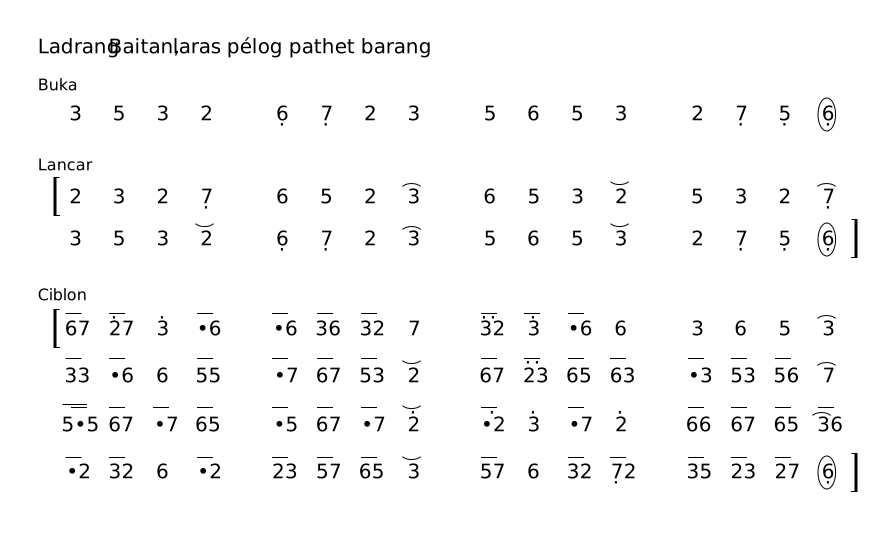
A very common technique across many musical cultures is notate music using the same symbols used for notating text.
Pitch Description
Most historical alphabetic notations use symbols to indicate pitches of a particular scale. These systems, which include ancient Greek notation, Indian swaralipi, Korean jeongganbo and yuljabo, Chinese gongche, and English tonic sol-fa systems all use single characters, small groups of characters, or short syllables to indicate either absolute pitches or pitches relative to a tonic note.


Because these systems indicate pitches, they are usually prescriptive systems, even if some of them are designed around particular instruments or instrument families. In many cases, the systems do not record rhythm or other musical direction, leaving these elements to be dictated by lyrical meter, cultural tradition, or performer discretion.
Tablature
Some systems use alphabetic characters as a descriptive notation, indicating specific performance directions rather than actual pitches. Japanese kunkunshi notation, for example, specifies the fingerings used on a sanshin, so while the indications 四 and 下老 represent the same pitch, 四 is played on the instrument's middle string and 下老 is played on the lowest string.
Braille Music
Braille music notation uses the 63 characters of the braille alphabet — a tactile system built around a grid of six raised dots — to form an extensive and detailed method for notating music. The system was designed by Louis Braille, who himself was an amateur organist.
Graphic Notation
Some musical cultures make use of more graphic methods for notating music. In many cases, these systems are able to notate rhythm and meter more accurately by portraying pitch and time on two different axes.
Piano Roll
Modern music software often allows music to be viewed and edited in piano roll notation, in which notes are displayed as horizontal bars in a scrolling graph with pitch on the vertical axis and time on the horizontal axis. This system is known as piano roll notation due to a similar technique used in early player pianos.

Tablature
Music for plucked string instruments like guitar and lute is often written in a descriptive graphic format where fret numbers are shown on horizontal lines representing the instruments strings. Tablature systems use different approaches for portraying rhythm, such as showing simple symbols above the numbers, or combining the tablature with other rhythmic notation systems.
Because it can be constructed using ASCII characters, guitar tablature is commonly used to share notated music online; sites such as Ultimate Guitar are well-known databases for both amateur and professional musicians to expand their repertoire.
Neumes
In order to preserve procedures among different communities, religious cultures have historically used ekphonetic notation, a system of adding symbols to a text to indicate specific pronunciation, phrasing and tone. Examples of this through history include Islamic tajwīd, Hebrew cantillation, and the Vietnamese Catholic practice of đọc kinh.


By the 9th century CE, a somewhat standard form of ekphonetic notation was being used with religious chant in the Byzantine Empire. This system made use of short, wavy lines called neumes written above the chant text. A given neume could indicate a single pitch or a movement through several pitches, portrayed as a graph of pitch against time. These symbols were used as a mnemonic device for melodies that were learned by rote, so they did not include precise musical direction.
Other Graphic Systems
Composers and theorists sometimes create new graphic systems to notate individual works or broader musical languages. This might be due to established systems proving insufficient or unhelpful for a particular music or instrument, as with TTM, a system for notating turntablism. In other cases, a composer may wish to use graphic notation as a visually artistic statement, whether or not the unconventional notation provides musical meaning.
Staff Notation
Eventually, as a means of bringing more pitch accuracy to neume notation, musicians began adding horizontal guidelines to indicate specific pitches. As the symbols evolved, this collection of lines, called a staff, continued to be a useful tool.
Modern Staff Notation
One of the most common forms of music notation traditionally used by music theorists is modern staff notation, a system which evolved from neume notation used in Europe in the medieval and renaissance eras. In this system, pitches are indicated with a system of five-line staves and clefs to indicate range and context, note length is specified with different typographic additions and alterations to the basic note shape, and other musical nuances are portrayed with additional symbols or descriptive text.
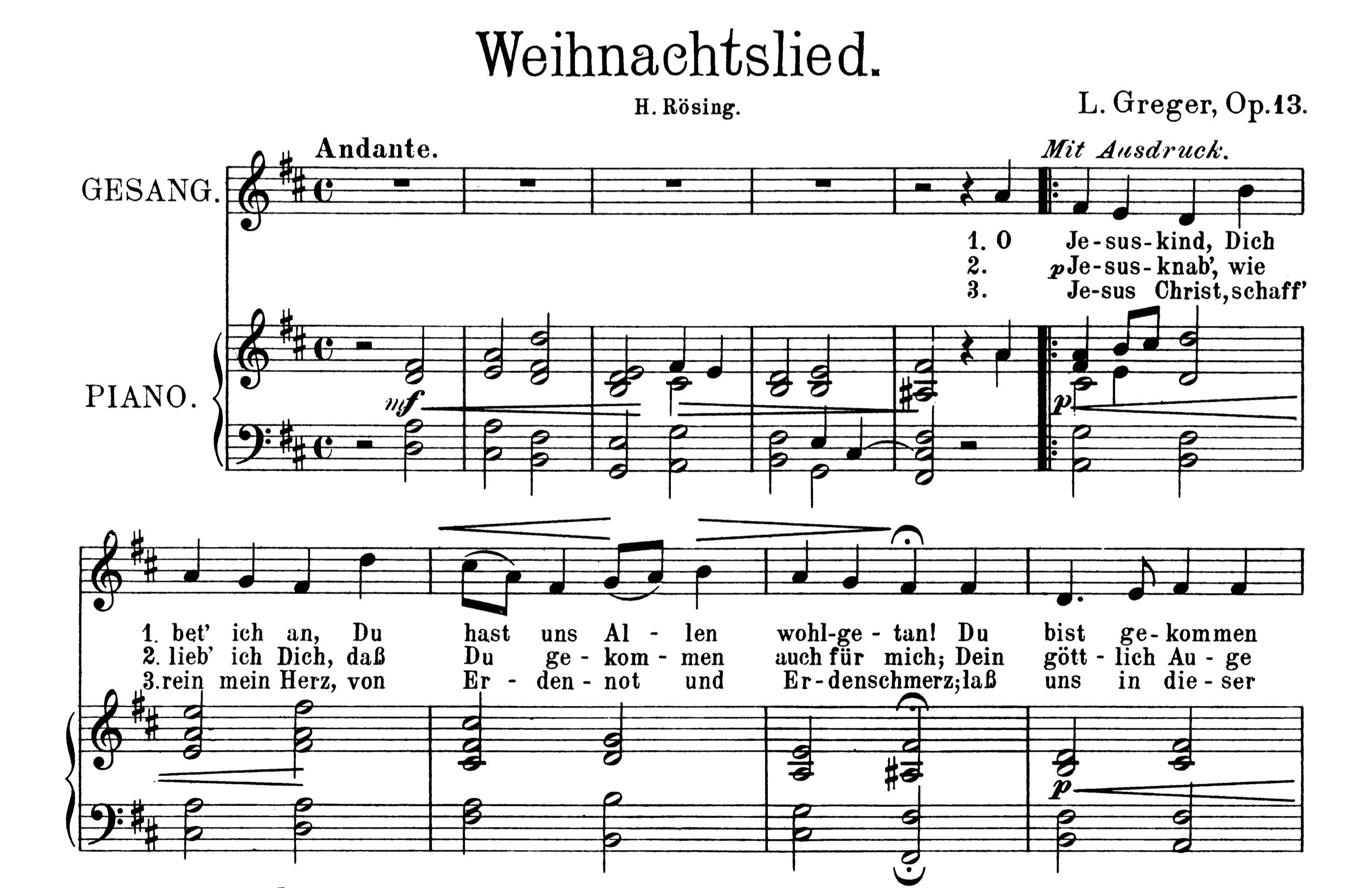
Because this system is used throughout this text, it is described in more detail in Notation.
Variations
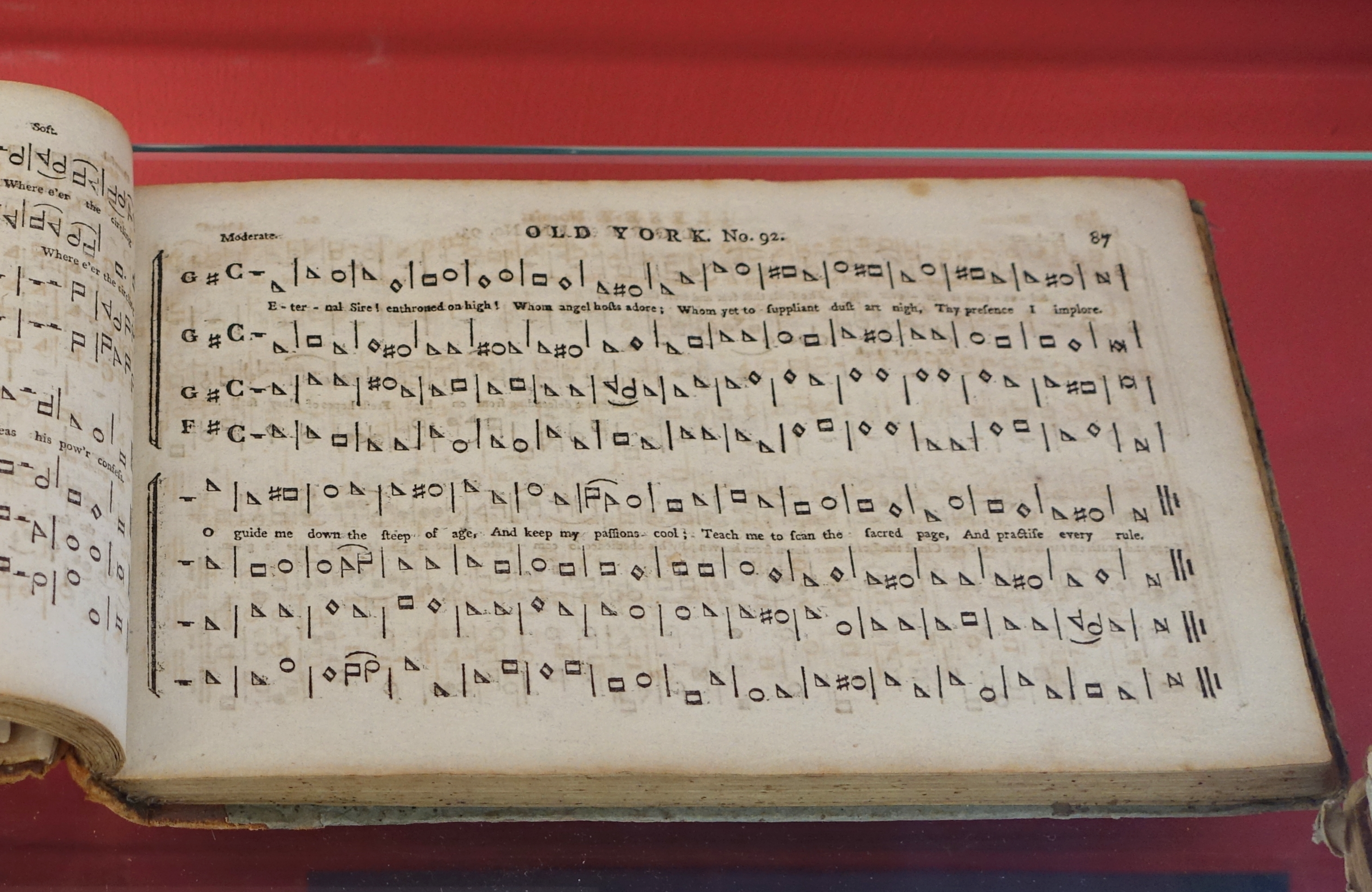
Because of its ubiquity, modern staff notation has sometimes been used as a model for other systems. Percussion notation uses staves of five or fewer lines to denote different unpitched instruments, which can be further delineated by note shapes. Some systems, like shape note and simplified music notation, introduce changes to make the system easier for beginning musicians and those not fluent in modern staff notation.

Other Systems
Efforts to address the idiosyncracies of modern staff notation have led to other staff-based notational systems. One such system is klavarskribo, invented by Dutch theorist Cornelius Pot in 1931, which uses a vertical staff which aligns with the notes of a piano keyboard.
Chord-Based Notation
Musicians often find it useful to notate the chords of a particular piece of music to facilitate performance or analysis.
Lead Sheet
Lead sheet notation, commonly used in jazz and popular music, involves simply notating chord names within a basic rhythmic structure. The chords may be written over lyrics or combined with a melody written in staff notation. Sometimes the chords are written above slash notation, usually to indicate that the performer is to improvise music over the harmonic context.
Chord symbols in lead sheets are often written in macro analysis, where chords are labeled with the letter name of the chord's root along with symbols that specify the chord's type. A common alternative is Nashville Number System, in which chords are specified by arabic numerals in reference to the key of the piece being played.
Figured Bass
A common performance technique in eighteenth century Europe was to accompany solo, chamber and large-ensemble music with a basso continuo, an instrumental duet consisting of a low instrument like double bass, cello or bassoon which reads a part in staff notation, and a keyboard instrument like harpsichord or clavichord which improvises an accompaniment line by reading and interpreting symbols written below the staff. These symbols, called figured bass indicate pitches to be added to the notated pitch to create chords.

Roman Numerals
When analyzing the chords used in a piece of music, theorists will often use Roman numerals in the same way as the Nashville Number System, notating chords based on the key of the piece. These numerals are sometimes combined with elements of figured bass to specify further characteristics of the chords being notated.
Electronic Notation
Theorists differentiate between recorded music, in which actual soundwaves are captured to be reproduced later, and notated music, which contains the instructions for musical performance. While computers are able to record, reproduce and manipulate recorded music in the form of digital audio, there are also methods of notating music in digital form.
Music Sequencing
Digital audio workstations can record performance data — for example, when a particular key is pressed on a keyboard, how hard it is pressed down, and how long it is held. This data, called a sequence, can be edited to adjust details of the performance, and reproduced with different sounds or with different electronic instruments.
Music software packages generally have proprietary formats to record performance data, but a common format which many such programs can read is the Standard MIDI File format, which stores performance data using a system based on the MIDI specification.
Staff Notation
Computer programs called scorewriters allow musicians to create and edit music notation, usually in modern staff notation. These programs are analagous to word processors for working with text.


Like music sequencers, scorewriters commonly store files in a proprietary format, but many of them can open and save files in the MusicXML format, an open format for storing notated music in modern staff notation.
Music Programming
Music theorists sometimes use computers to do complex, mathematical analysis on specific musical works, or do corpus studies on large collections of individual pieces to detect trends and patterns. To do so, they might notate aspects of music in formats that can be easily parsed by a computer, such as Parsons code, which records melodic contour and ABC notation, which encodes basic elements like key, meter, pitch and rhythm in a text-based format. Modern tools like music21 combine text-based notation formats with powerful artificial intelligence for analyzing and creating music.
Notating Music: Summary
- Musical notation is the preservation of instructions for performing a piece of music.
- Notation facilitates collaboration, teaching, distribution, archiving and analysis of music.
- Descriptive notation is notation that describes the gestural or mechanical processes necessary for performing a piece of music on a specific instrument.
- Prescriptive notation is notation that describes what the performance should sound like, independent of what methods are used to perform it.
- Different notation systems can have unique relationships with the music they portray and the musicians who use them.
- Emic notation is a notation system used by and within a musical culture, which may require membership in, or familiarity with, the culture to fully understand.
- Etic notation is a notation system created outside a musical culture for the purposes of analyzing or understanding the culture's musical language.
- Musical notation is sometimes carefully crafted and treated as a visual art in its own right.
- Various systems of notation can be organized into different categories:
- Alphabetic notation systems ascribe musical meanings to letters, numbers or other symbols.
- Graphic notation systems use more complex systems beyond text to portray music.
- Staff notation systems are a specific type of graphic notation which portray pitch and rhythm on a group of lines which correspond to a range of pitches.
- Chord notation systems use text or symbols to describe the chords of a piece, and are sometimes used in combination with other notational systems.
- Electronic notation systems facilitate the creation, manipulation and performance of music using computer hardware and software.