Recording Sound
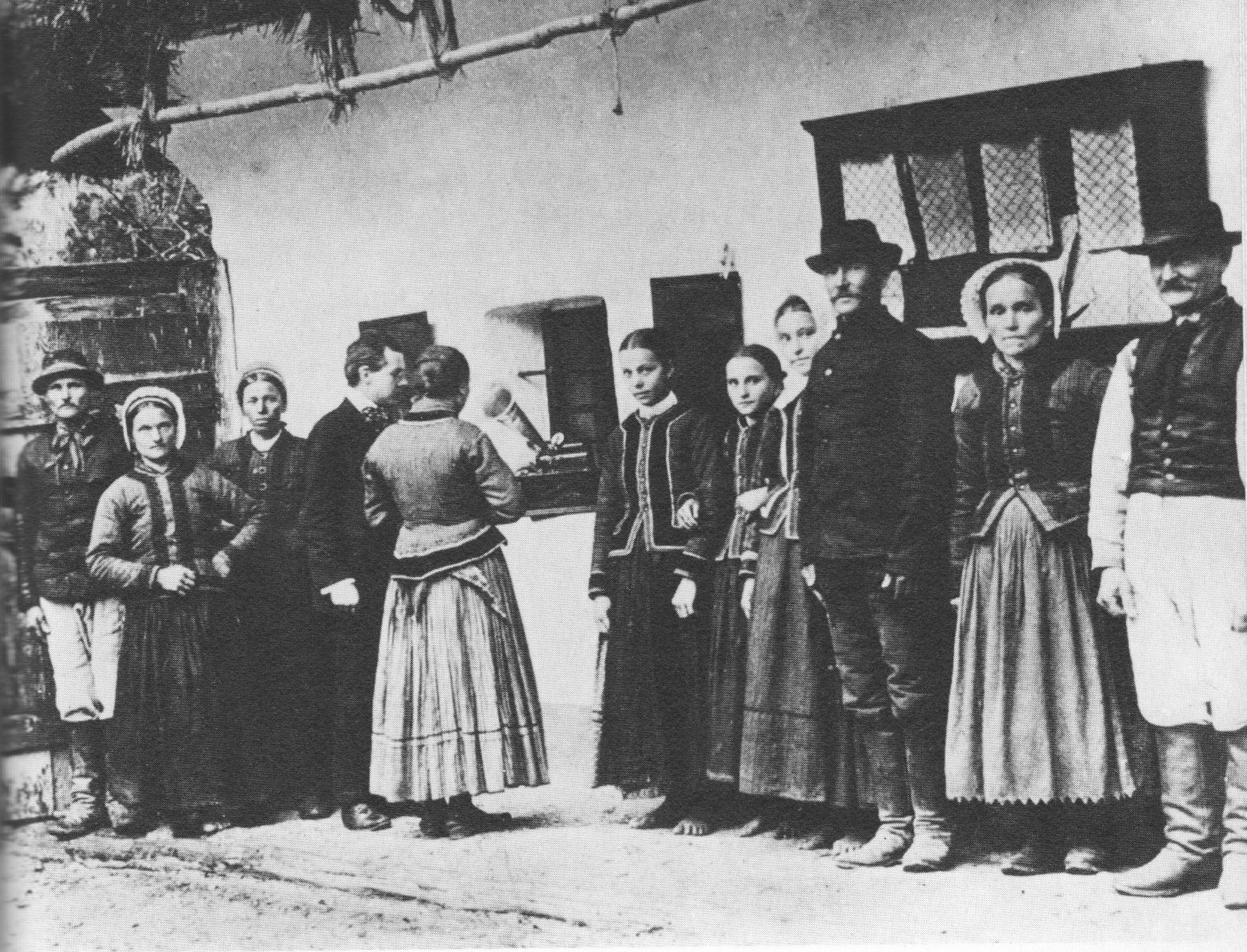

One of the most significant events in music history was the invention of sound recording in the late 19th century, making it possible to hear musical performances again and again, without the performers present.
Analog Formats
Analog recording involves capturing the actual shapes of sound waves into a physical form. Though it is more susceptible to imperfections and degradation, various methods of analog recording dominated the music industry for most of the twentieth century.
Phonograph
Phonographs record sound by carving sound waves into a soft material like wax or plastic.
Phonautograph
The first sound recording device was the phonautograph, which was constructed to mimic the inner ear. The device consisted of a membrane attached to a stylus, which traced its movements into a fine layer of soot. While this created a visual impression of the sound waves, these recordings could not be played back.
Wax Cylinder
American inventor Thomas Edison is generally credited with applying the phonoautograph's process to wax, creating a recording that could be played back. Edison's phonograph combined recording and playback into a single device.
Disc
Edison's process was refined over several decades. Wax cylinders were replaced with discs, made first from shellac, a type of resin, and layer from vinyl. Phonographs were fitted with electric motors, and advances in microphones caused recording quality to improve. By the 1950s phonograph records were long-lasting, provided high-fidelity playback, and facilitated the dawn of the modern recording industry.
Photographic Film
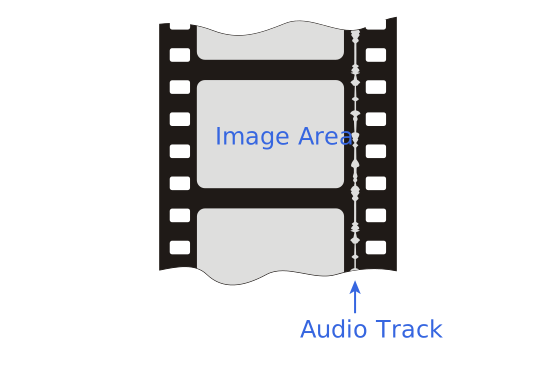
Early films were "silent" in that they had no accompanying recorded sound; dialog was placed on intertitles and films were often accompanied by a live musician playing a theatre organ. In the late 1910s, American inventor Lee De Forest pioneered a technique of including sound recording on a the film itself. The projector's light would shine through an area on the film and a photoelectric cell on the other side of the film would convert the variations in light intensity into electrical signals sent to a speaker. This method of sound recording would remain in widespread use until the early 1990s and 2000s, when it was replaced by digital sound recording.

Magnetic Tape
In the 1930s researchers also began experimenting with using metal tape to record the fluctuations in the magnetic field of an aurally sensitive electromagnet. Tape was much more compact than vinyl records, and could easily be erased and reused. Eventually, plastic tape with a metal coating was used, allowing recordings to be edited through splicing and reattachment.
Reel-to-Reel
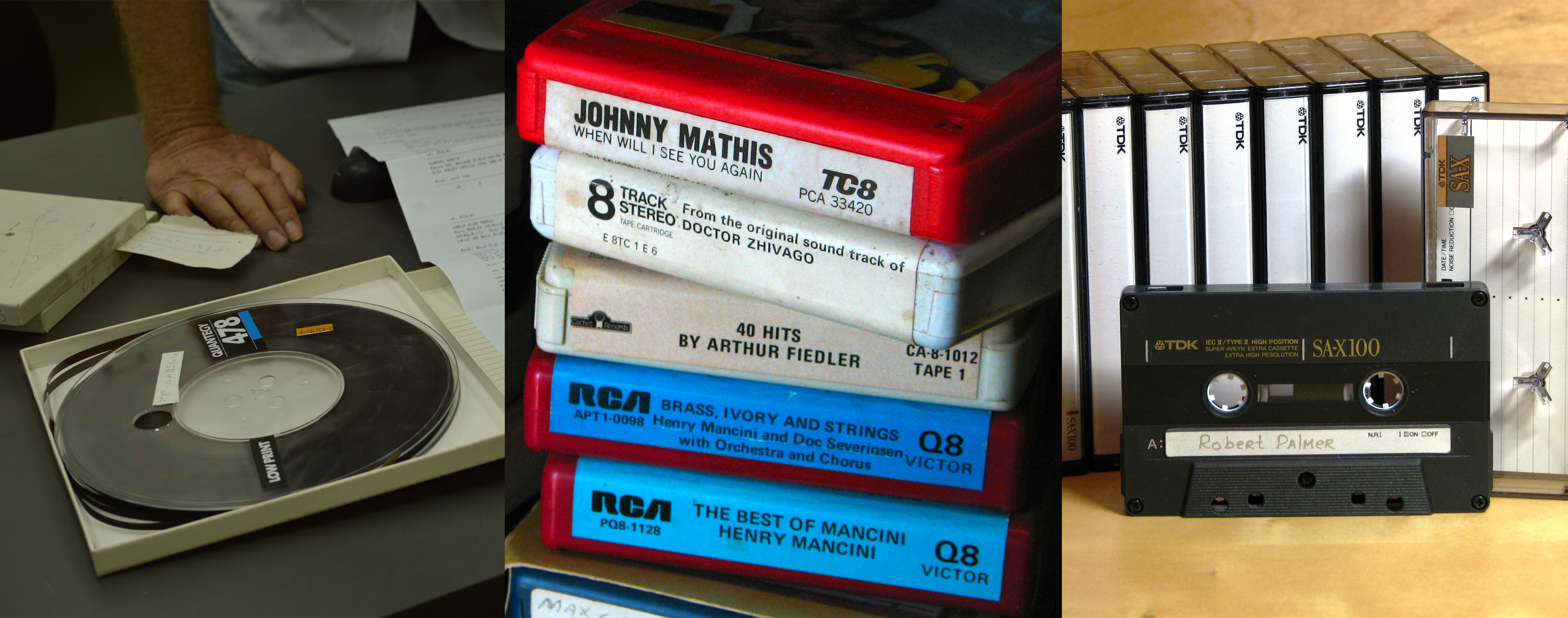
The first consumer tape recording devices, called reel-to-reel players, involved large spools of tape which were threaded by hand through the tape heads into an empty spool. Continued innovation led to multitrack tape recorders, which allowed more than two channels of audio to be stored on a single strand of tape.
Cassette
The bulky nature of the reel-to-reel players led to various methods of packaging magnetic tape inside plastic cartridges, a form which lent itself to automobile stereos. Stereo 8, a format more commonly known as "8-track," became popular in the United States in the 1960s, but it was made obsolete by the compact cassette, a smaller cartridge format which became popular worldwide in the 1980s.

.jpg)

Digital Formats
Instead of directly reproducing sound waves into media, digital recording involves measuring a waveform at particular intervals and recording the measurements. Though analog recordings tend to lose quality with the degradation of their physical material, digital recordings consist of numeric data and remain at a consistent quality as long as the data is reproduced accurately.
Digital Audio Tape
The popular compact cassette format was used as an early storage device for home computers, which would use a modem-like process to convert digital data to an audio recording and back. This concept was adopted to record digital audio, and led to a new physical cartridge format, Digital Audio Tape or DAT The Alesis corporation adapted this to record digital audio to VHS cassettes, called Alesis Digital Audio Tape or ADAT. While neither format became popular among consumers, they were favored by recording studio engineers.
Compact Disc
The most popular digital audio format at the beginning of the 21st century was the compact disc or CD. CDs store data as microscopic bumps on a reflective surface, accessed by shining a laser on the surface and detecting the intensity of the reflected beam. The reflective layer is coated by a clear protective lacquer; scratches on this layer can often be repaired without affecting the data layer beneath.
Digital Audio File
Advances in the processing speed, storage capacity and internet connectivity of home computers soon made digital audio file formats like MP3 the preferred medium for consumer music. Entire music collections could be stored and easily accessed on computers or on portable devices like the Apple iPod. Consumers had the option of copying their CDs to computer storage, a process called ripping, or even directly purchasing digital audio online. As broadband internet connections and internet-enabled smartphones became more common, consumers moved away from owning recordings in favor of subscribing to streaming services like Spotify.
Digital Audio Techniques
While digital audio generally has a much higher fidelity than analog audio, this is dependent on a few different factors.
Sample Rate
The resolution of a digital audio recording — how often the sound wave is measured — is referred to as the sample rate of the recording. A higher sample rate produces a more accurate representation of the waveform, but requires recording more data for a given length of time.

Most common digital audio formats use a sample rate of 44.1 kHz, or 44,100 measurements per second. Sample rates higher than this are generally considered unnecessary, since the resulting difference in quality is undetectable by human ears.
Bit Depth
In digital audio, the precision of the measurements made influences the quality of the recording. A lower precision measurement takes less storage space but results in a lower quality recording. This precision is referred to as bit depth. A bit is a single binary digit, which can be either a 0 or 1. Most audio formats today use at least 16 bits for each measurement; some go much higher.
Compression
Musicians often consider CD audio, which consists of two channels recorded at 44.1 kHz and a bit depth of 16, to be a high quality audio standard; this process requires approximately 10 MB of data to store 1 minute of audio. When digital audio was first becoming popular, personal computers had less than 500 MB of storage, and internet connections were limited to downloads of 500 KB per minute, making full quality digital audio impractical.
Software engineers have developed different methods of compressing audio information to reduce this size requirement. Some methods of audio compression use shorthand to encode longer sequences and remove audio that falls outside the realm of human hearing, reducing file sizes with no perceptible loss of quality, a process called lossless compression.
Other techniques involve making sacrifices to audio fidelity like reducing bit rate or sample size, either subtly or more obviously. These techniques are called lossy compression.
The most common forms of digital audio compression used today are those codified by the international Moving Picture Experts Group: MP3 — short for MPEG-1 Audio Layer III — and M4A, which stands for MPEG-4 Audio.
The affects of audio compression can vary depending on the type of audio being recorded. Human speech requires relatively little fidelity to remain clear and intelligible, whereas orchestral music, with its large range of pitches and variety of timbres, will often suffer from side effects of high compression.
Recording Music: Summary
- Audio recording involves capturing audio into a physical form that allows the sound to be recreated later.
- Analog audio recording captures the actual shapes of sound waves into a physical form, and is susceptible to degradation through repeated use.
- A phonograph permanently carves sound wave shapes into a media, such as wax, shellac, or vinyl.
- Photographic film for video can include sound recordings by shaping a beam of light shining through the film.
- The field created by a speaker's electromagnet can be recorded to magnetic tape, as in reel-to-reel, 8-track, and compact cassette tape recorders.
- Digital audio recording records the measurements of sound wavelengths into numeric data, which is stored for later recreation.
- Common digital audio media include digital audio tape, compact disc, and digital audio file formats like MP3.
- The fidelity of digital audio depends on how many measurements are made per second, a value called sample rate, and the precision of those measurements, called bit depth.
- Recording audio with higher sample rate and bit depth requires larger amounts of data, increasing file size and transfer times.
- Digital audio compression algorithms like MP3 and M4A reduce file sizes by encoding repetitive data with systems of shorthand and by not ignoring audio ranges and details that humans cannot hear.