Acoustics


When we hear a sound, we're witnessing a complex series of events: the sound's creation, its movement through the air, and our perception of it. Acoustics is a field which focuses on these fundamental, physical properties of sound.
Sound Creation
Sound can come from many different sources — natural and artificial, intentional and consequential, organized and chaotic. As musicians, we often focus on the refined sounds created by finely crafted instruments or carefully trained voices, but we are almost always surrounded by a complex soundscape of sounds from things around us.
In every case, sound is created by something vibrating the molecules in the air. Faster vibrations result in higher sounds; slower vibrations create lower sounds.
Instruments
Chordophones
Chordophones produce sound by plucking, bowing, or striking one or more strings stretched along the body of the instrument. Plucked chordophones include instruments like guitars and ouds. Bowed chordophones include violins and cellos. The most common struck chordophone is the piano, which produces sound by hammers striking strings.
A string vibrates at a frequency determined by its tension. A longer string has less tension and vibrates more slowly. If the string is shorter, or if it is pulled tighter, the vibrations will be faster. Therefore, larger instruments like cellos and basses play lower sounds than their smaller counterparts, violins and violas. Players fine-tune their strings by adjusting tuning pegs that change the tension of each individual string.
The vibrating strings in a chordophone (and, in fact, the vibrating mechanisms of almost every instrument) will often create multiple frequencies. The primary frequency, called the fundamental, is created by the vibration of the entire string. However, the string will also vibrate at higher frequencies which correspond to divisions of the string as shown in Figure 2. The relative strength of these additional frequencies — called overtones — affect the quality of the sound.
Idiophones and Membranophones
Idiophones are instruments that create sound by vibrating all or part of the body of the instrument. Many percussion instruments fit into this category, such as cymbals, marimbas and maracas. While metal and wood are the most common materials used in idiophones, they can be made of any material, including glass, plastic, or even stone. An idiophone's frequency is determined by the size and composition of its material; its pitch cannot be changed without permanently altering the instrument.
Membranophones are instruments which vibrate the air using a membrane stretched over the body of the instrument. The most common type of membranophone is a drum: an instrument with a drum head of animal skin or plastic which is usually struck by a hand or a mallet. Another type of membranophone is the kazoo, in which a rattling membrane is used to modify the sound of the human voice. Like a chordophone, a membranophone's frequency is determined by the size and tension of the membrane.
Idiophones and membranophones can be pitched or unpitched. Unpitched instruments like gongs and snare drums create sounds that are vaguely high or low but not at one specific frequency. Pitched idiophones include mallet instruments like xylophones and glockenspiels; an example of a pitched membranophone is the timpani, which is tuned to a particular pitch with a pedal that adjusts the tension on the drum head.
Aerophones
Instead of creating sound with vibrating wood, plastic or metal, Aerophones create a vibrating column of air inside the instrument. This air acts just as a vibrating string would; the length of the column is determined by adjusting the effective length of the instrument. Brass instruments accomplish this by changing the length of tubing the air goes through. Trombones use a slide which visibly extends the air channel; other brass instruments use valves to redirect the air through longer pathways.


Woodwind instruments are also aerophones. Most of them vibrate the air column using one or two small wooden reeds, and the length of the air column is changed by opening or closing holes in the instrument body. These holes can be covered directly by the fingers, as with the recorder, or by keys made of metal and cork, like the saxophone.
The vibrations of the air column can be influenced in complicated ways by opening holes at particular points along the waveform, but in general, as holes are opened up toward the beginning of the air's pathway, the shorter the air column is, and the higher the resulting pitch.
Voice
Our vocal cords are not actually cords, but stretched membranes, so the human voice is technically a membranophone. We can change the quality and volume of this sound by narrowing ("ooh") or closing ("mmm") our lips or moving our tongue ("lll", "rrr").
Additionally, our lips and tongue can act as idiophones ("t," "p"), and can work with our breath to act as aerophones ("fff," "sss"). These "instruments" can be used by themselves, or they can be combined with the vocal cords to make different types of sounds.
| Unvoiced | Voiced |
|---|---|
| p | b |
| f | v |
| s | z |
| k | g as in "good" |
| th as in "with" | th as in "though" |
| sh as in "should" | "zh" as in "treasure" |

Speakers
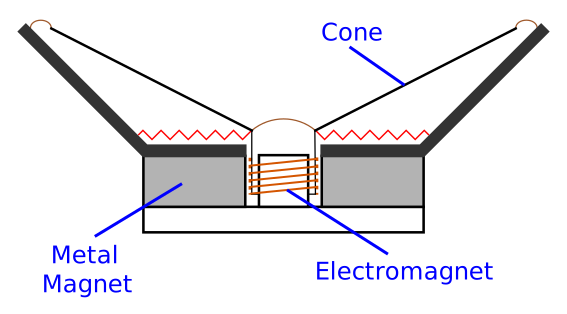
Electronic instruments and devices create sound using a speaker. All speakers, from electric
When an electrical current passes through a wire, a small magnetic field is created around that wire. A coiled up wire is called an electromagnet, which acts just like a regular magnet. The polarity of an electromagnet depends on the direction of the electrical current.
A speaker contains an electromagnet placed next to a regular metal magnet. By very quickly switching the direction of the current in the wire, the metal magnet is either attracted or repelled, causing vibrations in the surrounding air. In a speaker, these vibrations are amplified by a cone made of paper or plastic.

Sound Propagation
Sound Waves
When a string, membrane or other material vibrates the air around it, a chain reaction takes place. Each vibrating molecule of air causes neighboring molecules to vibrate, creating waves through the air. While each molecule only moves a tiny distance and back, these sound waves will continue to travel until their energy is dissapated.
The Speed of Sound
The speed of sound through air is about 340 meters per second. This is much slower than the speed of light, which is close to 300,000,000 meters per second. While nothing can exceed the speed of light, aircraft like the F-15 Eagle and Concorde are capable of flying faster than sound. Because sound takes nearly a third of a second to cross a standard football field, marching bands must rely on visual cues instead of aural feedback to keep synchronized. Thunder, the sound produced by lightning, can take several seconds to reach an observer miles away, and the distance between the ends of a single lightning bolt can spread its sound over several seconds.
The speed of sound is also affected by the temperature and density of the medium it is passing through. In general, speed increases with density; sound can travel around 1500 meters per second through water, and 3000 to 6000 meters per second through solids like walls or windows.
Sound Reception
Ears
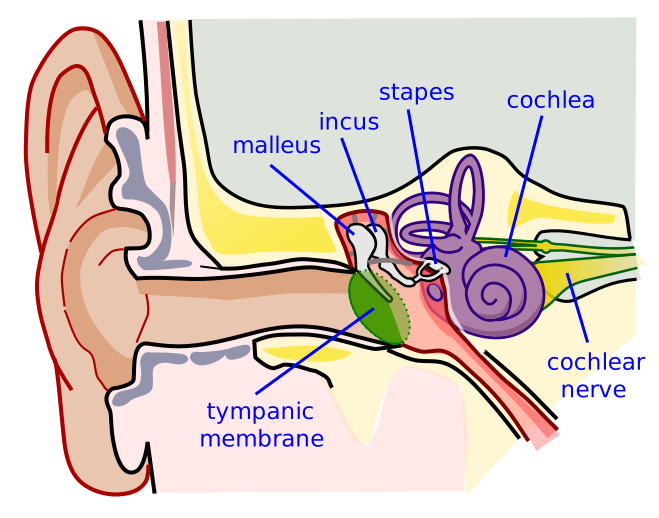
Human ears are capable of detecting sounds across an enormous frequency range. The ear can detect minute changes in air pressure and translates them into electrochemical impulses which are sent to the brain.
The ear is generally considered to have three portions. The outer ear or auricle consists of the fleshy portion outside the head, which serves both to protect the inner portions and to direct soundwaves into the ear. The middle ear contains the tympanic membrane or eardrum, which, when impacted by soundwaves, causes tiny bones to push against the cochlea, a structure in the inner ear which contains fluid. The back-and-forth movement of this fluid moves tiny hairs which line the cochlea, all of which act as tiny switches for auditory neurons. These neurons pass the messages on to the brain, which interprets them as sound.

Cochlear Implants
People who are deaf or who have a severe hearing impairment will sometimes use a cochlear implant, an electronic device which provides the user with the ability to hear. The implanted device contains an electrode which is inserted into the cochlea to electrically stimulate the auditory nerve. This implant is connected to an external microphone, often worn behind the ear or as a piece of jewelry.
While modern implants can detect frequency and amplitude ranges close to that of the ear, it is impossible for someone with a normal hearing capability to know what a cochlear implant "sounds like" because it does not produce any sound in the traditional sense; the implant bypasses the ear and sends messages directly to the nervous system.
Microphones
Microphones do the exact opposite of speakers: they respond to vibrations in the air and convert these waves into variations in electrical current. Interestingly, the most common type of microphone has the exact same mechanism as a speaker; only the direction is reversed. In fact, this type of microphone — a dynamic microphone — can be used as a speaker, and vice versa — though devices on the market are designed to be primarily effective doing only one or the other.

.jpg)
Other types of microphones use slightly different methods of converting vibrations into electrical signals. Condenser microphones use capacitors instead of magnets, which cause a similar affect on the electrical current. Ribbon microphones use a magnetic field but contain a metal ribbon that responds to soundwaves rather than an electromagnet. Other types include piezoelectric microphones, which use crystals which have an innate electrical response to pressure changes; fiber-optic microphones, which detect sound by changes in light intensity, and laser microphones, which measure the tiny vibrations of walls or windows as they respond to nearby sound.
Like speakers, microphones come in many shapes and sizes to meet a variety of needs. One important aspect of microphone design is directionality, which defines areas of sensitivity around the microphone. An omnidirectional microphone will be receptive to sounds all around the microphone, and is useful in devices like smart speakers. Most microphones used by singers are cardioid microphones, which are highly receptive on one end but not on the other. Some microphones have a very narrow field of receptivity; these "shotgun" microphones are used to isolate a particular sound from a distance.



Acoustics: Summary
- Acoustics is a field devoted to studying the fundamental physical properties of sound.
- Sound is created by anything which vibrates the molecules in the air.
- Faster vibrations result in higher pitches, and slowed vibrations create lower pitches.
- Chordophones produce sound by one or more tense strings being plucked, bowed or struck.
- Idiophones produce sound by the body of the instrument itself vibrating the air around it.
- Membranophones produce sound using a stretched membrane.
- Aerophones produce sound by vibrating a controlled column of air within the instrument.
- In all cases, the vibrating element usually produces multiple overtones, representing fractions of the element vibrating in different ways.
- The voice is primarily a membranophone, but the mouth can act as an idiophone or aerophone to create varied sounds.
- Speakers are also membranophones, driven by an electromagnet which vibrates a plastic or paper cone.
- Sound propagates as particles in a medium like air respond to waves of pressure. The energy of these waves dissipate over long distances.
- Sound travels through air at about 340 meters per second, much slower than light.
- The speed of sound is affected by the temperature and density of the material it is moving through.
- Most humans perceive sound primarily using ears.
- Ears consist of the outer ear, middle ear, and inner ear.
- The eardrum, located in the middle ear, is a membrane which translates air vibrations to movement.
- The cochlea, located in the inner ear, translates this movement into electrical impulses sent to the brain.
- Cochlear implants replicate the process of translating air vibrations into electrical impulses, allowing people who are deaf to perceive sound.
- Microphones translate air vibrations into variations in an electrical current that can be passed along a wire.