Multiphonics
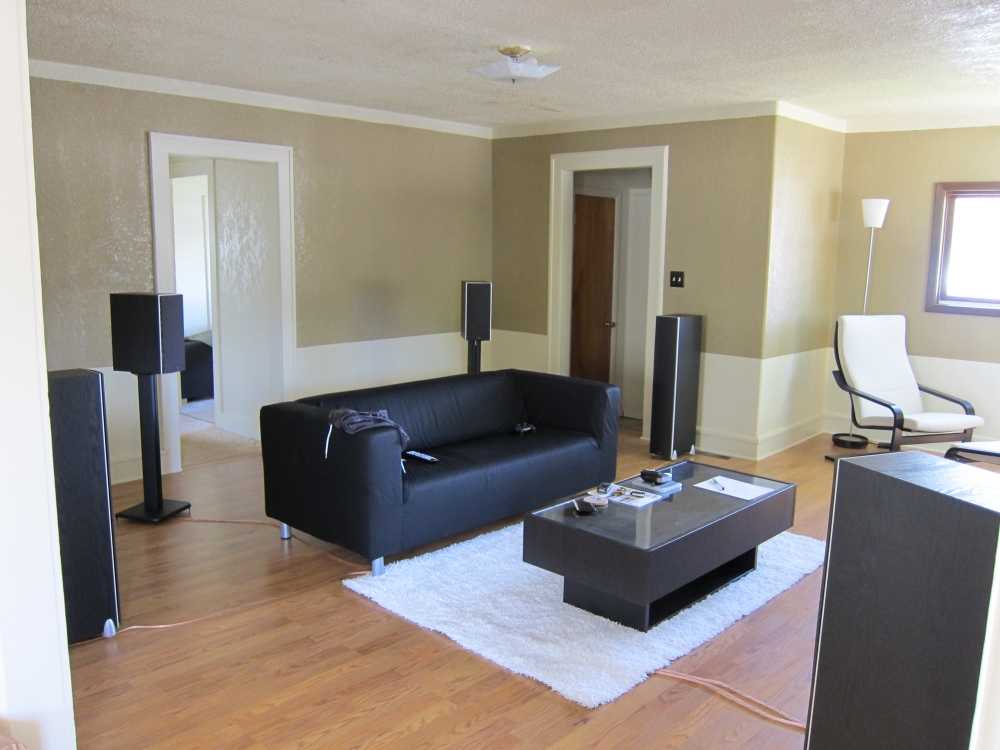
Most listeners are able to subconsciously sense the location of a sound by comparing how it is perceived in their right and left ears. By using multiple speakers, we can add a sense of physical space to live or recorded audio.
Stereo
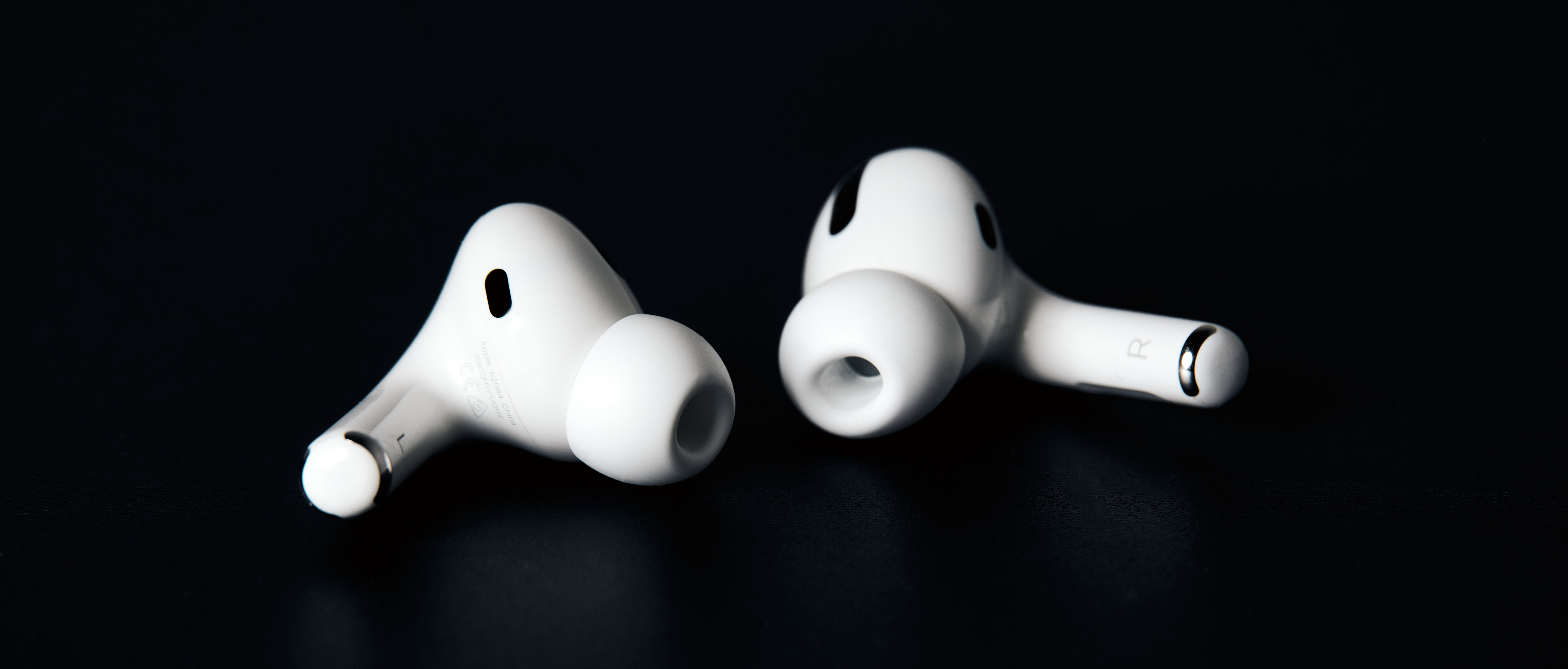
The most common form of form of multiphonics today is stereophonic or stereo sound. Stereo sound consists of two channels, left and right, which are played simultaneously in separate speakers. These speakers might be housed in separate cabinets or on opposing ends of a single unit like a boombox. Headphones and earbuds contain small speakers that are worn near or in each of the listener's ears.
Panning
If a sound is created directly in front of a listener, the sound will reach both ears with the same intensity. However, if a sound is generated on a listener's left side, it will sound slightly louder in the left ear than in the right, allowing the listener's brain to locate the sound's source.
Thus, if the two channels of a stereo recording are identical, sound will appear to emanate from a location halfway between the two speakers, but if the sound is louder in the left channel than in the right channel, it will seem to emanate from the left side. Adjusting the balance between the left and right channels as a means of physically placing the sound source is called panning.
Recording Techniques
A stereo can be made with two microphones, each recording one channel of audio, placed at some distance from one another. A sound on the left, for example, will likely be recorded by both microphones, but will be louder in the left channel.
A more faithful recording can be produced by using binaural microphones, bringing them closer together — matching the distance between most listener's ears — and orienting them perpendicular with one another. This arrangement is called a Blumlein pair after its inventor, English engineer Alan Blumlein.
Stereo Media
The most popular forms of audio media are designed around stereo sound. Digital audio formats like audio CDs and MP3 support two channels of audio as part of their specifications, and compact cassettes store audio in two separate and parallel 0.6 mm tracks that run the length of the tape.
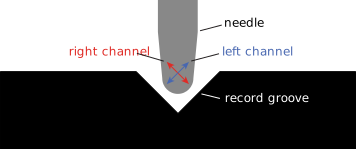
Record players use the two sides of a V-shaped groove to store separate audio channels. Rather than only moving horizontally, the record needle will move perpendicular to the inner wall of the groove to play the left channel and perpendicular to the outer wall to play the right channel.
Spatialization
By placing speakers in other positions around the listener, each relaying individual channels of audio, a more immersive audio experience can be created. While stereo sound creates a virtual sound space, the term spatialization typically refers to sonic environments created with three or more speakers placed around the listener.
Perceiving Depth
Even with stereophonic hearing, humans and other animals can perceive if a sound is coming from ahead or behind, and from above or below, by how the sound is reflected by the outer ear or auricle. Our brains are conditioned to sense the slight differences in sound subconsciously.
Headphones
Because they use only two speakers, traditional headphones and earbuds can only portray sound on a left-to-right axis. However, more recent devices contain sophisticated built-in processors which can selectively adjust panning and frequency response to create a sense of height and depth, as well as position and orientation sensors which can sense the user's head position so sounds seem to emanate from a specific position in the listener's environment, even when their head moves or rotates.
Multiphonic Sound
A more immersive aural environment can be created by adding more speakers around the listener, allowing sounds to come from beside or behind the listener.
Record companies in the 1970s began releasing commercial albums in quadraphonic sound, for which speakers were placed at the listeners front left, front right, rear left and rear right. Attempts to standardize the format included SQ, a format developed by Columbia Records, Sony and EMI; and CD-4, a format devised by Japanese manufacturer JVC. Because each of these formats required consumers to purchase new, specialized equipment, all were soon abandoned.
Musicians like German composer Karlheinz Stockhausen have written works which involve spatialization, including Kontakte, a 1960 work, written for four speakers and 1956's Gesang der Jünglinge, written for five speakers.
Theatrical Surround Sound
In 1940, Walt Disney Productions produced the film Fantasia, which featured animated segments set to orchestral works performed by the Philadelphia Orchestra led by English conductor Leopold Stokowski. Unlike the monophonic films which were standard at the time, the music for Fantasia was recorded using 33 microphones arranged throughout the orchestra, and the film was premiered in a 13-city tour in theaters fitted with multiphonic speakers.
Many modern films are produced using multiphonic audio, commonly referred to as surround sound. Movie theaters usually feature high-end multiphonic sound systems — often as a requirement of the studios whose films they show — and home surround sound systems, using wired or wireless speakers, are common in many people's homes.
Variations
Most consumer surround sound systems use six speakers: four full-spectrum speakers spaced around the viewer, one placed directly in front of the viewer which is primarily used for dialogue, and a subwoofer — a speaker which produces only the lowest frequencies. Because the sounds from the subwoofer are generally felt more than they are heard, the location of the subwoofer can be placed or even hidden anywhere in the room.
Because it uses five regular speakers and one subwoofer, this arrangement is known as 5.1 surround. Other arrangements include 7.1 surround, which adds speakers to the viewer's direct left and right, and 11.1.4 surround, which includes more side speakers and adds four speakers above the viewer.
Decoders
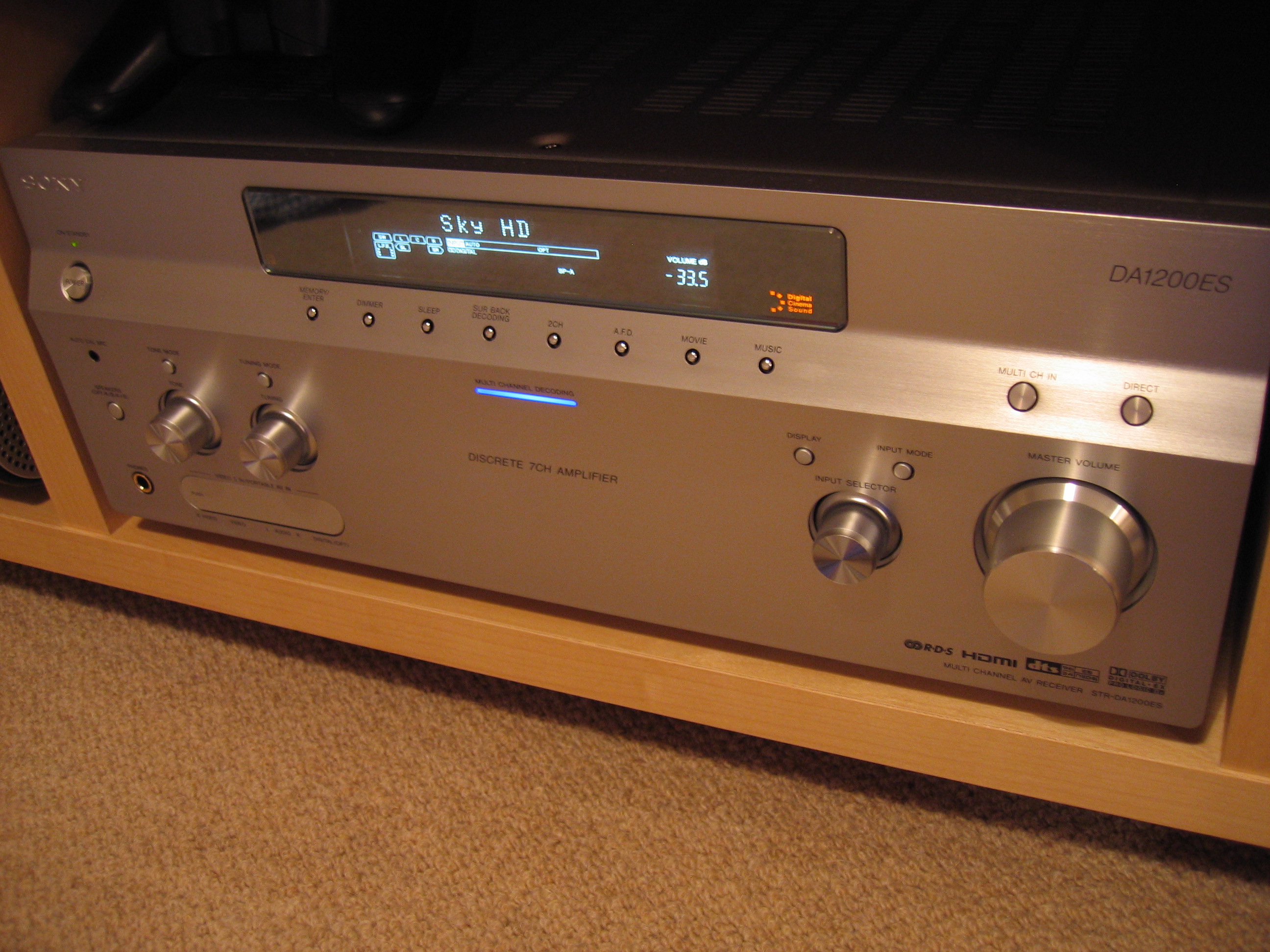
Because many recording formats and audio systems are designed around stereo audio, media is usually stored in a way that compresses multiple channels into a two-channel signal. This compression requires a device that interprets the signal and splits the different channels before delivering it to individual speakers. This device, called a matrix decoder, is the core of a consumer home theater system, and will often incorporate other features such as a means of selecting from different inputs — such as satellite or cable receivers, set-top boxes, and video game consoles — and tools such as graphic equalizers or other signal processors.
The most popular encoding schemes are developed by American companies Dolby Laboratories and DTS, and are proprietary technologies.
Surround Music
With the advent of consumer surround sound system and the more recent availability of spatialization in headphones, musicians and record producers are creating music which takes advantage of multiphonic sound — to create a more immersive sonic experience with added resonance, or to incorporate special effects to reinforce a multi-dimensional aural environment.
Multiphonics: Summary
- Multiphonic audio uses multiple speakers to add a sense of space to recorded music or sound.
- Stereo sound uses two channels — one for the left and one for the right.
- Most playback devices support stereo sound, using standalone speakers or headphones.
- The process of adjusting the relative volume between stereo speakers to locate a sound's source from left to right is called panning.
- Stereo recordings can be made with two microphones, separated either by distance or by placing them perpendicular with one another, an arrangement called a Blumlein pair.
- Media formats, including vinyl records, compact cassettes, audio CDs, and digital audio files all support stereo sound.
- Multiple speakers can be placed around the listener to create a more immersive environment, a process called spatialization.
- Humans and other animals with binaural heading can perceive sound location in three dimensions by sensing how incoming soundwaves are reflected by their auricles.
- Because they contain only two speakers, headphones normally cannot create a two- or three-dimensional aural environment. However, newer devices can use complex processing to simulate more immersive environments.
- Composers like Karlheinz Stockhausen used spatialization in some of their works. Record companies experimented with quadraphonic sound in the 1970s but the technology was not commercially successful.
- Spatialization became popular as part of movie soundtracks as surround sound, first in specially designed theaters and later in home theater systems.
- Surround sound is used in many forms, often described as "X.Y.Z," where X is the number of speakers at the listener's level, Y is the number of subwoofers, and Z is the number of speakers placed above the listener.
- Encoding technologies like Dolby Surround and DTS are used to encode multichannel audio onto stereo media. Encoded audio requires a matrix decoder to play back.