Synthesis

While the term often brings up imagery of 1980s-era bands and stands with multiple, multicolored keyboards, synthesizers come in many different forms — keyboards, rack-mounted devices, or even computer programs running on a laptop — and are omnipresent in today's music.
Sound Sources
A defining characteristic of a synthesizer is that it generates sound using one or more oscillators: electronic components that convert a direct electrical current into a current that alternates directions at a specific frequency.
Basic Oscillators
At their most basic level, oscillators generate a smooth oscillation between a positive voltage and a negative voltage, which on a graph appears as a sine wave. When this current is translated into sound using a speaker, the graph reflects the relative position of air molecules as sound waves pass through them.
The sound generated by a sine wave oscillator is often characterized as "simple" or "pure," because it consists of only one frequency. The creation of more complex timbres by combining multiple oscillators is called additive synthesis.
Other waveforms can be created by adding additional frequencies at multiples of the base frequency (referred to as partials or harmonics) at successively lower amplitudes (a process called roll-off).
- A sawtooth waveform results from adding all of the base frequency's harmonics, with each harmonic's amplitude set to the inverse of the harmonic's number — so the second harmonic is half as loud as the base frequency, the third harmonic is one-third as loud, and so on.
- A square waveform results from adding only odd numbered harmonics: the base frequency times 3, times 5, times 7 and so on. Like the sawtooth waveform, the relative amplitudes of the harmonics are the inverse of the harmonic's number.
- The triangle waveform is more complex: like the square waveform, it uses the odd-numbered harmonics, but alternates between adding and subtracting the values. Also, the amplitudes of the harmonics are much lower: each harmonic's amplitude is the inverse of the square of the harmonic number, so the third harmonic is a ninth (32) as loud as the base frequency.
The construction of these complex waveforms from individual sine waves are called Fourier transforms, and are used in many other fields in addition to music.
Combining Oscillators
Oscillators which generate basic waveforms can be combined with other oscillators to create more complex timbres.
Amplitude Modulation
A second waveform can be configured to control the amplitude of a primary waveform. At high frequencies, this process — called amplitude modulation — changes the timbre of the sound.
Frequency Modulation
Like amplitude modulation, frequency modulation involves controlling the frequency of a waveform with a second waveform.
Pulse Waves
Through more complex waveform combinations, a square waveform can be modified to change the ratio between high- and low-pressure zones. These waveforms are called pulse waves and the resulting timbre changes based on the relative width of the pulses.
Pulse Width Modulation
As with amplitude and frequency modulation, a second waveform can be set to control the width of a pulse wave, creating more complex timbres.
Noise
Noise is the result of combining random waveforms with many different frequencies. Common sources of noise in everyday life are electric fans, which amplify the already random motion of air particles against our eardrums.
Noise generators are special types of oscillators that can create different types of noise, which theorists label with different colors:
- Just as white light results from the combination of all colors of light, white noise has waveforms with equal amplitudes across the frequency spectrum.
- Noise which has higher amplitudes for lower frequencies is called red noise, named for red light, which has lower wavelengths. Red noise is also called Brown noise, not because of the color but because it shows aural result of Brownian motion, the random movement of gas particles.
- Noise with higher amplitudes for higher frequencies is called blue noise or purple noise, after the colors with higher wavelengths of light.
Shaping the Sound
In a synthesizer, an oscillator's sound is controlled to start and stop in response to directions sent from a musician or computer. The simplest form of control is a gate: when the synthesizer receives a "note on" message, it starts the oscillator at full amplitude, and when it receives a "note off" message, it stops the oscillator.
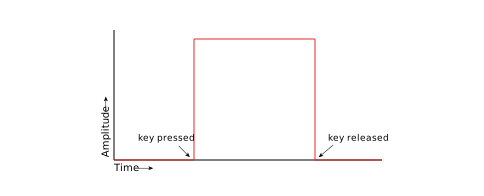
However, few acoustic instruments or natural sounds sound like gate-controlled oscillators. For example, a note played on a glockenspiel is loud for an instant and then slowly fades out over a few seconds. In synthesis, the shape of a particular sound is called its envelope.
The ADSR Envelope
The most common type of envelope used in synthesizers is the ADSR envelope. This envelope involves two different volume levels: an initial full level, and a second, lower level where the sound rests until the end of the note. The name comes from the four variables which can be changed to affect the shape of the sound:
- Attack is a value which describes how long the note takes to reach its initial full amplitude.
- Decay describes how long the sound takes to go from full amplitude back down to the lower amplitude.
- Sustain is the amplitude of the lower volume level, measured relative to the initial full volume.
- Release is a value which describes how long it takes for the sound to decay after the "note off" signal.
Other Envelopes
While ADSR envelopes are the most common in synthesizers, other types of envelopes exist. ADHSR envelopes add a fifth variable, hold, which indicates how long the sound should remain at full volume before decaying to the sustain level. DADSR envelopes add a delay setting which determines how long after the "note on" event the attack phase should begin. Some synthesizers use more complicated envelopes with multiple peaks and plateaus.
Direct Control
Envelopes are necessary when working with controls like keyboards, where signals are sent as simple "note on" and "note off" events. More complex controllers allow for direct control of the sound. For example, a wind controller sends continuous data to indicate the intensity of the player's breath, giving the player direct control over the envelope of the sound. Some keyboard controllers support aftertouch: sensors in each key that detect the pressure with which a player is pressing an already depressed key.

Synthesis: Summary
- Synthesizers use electronic components call oscillators to produce sound.
- A single, basic oscillator produces patterns that, when graphed, appear as sine waves.
- Additive synthesis involves the combination of multiple oscillators to create other patterns.
- By combining a sine wave with its natural harmonics or partials — waves with frequencies at multiples of the original wave — we can create other types of waveforms, which in turn create different timbres.
- Variables in this equation include which harmonics are used, and how steeply the amplitude is reduced with each successive harmonic (a value called roll-off).
- Adding all of a base frequency's harmonics creates a sawtooth waveform.
- Adding only the odd harmonics creates a square waveform.
- Adding only the odd harmonics, using a steeper roll-off, and inverting every other harmonic results in a triangle waveform.
- Pulse waves are square waveforms which, through complicated Fourier transforms, have variable ratios of positive and negative pressure in the waveform. Changing this ratio, called the pulse width, changes the timbre of the resulting sound.
- Further timbres can be created by using oscillators in other ways.
- Using a lower-frequency oscillator to control the amplitude of another waveform is called amplitude modulation.
- Using a lower-frequency oscillator to control the frequency of another waveform is called frequency modulation.
- Using a lower-frequency oscillator to control the pulse width of another waveform is called pulse width modulation.
- Noise is generated by an oscillator generating random waveforms across broad frequency ranges.
- White noise is noise spread uniformly across the frequency spectrum.
- Red noise — also called Brown noise — is noise which is louder in lower frequencies than in higher frequencies.
- Pink noise is noise that is louder in lower frequencies, but not as markedly as in red noise.
- Envelopes determine the shape of individual synthesized notes.
- A gate is the simplest type of envelope, involving an immediate increase to full volume when the note begins and an immediate decrease to silence when it ends.
- An ADSR envelope is the most common type of envelope used in synthesis, with variables for length of attack, length of decay, ratio of the note's sustain amplitude to the full volume, and the length of the note's release.
- Other types of envelopes can exist, adding values for a hold before the decay, a delay before the attack, or additional values for multiples peaks and falls.
- Certain controller devices, like wind controllers allow direct control of the envelope by the user.