Electric and Electronic Instruments

At the beginning of the 20th century, the construction of power grids caused electrical appliances to become more commonplace, and instrument manufacturers began experimenting with using electricity to create new types of musical instruments.
Electric Instruments
Electric instruments produce sound by translating vibrations into electrical impulses, which are then amplified and played through a speaker.
Electromagnetism
Electric instruments rely on a physical phenomenon called electromagnetism: the ways in which magnetism and electricity interact.
When a magnetic field moves near a conductive wire, it causes the movement of electrons in that wire. This movement of electrons is called a current. Similarly, when a current is run through a wire — for example, by connecting it to a battery — the current creates a magnetic field around the wire.
This property can be harnessed in a useful way by configuring coiled wires on a rotor inside a magnet-lined housing so that running a current through the wires causes the rotor to spin. This mechanism, called an electric motor, is used to spin discs inside the resonance tubes of a vibraphone, creating a vibrato which gives the instrument its name.


Microphones and speakers
Simple electromagnetism also forms the foundation of speakers and dynamic microphones. In their most basic form, these devices use a diaphragm attached to a wire coil which is placed within a magnetic housing. When configured as a dynamic microphone, sound waves move the diaphragm and the resulting movement of the coil within the magnetic field creates a variable current in the wire.
When reversed, the same apparatus becomes a speaker; when a rapidly changing current sent through the wire will cause the diaphragm to vibrate, vibrating the air around it and generating sound waves.
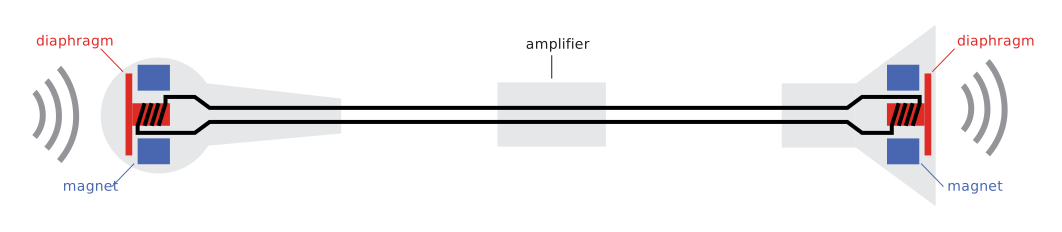
Actual speakers and microphones refine this process in specific ways to maximize efficiency and fidelity, and other types of microphones — electret microphones and ribbon microphones, for example — use slightly different arrangements to capture sound waves. While theoretically, a simple microphone connected to a simple speaker should work without additional power, in reality the amount of current generated by a microphone is not enough to generate audible sound, so public address systems require the use of an amplifier.
Electric Guitars
In the 1920s and 1930s, acoustic guitar makers began experimenting with electromagnetic processes, eventually creating the modern electric guitar. Rather than using a diaphragm, electric guitars place electromagnetic pickups underneath each metal string. Each pickup consists of a wire coiled around a magnet, so the vibrating string causes fluctuations in the magnet's field which are translated to the wire as a current.
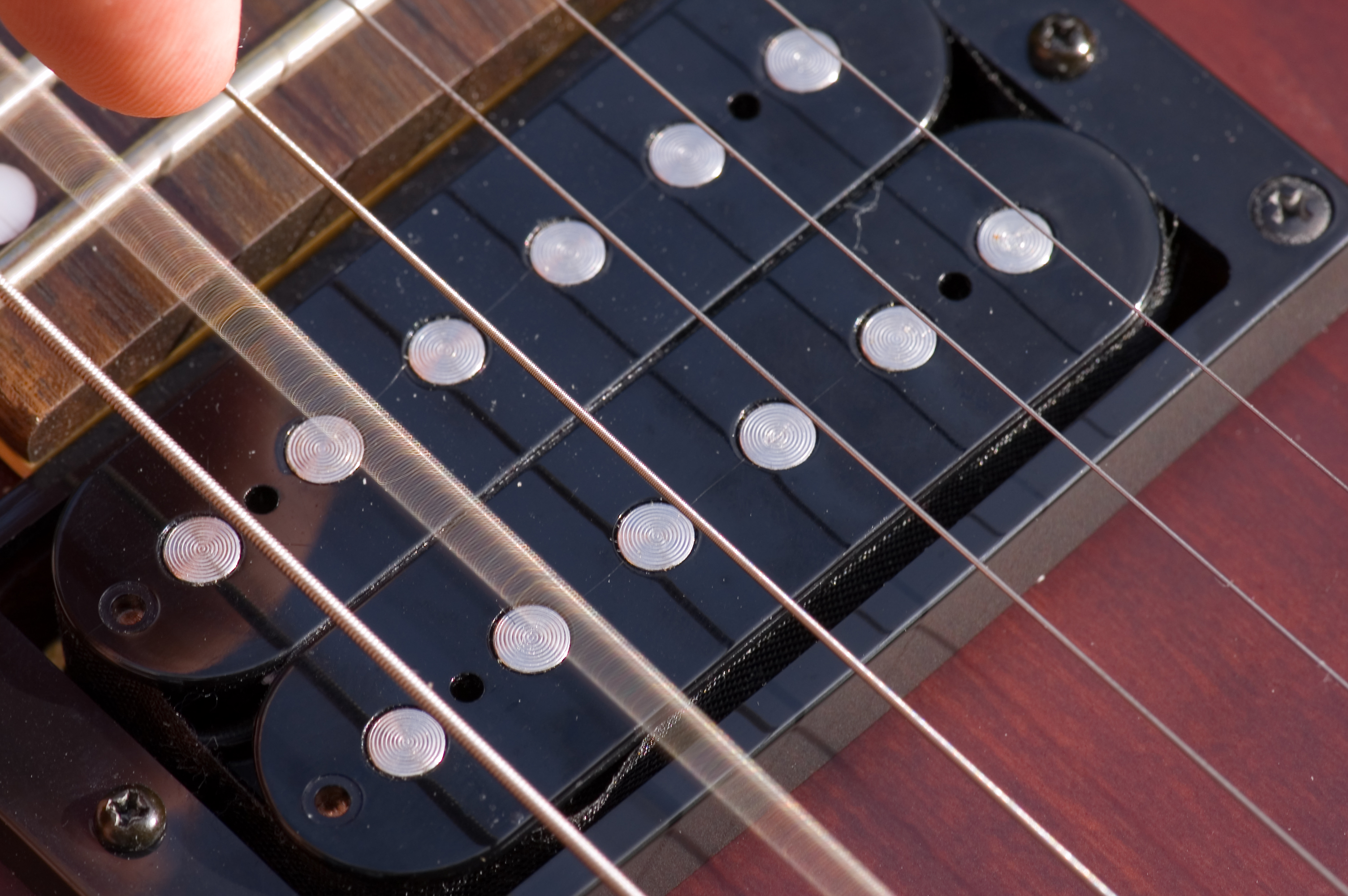
Because they have a solid body instead of a resonating chamber, electric guitars must be connected to an amplifier for performance; playing an unamplified guitar produces a very quiet acoustic sound.
Hammond organs
Created as a low-cost alternative to the pipe organ, a Hammond organ uses a variation on electric guitar pickups to generate sound. In place of a vibrating string, the Hammond organ uses tonewheels: spinning discs with specially-ridged edges which, when placed next to a pickup, induce a similar current.

Some models of Hammond organ have a built-in amplifier and speaker, and others must be connected to an external speaker cabinet. They are often used with a Leslie speaker, an amplified speaker which rotates inside its cabinet,creating a vibrato effect which can be controlled by setting the rotational speed.

Other Electric Instruments
Another method of using electricity to create sound by generating two different frequencies and controlling how they interfere with one another, a process called heterodyning.
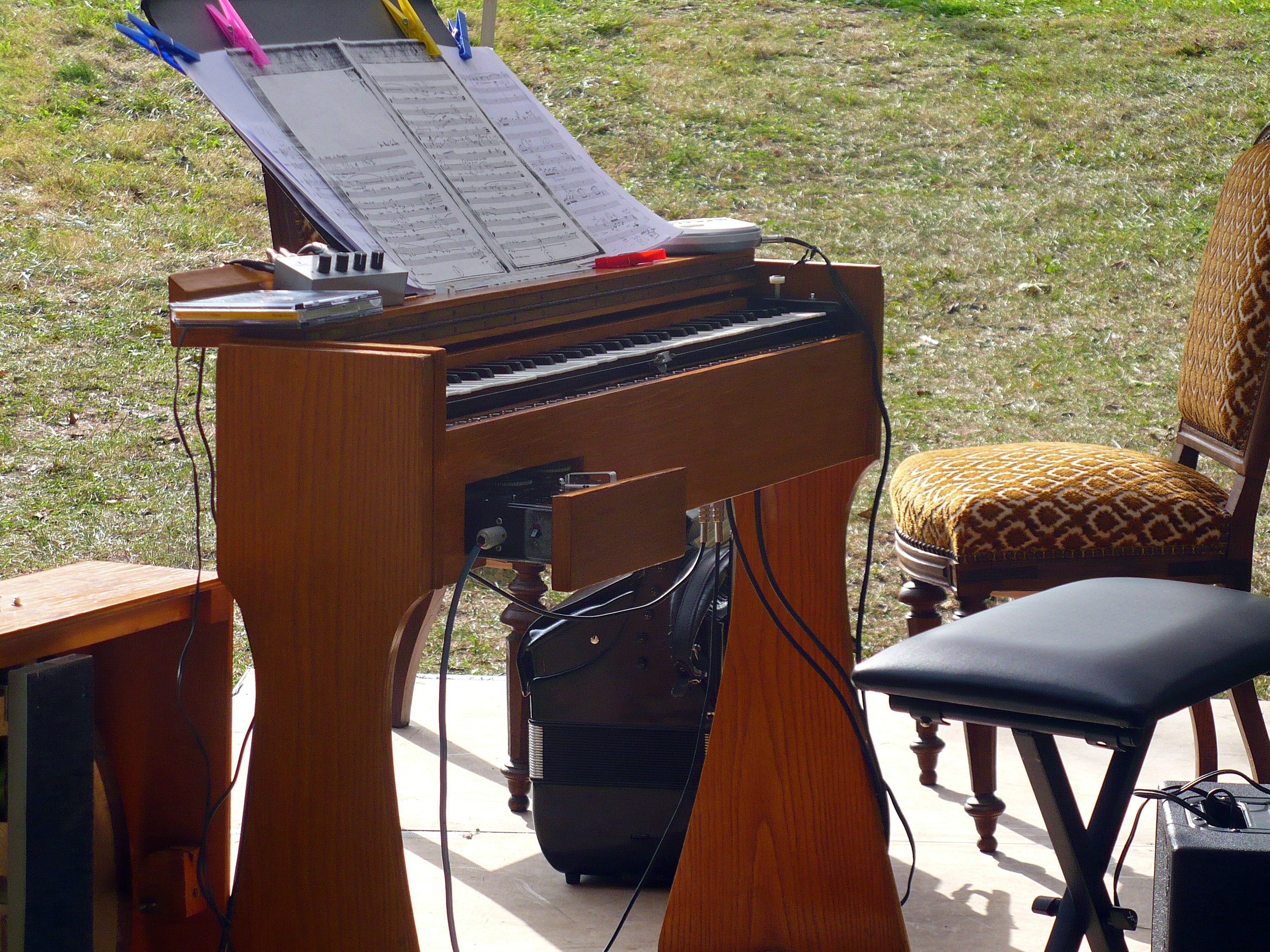
The ondes Martenot is an instrument designed around this technique, invented by French cellist and inventor Maurice Martenot after noticing the audible interference created by adjacent radio transmitters. The instrument consists of a specific type of speaker called a diffuseur connected to a console with two control surfaces: a traditional keyboard and a ring suspended from a wire which can be moved from side to side to control the pitch of the instrument's single voice.

An instrument which uses a similar principle is the theremin: an electric instrument with which pitch and volume are controlled by moving one's hands near — but not touching — the instrument's two separate antennas.
Electronic Instruments
In the field of engineering, electric devices are those which convert electricity to other forms of energy like movement, heat, light, or sound; electronic devices use electricity as a means of conveying and manipulating information. Because all instruments produce sound, musicians generally use the term electronic instrument to refer to an instrument which generates sound computationally rather than through physical vibrations or field interference.
Oscillators
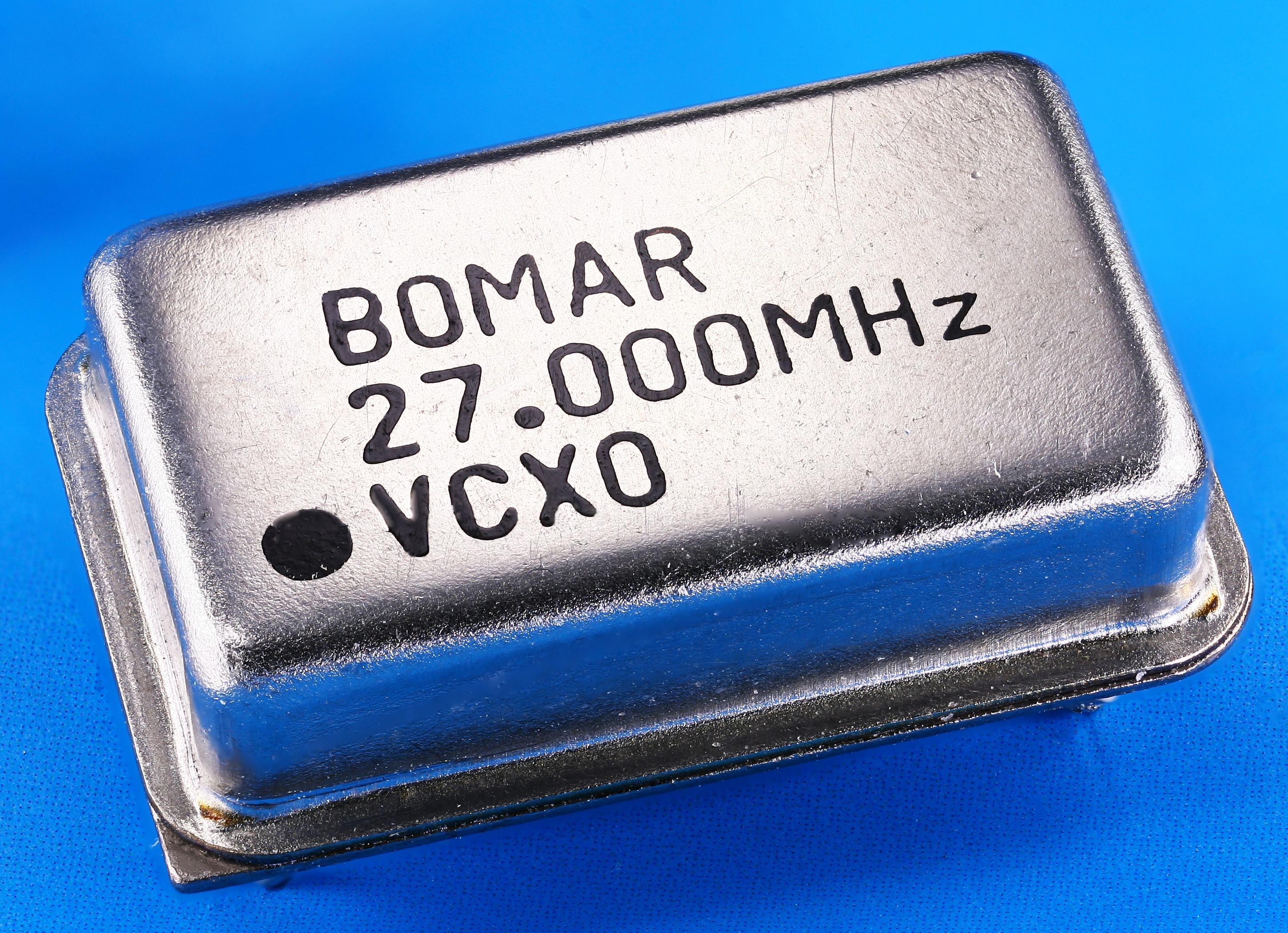
An oscillator is an electronic component which converts a direct current — a current flowing continuously in one direction — into a periodically alternating current. Oscillators can be used to generate AC power, but are more commonly used to create a low-power signal. Oscillators which produce audible frequencies — for example, 440 Hz for A4 — can be used to generate sound in electronic musical instruments.
Oscillators can be constructed in different ways. Early oscillators used vacuum tubes, sealed low-pressure glass containers with electrical components inside. Modern oscillators are generally manufactured as discrete electrical components designed for use on circuit boards.

Synthesizers
Any musical instrument which creates sound using oscillators is called a synthesizer. Physical synthesizers are commonly designed one of two configurations.
- A keyboard synthesizer is a synthesizer with its own built-in keyboard. These instruments may have an on-board amplifier and speakers for standalone use, or may need to be connected an external sound system.
- A console synthesizer is a component — often designed to be mounted in a standard 19-inch rack — which is meant to be controlled by external input devices and connected to an external sound system. These are often designed to be used with MIDI controllers or computers.
Software synthesizers are computer programs which emulate the sound — and often the physical interface — of physical synthesizers. These programs are generally available as plugins for digital audio workstations.
MIDI
While synthesizers create an audio signal which must be sent to a sound system, most synthesizers are also designed to be controlled by other devices such as keyboards or computers. The language most commonly used to send performance information is called Musical Instrument Digital Interface or MIDI.
A MIDI signal does not contain actual audio waveforms, but instead consists of simple directions, such as a signal to begin playing the note Ab3 at 72% volume. Thus, a set of MIDI directions sent to different synthesizers might yield different results, just as the performance of a certain piece of sheet music will sound different when performed by an oboist, violist, or timpanist.
A MIDI controller is a device which converts a musician's gestures into MIDI information. MIDI controllers do not create sound on their own, just as typing on a computer keyboard has no effect unless it is connected to a computer. MIDI controllers exist in many forms:
- Keyboard controllers are the most common type of MIDI controller. They are available in many sizes, from full 88-key varieties to more portable 2-octave configurations with miniaturized keys. Keys may be touch-sensitive, detecting the velocity with which the performer presses them and sending it as a MIDI signal, and more expensive models may feature weighted keys to better mimic the feel of an acoustic piano. Most controllers support the use of a sustain pedal and include a pitch bend wheel for controlling the tuning of individual notes, and other wheels, buttons, or sliders which can be programmed to send other types of MIDI data.
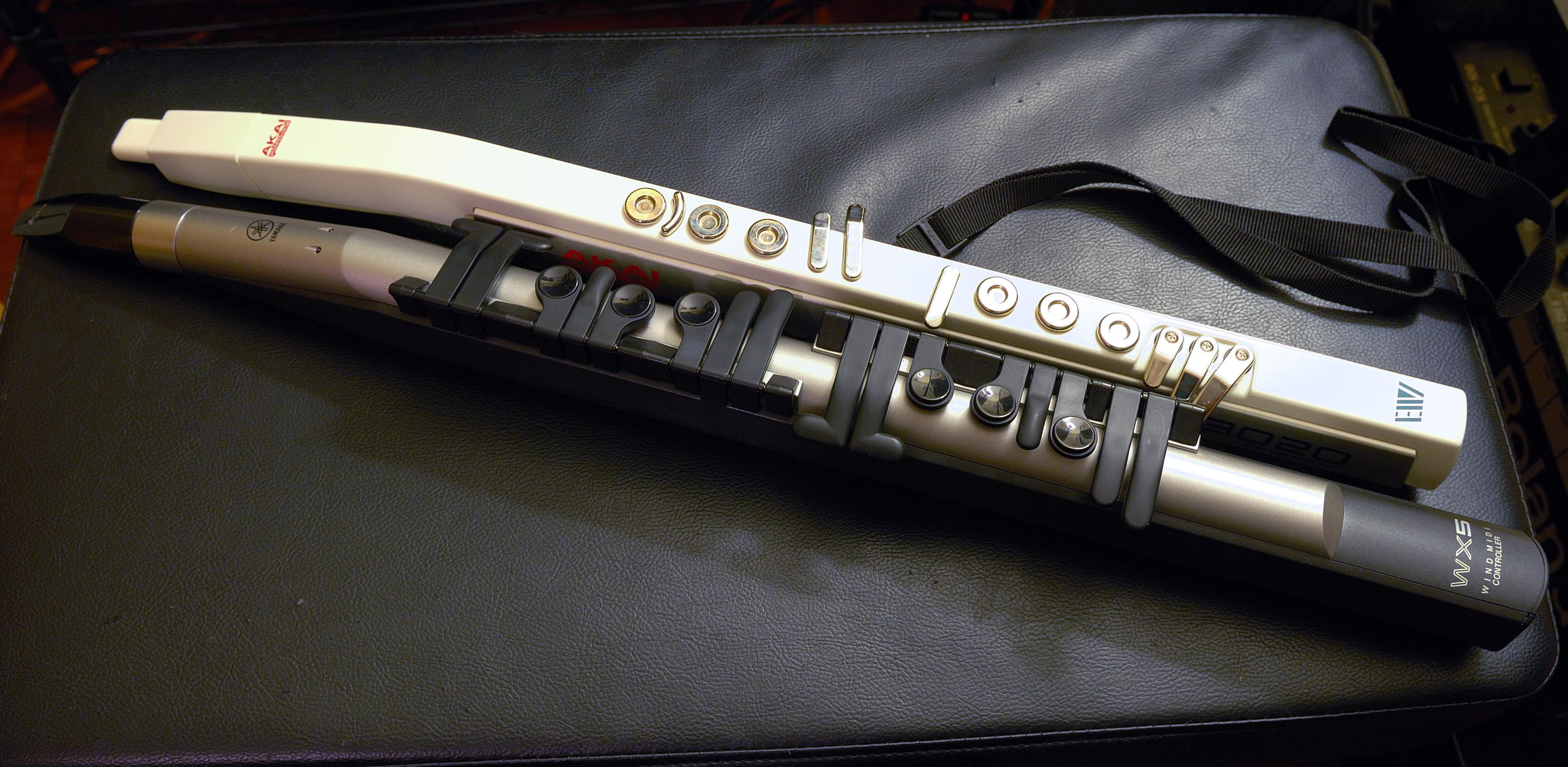
- Wind controllers are controllers which are played like wind instruments. They feature keys which can be configured to match fingering systems of instruments like flute, saxophone or clarinet or which mimic the valves of a trumpet, euphonium or tuba, and a breath controller which detects the intensity of the air being pushed through the instrument by the player.
- Drum set controllers are systems of various separate controllers configured to match a standard drum set, including pressure-sensitive pads for snare drums, toms, and cymbals, and pedal controllers for bass drum and hi-hat.
- Other types of MIDI controllers include keytars which provide a keyboard in a guitar-like configuration, mallet controllers which have a xylophone-like playing surface, string controllers which take the shape or guitars, violins or other string instruments, and other sensors which detect movement, light or sound.
MIDI interfaces allow computers to be connected to a MIDI system. Connected controllers can be used to provide input for music software such as scorewriters, digital audio workstations, and others. These programs can also be configured to control external synthesizers and other MIDI-compatible equipment such as lighting systems and pyrotechnics.
While late-20th century MIDI setups often relied on external equipment and complicated cabling, modern electronic musicians tend to only use software-based synthesizers. As a result, modern setups often include a MIDI keyboard controller with a built-in MIDI interface connected to a desktop or laptop computer with a single USB cable.
Electric and Electronic Instruments: Summary
- Electric Instruments produce sound by translating vibrations into electrical impulses to be sent to a speaker.
- The electromagnetic force causes a current to move through a wire when a magnetic field moves nearby.
- Similarly, a current is sent through a wire creates a magnetic field around the wire.
- Microphones use this concept to translate sound waves into electrical current, and speakers use it to translate electrical current into sound waves.
- Electric guitars use electromagnetic pickups beneath each string to convert the string's vibrations into electrical current.
- Hammond organs use tonewheels placed near pickups to generate an electromagnetic signal.
- Hammond organs are often used with Leslie speakers, which are speakers placed on rotating platforms to create vibrato.
- Electric instruments like the ondes Martenot and theremin use the interference of radio transmitters set to different frequencies.
- Electronic instruments generate sound computationally rather than through physical vibrations or interference.
- Synthesizers create sound with oscillators, which are electrical components that convert direct current into alternating current.
- Keyboard synthesizers are synthesizers with built-in keyboards.
- Console synthesizers are synthesizers which are usually mounted in a cabinet, and are controller by a separate keyboard or computer system.
- Software synthesizers are computer programs which emulate the sound and interface of physical synthesizers.
- MIDI, which stands for Musical Instrument Digital Interface, is a language used by electronic instruments and controllers to communicate.
- MIDI signals consist of instructions for playback, not recordings of the sound itself.
- MIDI controllers are devices which translate human performance into MIDI signals, and include keyboard controllers, wind controllers, drum set controllers, and others.
- MIDI interfaces allow MIDI devices to be connected to computers, allowing for software programs like scorewriters and digital audio workstations to read and control MIDI devices.