Film & Television Music
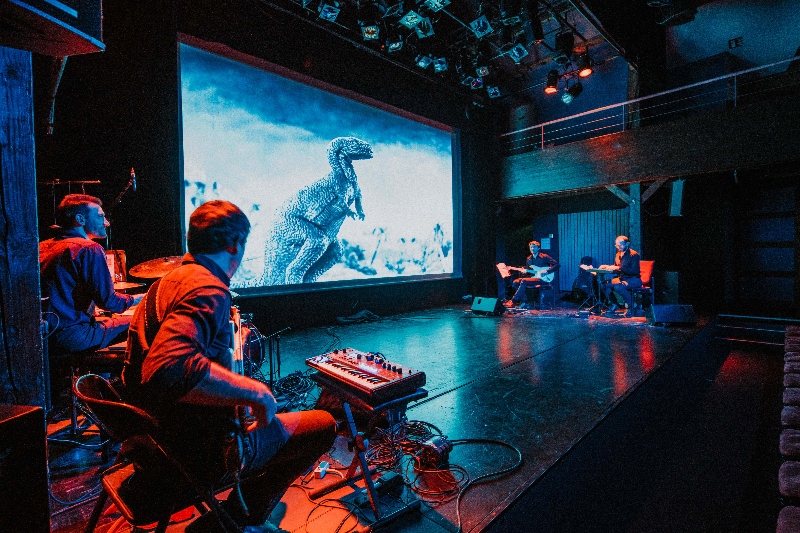

Musical soundtracks for film and television actually predate recorded dialogue; early films had no audio component at all, and were accompanied by a musician playing — sometimes improvising — an organ inside the theater as the film was presented.
Composing for Film & Television
To write music for movies, television shows or other video formats, composers use the same concepts of melody, rhythm, harmony and form involved in other forms of music to underscore and amplify the action happening on-screen.
Selecting Cues
Most video genres do not use music continuously throughout the production, but reserve it for specific scenes or portions of scenes. Thus, one of the first steps in the compositional process involves deciding which portions of the video should feature music. This can be done in close collaboration with or based on notes from the project's director, or might be done by the composer alone.
For this process, the composer is usually provided with a rough draft of the film or television episode referred to as the composer's copy. The composer's copy should be edited so the timings of the scenes are finalized, but may have elements like recorded dialogue, foley, or special visual effects in a rough, unfinalized form.
A contiguous segment of video accompanied by a musical score is called a cue. The beginning and end of a musical cue can align with specific events on screen, or can start and stop subtly amidst dialogue or other audio.
Musical Styles
Film, television and other video formats make use of a wide diversity of musical styles and performing forces. In the 2004 film The Incredibles, composer Michael Giacchino made use of a 1960s-era big band style, even recording the soundtrack using analog equipment. For the 2017 horror film Get Out, composer Michael Abels blues influences with Swahili voices to achieve an unsettling effect.
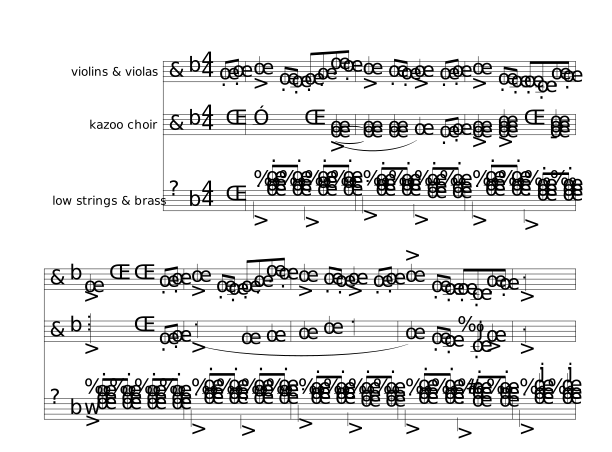
While music written for credits sequences are generally intended as standalone works, musical cues within the production are sometimes dependent on the on-screen action, and might sound disjointed or sporadic when heard independently. In some cases, music written for a scene might underscore dialogue or other audio, and go relatively unnoticed by the viewer.
Directors will sometimes use existing music during production to assist with setting the mood for particular scenes, and to portray to the composer what type of music they are looking for. This music is called a temp track and might include classical or popular pieces, or soundtracks from other films. The temp track is almost always removed and replaced with the original score by the composer. A famous exception to this is the 1968 film 2001: A Space Odyssey, for which composer Alex North wrote an original soundtrack; North's work was discarded by director Stanley Kubrick late in the editing process in favor of Kubrick's temp track, which included works by Richard Strauss, Johann Strauss, and György Ligeti.
Tracking
For a particular cue, a composer might take careful notes about not only the mood and dramatic direction of the scene, but about particular specific events that the music should accentuate. For example, a character in a scene might strike an adversary or react to an off-screen event, or two characters might kiss one another for the first time.
For events that take place at a certain moment in time, the composer can note the timecode of the event — a system of timekeeping that indicates the hours, minutes, seconds and frames since the beginning of the video. A black rectangle containing the time code is overlaid on the composers copy in the lower center of the frame.
Once the composer has recorded the timecodes of significant events, sometimes called hits, they will sometimes construct a framework of meters and tempo changes to match, a process called tracking. For example, a composer might discover that a 4/4 passage at a tempo of 96 beats per minute will result in only one hit landing on a strong beat, whereas changing to 95 beats per minute causes two hits to land on a strong beat. Tracking might involve sudden changes in tempo or even almost imperceptible accelerandos or decelerandos to increase the hit alignment. Because of the mathematics involved, the process of tracking can be simplified by the use of specialized computer software.
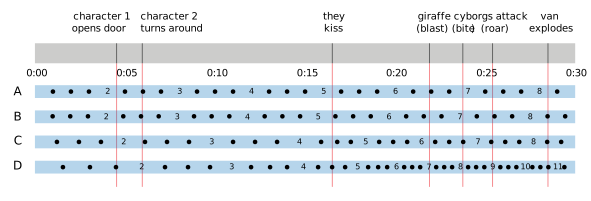
Once a tempo/meter map is constructed by way of tracking, the composer will write a piece which fits it. In addition to aligning rhythmically, other characteristics of the music, like intensity and orchestration, might be written to work around dramatic elements like dialogue or sound effects.
When a soundtrack is recorded by an orchestra or other ensemble, the ensemble's conductor (often the composer themself) will generally listen to a metronome beat through a set of headphones to assist in aligning the music with the tempo map and thus the events onscreen.

Film vs. Television
Budget differences for different projects affect the amount of music written and recorded for the soundtrack. Films, especially those produced by major studios, will often have a single composer who scores the entire film with original music, a process that may take months.
Television shows, on the other hand, may vary much more wildly in regards to the amount and quality of music. The Simpsons' opening theme was written by Danny Elfman, but musical cues for seasons 3 through 28 of the show were written on a week-to-week by Alf Clausen and recorded using a 35-piece orchestra. For the 1989 television series Seinfeld, composer Jonathan Wolff scored the show's minimal soundtrack using a synthesizer, improvising slight differences from week to week. The soundtrack of The Pink Panther cartoon shorts are comprised almost completely of cues written by Henry Mancini for the cartoon and the 1963 film of the same title.
Music and Diegesis
Film and television music can have different types of relationships with the fictional world portrayed on screen.
Diegetic Music
A diegesis is a fictional world portrayed in a story, and music that is taking place within that world — that is, music which can be heard by the characters in the story — is called diegetic music. For example, if the characters in the story are listening to music on the radio, or performing music on stage as part of the drama, that music is considered to be diegetic.
The quality of diegetic music performed live by the characters can help establish the level of realism or fantasy in a production. For example, the fictional band Sex Bob-Omb from the 2010 film Scott Pilgrim vs. the World is realistically portrayed on screen as an amateur indie garage band. In contrast, the 2009 television show Glee features regular professionally-produced musical numbers, ostensibly performed by high school students live with little or no rehearsal.
Non-Diegetic Music
Music heard only by the viewer and not the characters is considered non-diegetic music. This is the most common use of music in film and television, which uses music to underscore notable scenes as a means of portraying the story for the viewer in a compelling way. For example, composer Bill Conti's soundtrack accompanying Rocky Balboa's training regimen in the 1976 film Rocky is non-diegetic but is commonly used at sporting events and for other athletic situations to portray hard-won victories.
Quasi-Diegetic Music
A film or television production can in some cases blur the boundaries of diegesis as a narrative device.
Imagined Music
In some cases, music heard by the viewer might be diegetic to a single character within the story. In the 2007 Scrubs episode My Musical, a hospital patient suffers an aneurysm which causes her to perceive everyone around her to be singing and dancing; when the patient is no longer on screen, the episode's dialogue returns to normal. The 2020 series Zoe's Extraordinary Playlist used this as a regular narrative technique, with the character Zoey Clarke discovering that she has the ability to perceive other people's thoughts as elaborate musical numbers.
"Musical Reality"
Often, spontaneous musical numbers may be an accepted reality within a diegesis. This is especially common in children's television, including shows like Sesame Street and Animaniacs. Broadway musicals, as well as film adaptations thereof, fit squarely into this category, as do musical films such as 2017's The Greatest Showman. American producer Walt Disney capitalized on this format in his feature-length films like 1937's Snow White and the Seven Dwarfs, 1942's Bambi and 1950's Cinderella.
The notion of a musical reality is sometimes used for comedic effect. In the 2015 television series Galavant, characters regularly break the fourth wall by both acknowledging the fantastical nature of musical reality and even demonstrating their awareness of being in a television show. The 2007 film Enchanted, and the 2021 television series Schmigadoon! both feature characters who are bewildered by apparent musical realities taking place around them.
Film & Television Music: Summary
- To write music for film, music or other video, composers use special techniques to align the music with the events happening on-screen.
- The first step usually involves determining when musical cues — individual pieces of music which occur over the drama — should occur.
- The project's producer will usually provide a composer's copy: a copy of the production which has been edited for time but which does not include finalized audio or special effects.
- The composer might work from the director's notes, or in close collaboration, to determine the placement of musical cues.
- Directors will sometimes use temp tracks: preexisting recordings temporarily used to establish a particular mood or style for the composer to follow.
- Next, a composer will create a map of tempo and meter for the scene.
- The tempo/meter map might be designed to have specific events in the drama, called hits, occur on downbeats.
- Events in the video are notated with their timecode, a system which labels the hours, minutes, seconds and frames of every moment in the video.
- In order to align beats with hits, the tempo/meter map might need to incorporate several tempo changes, which can be sudden or gradual.
- During the recording process, conductors — and sometimes other performers — will listen to a click track, a recording of a metronome click which follows the cue's tempo/meter map.
- While the process of scoring a film can take months, many television composers work on a weekly schedule to track, compose and record the music for each episode.
- Some television shows have much fewer musical cues, and might use a library of prerecorded music rather than compose new music for each episode.
- Music in film, television and video can have different relationships with the fictional world portrayed on-screen.
- Diegetic music is music which is occurring within the reality of the story, and which can presumably be heard by the characters in the story.
- Non-diegetic music is music which is played as part of the presentation of the story, heard by the viewer but not by the characters in the story.
- Quasi-diegetic music is music which blurs the lines of the diegesis.
- Imagined Music is music heard by one or some of the characters, as in a story where a character interprets their environment through a musical lens.
- Musical Reality is a genre of film, television or video in which characters spontaneously sing and dance in synchronization and without rehearsal.