Video Game Music

Video games have incorporated music since the early days of the format as a means of establishing mood and providing feedback to players. With video game soundtracks sometimes rivaling the breadth and quality of film scores, ludomusicology — the study of video game music — has become an area of special interest to music theorists.
Early Video Game Music
Atari's Pong, released in 1972 as the first widely manufactured arcade video game, included simple sound effects but no musical soundtrack. The first video game to feature a continuous soundtrack was Taito's 1978 game Space Invaders, which featured a repeated four-note descending scale which increased in tempo as the gameplay progressed.
Most early arcade units included sound chips like General Instrument's AY-3-8910, which were limited to playing three sounds at once, each one limited to a few different timbres. Composers would create the illusion of greater polyphony by having a single voice alternate between two different pitches hundreds of times per second, and would combine the available options in innovative ways to increase the diversity of timbres in a particular game.
Home Consoles
Products like the Atari 2600 in 1977 and the Nintendo Entertainment System in 1983 brought video gaming into the home and used a system where the central processing unit, graphics, sound and input controls were housed in the console itself, and game programs were stored as ROM cartridges. Nintendo's console used the RP2A03 or RP2A07 sound processors manufactured by Ricoh, which provided 5 timbre-specific sound channels.
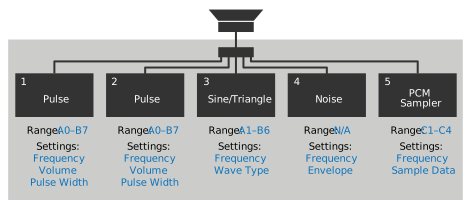
Because of the considerable hardware and software limitations imposed by early consoles, composition involved not only artistic capabilities but experience in electronic sound design and computer programming, since creating even a relatively simple score often the meticulous balance and interplay of a available sound channels and careful use of very limited storage space and processor resources.
Chiptune
The popularity of home game consoles, early personal computers like the Commodore 64, and portable systems like the Nintendo Gameboy created a culture which persevered even as gaming products became more advanced. A notable aspect of this culture is chiptune music, which features music arranged or written for primitive video game sound generators, performed either using software emulators or by connecting keyboards and sequencers to the chips themselves.

Some chiptune artists, like the group 8 Bit Weapon, use only the sounds generated by early sound processors in their music; others, like the band I Fight Dragons, combine video game sounds with traditional rock instruments like electric guitar, modern synthesizers, and drums.
Modern Video Game Music
Thanks to the use of larger-format media like DVDs and cloud storage, most modern video games — even those which use chiptune music for nostalgic effect, like independent developer and composer Toby Fox's 2015 game Undertale — store music as complete digital audio files rather than sending sequenced music to a sound chip. As a result, game designers can include much more elaborate soundtracks, often recorded using full orchestras or folk instruments and professionally produced.
While video games will occasionally use prewritten music — Firaxis Games' 2005 video game, Civilization IV, uses music appropriate to the current time period by composers such as Johannes Ockeghem and Antonín Dvořák — most video games feature music written originally for the game itself.
Music modern video games will often change depending on the game situation, and can provide feedback for the player in different ways.
Cut Scenes
Modern video games will often include intermediary segments of animation or live action as a means of advancing the overall plot of the game. These segments, called cutscenes, do not involve any player control, and will sometimes appear while upcoming levels are being loaded into short term memory.
Because these scenes have predetermined lengths, accompanying music can be scored using traditional film or television techniques.
Urgency
During game play, background music can help create a sense of urgency as a means of prompting the player toward certain action. A well-known example of this occurs throughout the many games in Nintendo's Mario Kart series: game play consists of three laps on a looped race course, and upon the reaching the final lap, a fanfare is played and the tempo of the background music is increased for the remainder of the race.
Progress
A game's soundtrack can provide feedback to the user regarding progress toward a certain goal. For example, in the 2015 Square Enix game Final Fantasy XV, the final battle to defeat Loqi Tummelt in the MA-X Cuirass armored suit features music composed by Japanese composer Yoko Shimomura which occurs in stages: a loop that plays during the primary battle, a loop that plays when the armor is nearly destroyed, and a segment which plays when Tummelt is defeated.
Location
Some modern video games are open world games, where the player is not restricted to a particular guided path but instead has the ability to wander the game's world freely. These games will often make use of soundtracks that are dependent on location. In Manaka Kataoka, Yasuaki Iwata and Hajime Wakai's soundtrack for the 2017 Nintendo game The Legend of Zelda: Breath of the Wild, towns in the game's world each have a unique soundtrack which begins when the player crosses a set boundary outside of the town, and which increases in volume as the player nears the townsite. Each town's soundtrack contains a day version and a night version, which segue seamlessly at dusk and at dawn. Once the player exit's the town's boundary, the soundtrack reverts to an aleatoric texture consisting of sporadic piano figures.
Rhythm Games
Rather than using music to create ambience or provide low-level feedback,

Structure
The unique challenge of writing for video game music is managing time flexibility, since the length of time a player spends in a particular environment will vary among players and among individual gaming sessions.
Playlists
Rather than having a soundtrack that is directly influenced by the player's actions, some games instead employ a playlist of discrete recorded tracks. The 2015 Psyonix game Rocket League, in which players drive cars in a soccer-like game, features a soundtrack of more than 40 EDM pieces recorded by artists like Slushii and Infected Mushroom.
Looping
The most common method employed by game composers is looping: the composition of passages which can repeat indefinitely without interruption. Short loops require less memory storage, but can become monotonous and even distracting for the player. Longer loops allow for increased interest and engagement, but require more memory storage.
One challenge with looping music in video games is handling transitions between pieces. Some games might transition to the new music immediately based on the player's actions, causing a break in the flow of the piece. This is often done with a short transition passage, written in a way which embraces the interruptive nature. In other games, the transition may be designed to segue smoothly from the end of the music loop, and the system need only wait until the current loop has completed before transitioning into the new piece.
Layering
An effective method of handling transitions is to construct a single looped soundtrack that is comprised of several channels or layers, with different combinations of channels present in a given environment. The 1998 Rare game Banjo-Kazooie incorporates this method, with 8 sequenced tracks written by British composer Grant Kirkhope to be combined based on the player's location and whether or not they are underwater or above ground.
Video Game Music: Summary
- Video games in the late 20th century often used sequenced music using a built-in sound processor.
- Early sound processors were limited by the types of sounds they could produce and the number of sounds they can play at once.
- Modern chiptune artists incorporate sound from early video game systems in their music, or arrange music using only the sounds available to early consoles.
- Modern video games incorporate prerecorded music as digital audio files.
- Music can be used in video games to provide ambience or player guidance and feedback.
- Cut scenes are intermediary segments where the player does not have control, and may be scored using traditional media music techniques.
- Music may provide an indication of urgency to the player; for example, an increase in tempo may indicate that the player is running out of time to complete a level.
- Music may indicate progress toward a particular target or signify the completion of a goal.
- Music may help establish a different atmosphere for various locations within the game world.
- Rhythm games are built around music, requiring the player to react or anticipate musical events such as downbeats or chord changes.
- Some games use a playlist of curated music to provide background music for gameplay.
- Game soundtracks often make use of looping, the composition of a piece of music which can repeat continuously without a perceivable break in melodic or rhythmic flow.
- Looped soundtracks can handle transitions between pieces by making an abrupt change or by waiting for the loop to complete before moving to a transitory passage.
- By designing a multitracked loop in which only particular tracks are used for a given location, a game soundtrack can follow a player's location without needing specially designed transitions.