Opera, Oratorio & Ballet

The combination of music, dance and theater dates back to prehistory: one of the oldest representations of musical performance is a cave painting in Ariège, France, depicting a person wearing an animal mask, perhaps engaged in dramatic presentation or ritual. Regardless of time period, purpose or intended audience, writing music for stage productions often involves specialized compositional techniques.
General Considerations
Dramatic musical productions are almost always intended as standalone performances, rather than programmed with other works on a concert or recital. As such, most operas, ballets and musicals are multiple hours long, often with two or more acts separated by intermissions. The plots of these works will usually capitalize on these breaks; for example, in a two-act musical, the first act will often end at a point of musical and dramatic tension.


In operas and musicals, the stage will contain the production's set and is where the cast portrays their roles; in ballets, the stage is used by the dancers in the production. As such, the orchestra is rarely located on the stage; instead, musicians perform in an orchestra pit, an area between the stage and the audience. The pit is generally lower than the audience, so performers do not block the view of the action on stage, and is separated from the audience by a short wall or pit rail to obscure the performers and provide audience safety.
Because of the size limitations imposed by many orchestra pits, orchestras for stage productions are usually smaller, sometimes with musicians doubling on multiple instruments. Modern musicals often incorporate synthesizers alongside acoustic instruments.
In general, instrumentalists are seated in the orchestra, and vocalists — soloists performing dramatic roles and chorus members performing as background extras — perform from the stage. A conductor seated in the orchestra pit directs all performers in the production.
Opera
Many cultures have long combined music, dance, and drama in cultural and spiritual rituals for millennia, such as the griots of West Africa who act as storytellers and historians for their communities. These performances range from improvisatory to strictly choreographed, but are not generally written down.
Many of the various forms of Chinese musical theater, including Peking opera (京剧), Yue opera (越劇) and Cantonese opera (粵劇), heavily incorporate vocal and instrumental music and is generally referred to as opera. These productions also include elaborate costumes and makeup, as well as dancing and acrobatics.
Many musicologists trace the beginnings of modern opera to the late sixteenth century, when a group artists who referred to themselves as the Camerata de' Bardi worked to revive the dramatic style of Ancient Greece, efforts which resulted in many of the standard elements of the operas of the 16th to 19th centuries.
While composers will sometimes create both the music and the story, more often they will set a pre-written story — a libretto to music, or collaborate with a librettist during the compositional process.
Elements of Opera
European operas from the 16th to 19th centuries were often number operas, operas comprised of many smaller pieces which could be sung as individual works. In many cases, one piece would lead directly into another without a break, referred to as a segue. Other pieces would be separated by a short break to allow for cast members to leave the stage, for sets to be changed, or for performers to accept applause from the audience.
Aria
Operas generally center around arias, accompanied vocal solos which showcase a particular cast member. Arias tend to showcase a vocalist's performance skill, and in fact many arias were written with specific performers in mind. For example, a famous aria from Wolfgang Amadeus Mozart's opera The Magic Flute — in which the Queen of the Night angrily orders her daughter to assassinate her rival — was written for the composer's sister-in-law Josepha Hofer, who had the vocal range to reach the F6 indicated in the score.

While there are notable exceptions, arias tend to pause the dramatic action of the plot, and feature the soloist expounding on their current situation or emotional state. A common form for arias is da capo, a variation of the basic ABA form with a B section that contrasts the repeated A section in tone and topic.
Duet, Trio, and Quartet
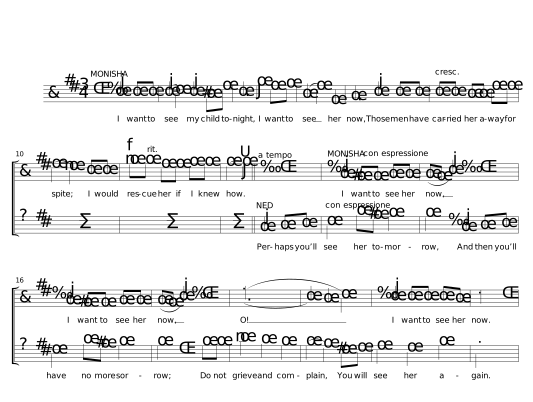
While arias are solo vocal performances, pieces featuring more than one cast member are referred to as duets, trios, quartets, and so on. These pieces tend to occur in the drama as conversations, commiserations, arguments or sometimes simultaneous asides. Because of their nature, these pieces will sometimes incorporate more plot movement than arias.
A common musical technique in these multi-character pieces is to have each person sing a portion of the piece as a solo, and combine the voices at points of higher intensity or resolution.
Chorus
A scene involving a crowd of people will often be scored as a chorus, where a choir will appear on stage but take the form of townspeople, party guests, or something similar. The choir members will be costumed appropriately and will often do some small amount of acting, such as pantomiming background conversations, when not singing. Chorus pieces may involve only the choir, or may use the choir to accompany soloists portraying lead roles in the drama.
An on-stage choir can sometimes serve as a narrator, acting as a part of the drama but also breaking the fourth wall and providing narration or commentary directly to the audience. In this case, the choir is referred to as a Greek chorus, reflecting a similar role regularly provided by small choirs in Ancient Greek stage productions.
Recitative
While operas are primarily comprised of arias, small group pieces and choruses, the advancement of the plot generally occurs between these pieces through asides, conversations and other interactions between the characters in the drama. In some operas, these portions of the drama are acted out with spoken dialog. In most operas of the Classical and Romantic eras, however, this dialog is performed in a half-sung style, where the natural rhythm of speech is maintained but the words are sung on specific pitches. This style is called recitative.
Recitative is almost always accompanied, but because the rhythm is fluid and dependent on the soloist, the accompaniment consists of sporadic chords that fall on particular syllables, or short figures that are played between spoken phrases.
Most recitatives are accompanied by a single keyboard instrument or a basso continuo, a style referred to as recitativo secco ("dry recitative"). Less commonly, recitatives are accompanied by the full orchestra. This type of recitative, called recitativo accompagnato, allows for less flexibility and improvisation.
Instrumental Works
Though operas are centered around vocal performances, they will occasionally feature instrumental works. Nearly all operas begin with an instrumental overture, generally performed with a closed curtain or an empty stage. This piece will often foreshadow many of the musical themes in the opera.
Operas are usually divided into multiple acts, programmed with intermissions between them to provide breaks for the audience and performers. Subsequent acts will each sometimes begin with a short instrumental work, referred to as an entr'acte or intermezzo. Like overtures, these works may foreshadow upcoming themes, or may reprise music heard just before the intermission as a way to aid in continuity.
Certain opera scenes may feature a dance on stage, either portraying an actual dance in the story, or interpreting particular dramatic events via dance. When a scene such as this features only instrumental music, it is called a ballet. In some cases, an opera might feature an instrumental piece during the performance (as opposed to before the curtain rises or between acts) that does not feature dancing; this type of piece is sometimes called a sinfonia.
Musical Techniques
Topic
Operas of the 18th century often drew upon stylistic norms with which audiences were familiar as a means of accentuating the drama. Some of these, called topics or topoi, originated from the earliest operas in the 16th century. For example, Claudio Monteverdi's opera Orfeo, Christoph Willibald Gluck's Orfeo ed Euridice and Wolfgang Amadeus Mozart's Don Giovanni all feature scenes in which a character enters Hell; these scenes are all scored with similar instrumentation and rhythmic intensity, drawing upon the audience's preconceived associations. Other scenes, such as those involving hunting or storms, might draw upon a shared vocabulary of other musical techniques.
Leitmotif
Operas also sometimes make use of specific thematic elements — melodies, chord progressions or rhythms — which are clearly tied to something in the plot, like characters, places, objects or concepts. An element used in this way is called a leitmotif, and will often be incorporated into the music when the corresponding idea is seen or referenced — for example, during a scene that takes place in a specific location, when a specific object is revealed by the characters, or even when an off-stage character is referenced in the music or dialogue.
Types of Opera
Traditional operas are usually staged with cast of several vocal soloists, small chorus and medium-sized orchestra, with performances lasting more than two hours. Operas in the 17th, 18th and 19th centuries tended to follow formal and stylistic traditions based on national or cultural origin, while operas in the 20th century tend to explore more modern and avant garde styles.
Other opera sub-genres pertain to characteristics like subject matter and length:
- Dramatic operas feature serious, realistic or dark themes. Italian dramatic operas of the 18th and 19th century are referred to as opera seria, the corresponding French style is tragédie en musique.
- Comedic operas contrast dramatic genres with light-hearted or humorous themes, drawing from earlier genres of comedic and improvisatory theatre. The Italian form of comedic opera is opera buffa, the French genre is called opéra comique, and the corresponding German form is singspiel.
- Operettas are operas which tend to be shorter and involve smaller numbers of performers. These productions often have lighter, humorous and sometimes satirical themes; in some cases, these works featured risqué language and themes. Operettas came to prominence in the 19th century, and included the very popular works of W.S. Gilbert and Arthur Sullivan, comedic productions known for their patter songs: rhythmically intense arias featuring extremely fast lyrical delivery.


Oratorio
An oratorio is a concert piece for vocal soloists, chorus, and orchestra. Like operas, oratorios feature soloists performing roles of characters in a drama, but they do not incorporate sets, costumes, acting or stage choreography. Instead, the productions are presented in a standard choral and orchestra performance format, with soloists coming to the front of the stage for their featured performances.
Oratorios have long been a popular form for religious music, where excessive stage production is often considered inappropriate. George Frideric Handel was well-known for his English-language oratorios written on Biblical themes, such as Esther, Israel in Egypt, and Messiah.
More recent composers have used the format for religious works, like Dinesh Subasinghe's Karuna Nadee, but also use the form to tell mythical stories (like Hans Werner Henze's Das Floß der Medusa) or even historical events (like Alfred Schnittke's Nagasaki).
Ballet
A ballet is a dance production set to music. While these performances may involve theatrical elements like costumes, sets, and the portrayal of specific roles, they feature neither singing nor dialogue; the story is portrayed using only music and dance.
As a standalone compositional form, ballet is a relatively recent invention. Operas in the 17th and 18th centuries often contained ballet scenes, which were instrumental and featured the cast dancing on stage. Dance productions were also common, with dances choreographed to music compiled from other sources, or written by members of the dance troupe. It was not until the ballets of Russian composer Pyotr Tchaikovsky — Swan Lake, The Sleeping Beauty, and The Nutcracker — that the full-length ballet emerged as a genre.
Ballets of the 19th century were generally choreographed with classical ballet techniques, such as dancing en pointe. Later ballets, such as those of fellow Russian composer Igor Stravinsky, used more avant-garde dance styles. These works are often commissioned by ballet companies, and involve the composer working closely with choreographers through the composition process. A single ballet composition might be choreographed differently by different dance troupes for subsequent productions; specific choreographies for popular ballets — for example, George Balanchine's 1954 choreography of The Nutcracker, which has been performed annually by the New York City Ballet every year since its premiere — sometimes survive as lasting works of art in their own right.
Like operas, ballets generally consist of many smaller works, which serve as scenes. While not as formalized as their operatic counterparts, individual dances within a ballet might be written for dancers performing alone, as partners, or in large groups.


Opera, Oratorio & Ballet: Summary
- Musical stage productions are generally written as standalone works.
- Productions are often multiple hours in length, comprised of smaller individual pieces.
- These works will often be organized into acts separated by intermissions. Acts are sometimes further divided into scenes.
- In these genres, the stage is usually used by cast members or dancers to enact the drama. Musicians are typically located in a lowered area between the stage and audience called the orchestra pit.
- Opera is a form of musical stage drama.
- Modern opera is considered to have begun in Italy in the 16th century, when a group of composers sought to revive the dramatic performance style of Ancient Greece.
- An opera's plot is known as the libretto, and is often written by someone other than the composer.
- Elements of opera include:
- Arias, solo pieces which typically do not advance the plot and sometimes written in an ABA form known as da capo;
- Duets, Trios, Quartets, etc., works like arias but which are written for multiple characters;
- Choruses, choral pieces performed by large groups of cast members on stage;
- Recitatives, an improvisatory musical dialog which is accompanied either by a single instrument or part (recitativo secco) or by the full orchestra (recitative accompagnato);
- Overtures, an instrumental piece played at the beginning of the opera, which may foreshadow upcoming musical themes;
- Entr'actes, instrumental pieces played after intermissions; and
- Ballets, instrumental pieces played during the drama to accompany a dance on stage.
- Operas might make use of topics — musical stylistic norms understood by audiences to represent particular situations or concepts — and leitmotifs, which are repeated musical themes associated with particular elements in the story.
- Operas are often categorized by subject matter, especially differentiating between dramatic opera and comedic opera. Operetta is a shortened form of opera, usually light and comedic in nature.
- Oratorio is a musical drama presented as a standard concert performance.
- Oratorios can include plots and characters, but do not make use of scenery, costumes or staging.
- Traditional oratorios tend to be religious in nature, but contemporary composers have also used the form to present mythical or historical studies.
- Ballet is a dramatic stage presentation performed through dance and without dialogue.
- Early ballet productions were generally performed using classical ballet techniques. Modern ballets make use of more contemporary dance styles.