Large Forms

All but the shortest compositions have some aspect of form: how different sections of music relate to one another. Composers often use familiar forms to align with — or subvert — listener expectations.
Forms
When music theorists discuss the form of a piece of music, they are generally referring to the largest sections of an individual piece of music and how they interact. In this way, smaller structures like phrases, sentences, or periods are considered microforms.
Formal Analysis
The form of a composition is often expressed simply by comparing large sections with one another. When comparing a section of music to a previous one, we classify it in one of three ways:
- If the section is identical or nearly identical to the previous section, it is considered to be a parallel section.
- If an otherwise parallel section has a difference that warrants recognition, it is considered related or similar to the previous section.
- If the section is neither parallel nor similar, we refer to is as a contrasting section.
Note that these relationships pertain primarily to melody, harmony and rhythm; two parallel sections might differ in other characteristics, such as lyrics or orchestration.
Notating form is generally done with capital letters, where a single letter represents a section. In most cases, the first section is indicated with an A. The second section is then given a letter based on its relationship with the first section:
| Relationship with Previous Section | Symbol |
|---|---|
| Parallel | A |
| Related | A' |
| Contrasting | B |
The symbol A' is pronounced “A prime.” For multiple different related sections, additional primes are added, such as A'' (“A double prime”) or A''' (“A triple prime”).
Subsequent sections will use the same system using consecutive letters: B, B' or C. If a later section is parallel or similar to a section earlier in the piece, the section should reuse prior letters as appropriate. So a piece which has two parallel sections separated by a contrasting section would have the form ABA.
Unary Forms
A piece which has a single, repeated section, is considered to have a unary form. There are two common subcategories of unary form.
Strophic form: ||:A:||
A composition written in strophic form have a single section of music which is repeated for the length of the piece. In vocal pieces, the lyrics generally change from section to section. Examples of strophic forms include:
- Hymns. While often associated with Protestant Christianity, strophic hymns were part of early worship in Hindu and Jewish cultures, and date as far back as ancient Egyptian and Greek cultures.
- Folk songs. Strophic folk songs are found across many cultures, with additional verses often added by singers as songs passed by rote from person to person and generation to generation.
- Blues. Blues songs are traditionally set over a consistent twelve-measure chord progression — the twelve-bar blues — which is repeated throughout the song, through vocal stanzas and instrumental solos.
- Jazz. One of the most common forms of a jazz piece begins with a head, a section of music with specifically written parts for the instruments in the ensemble. The rhythm section will then repeat the chord progression of the head — the changes — as instrumentalists take turns improvising solos. At the signal of the ensemble's leader, the head section will then be repeated in its original form, concluding the piece.
Theme and Variations: A, A', A''', etc.
A theme and variations is similar to a strophic form, but each succeeding repeat is changed in some way from the original by ornamenting, altering or fundamentally changing elements such as melody, meter, rhythm, or harmony. In some cases, variations eventually differ to the point where they bear little resemblance to the original. Examples of theme and variations include
- Classical Theme and Variations. Wolfgang Amadeus Mozart's Twelve Variations on “Ah vous dirai-je, Maman” is a well-known example of this form, which was common in Classical and Romantic eras.
- Pibroch is a Scottish form of music played on bagpipes that consists of a theme followed by a sequence of variations which often follow a specific, prescribed pattern.
Binary Forms
A piece with two contrasting sections is considered to be in binary form.
Basic Binary Form: AB
The simplest example of binary form is a piece with two contrasting sections. In most cases, the AB block is repeated several times, with varied lyrics and/or melodic variation. Many Latin American and Caribbean dance forms have this structure, such as rancheras, corridos, guajiras, tambús and rumbas. The form lends itself to an alteration between verse and chorus which is found in many simple songs throughout the world.
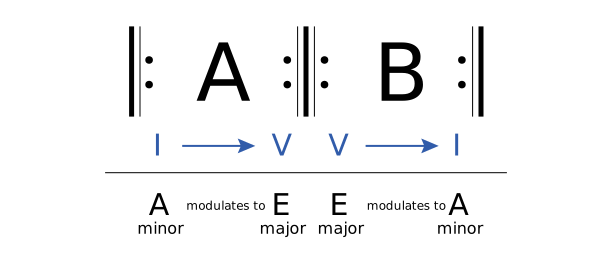
Baroque Dance Form: ||:A:||:B:||
A common form in the Baroque era is the dance suite, which is a set of several short pieces in different dance styles, like allemande, courante, bourée, and gigue. These pieces all share a specific type of binary form where both sections are repeated once. This form adds some specific key relationships: the A section starts in the global key of the piece, but modulates and ends in the key of the dominant, and the B section starts in the key of the dominant and modulates back to the original key.
Ternary Forms
Repetition is a fundamental concept in music; as listeners, it is often satisfying to hear a passage we recognize from earlier in a piece. One way to amplify this feeling of satisfaction is to have a section of contrasting musical material and follow it with a return to a familiar theme the listener has already heard.
Da Capo Aria: ABA'
One of the centerpieces of Baroque, Classical, and Romantic opera is the aria, a piece in which the plot of the drama pauses, and the depth of a particular character's position, emotion, or thought process is explored musically. Through the mid-1700s, arias were often written in two contrasting sections, with instructions to the performers to repeat the first section after finishing the second. Because this repeat was not written out but indicated with the abbreviation “D.C.” for da capo (Italian for “to the head”), this particular form is referred to as da capo aria.
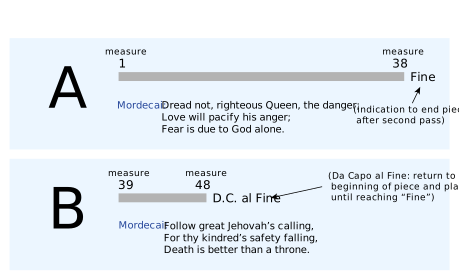
While it is often not indicated in the score, the standard performance practice is to ignore any repeat bars in the A section when playing it a second time. As such, the second A in this form us usually shortened, and given the indication A'.
Minuet and Trio: ABA'
An instrumental counterpart to the Da Capo Aria is the Minuet and Trio, a form common in the Classical era, often as a middle movement in a multi-movement piece. In this form, the A section is the minuet, a piece in triple meter based around a social dance from the 17th century. The B section, the trio, is often written in a contrasting key to the minuet. Like the da capo aria, pieces in this form generally do not have the repeats written out, using a "da capo" indication to direct the performer to repeat the A section, ignoring any internal repeats.
Rounded Binary Form: ||:A:||:BA':||
Occasionally, Baroque and early Classical composers would use a variation on Baroque Dance form in which the B section is shortened and the A returns in a shortened form within the second repeated section. This form is called rounded binary form.

32-bar Form: AABA
A form used very commonly in early American popular music is 32-bar form, sometimes also referred to as American popular song form or ballad form. This form expands the standard ABA form by repeating the first A. As the name suggests, each section generally consists of eight measures.
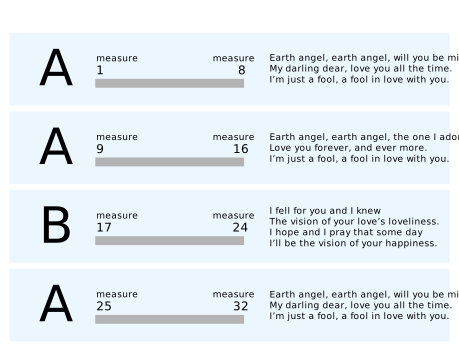
Other popular examples of 32-bar form include jazz standards like Billy Strayhorn's Take the 'A' Train as well as popular songs like Will You Love Me Tomorrow by The Shirelles and Green Day's Wake Me Up When September Ends.
Sonata Form: EDR
In the late Baroque era, composers often used a very specific variation of ternary form, especially in the first movements of works like symphonies or sonatas. This form, called Sonata Form or Sonata Allegro Form, is actually drawn from rounded binary form, but prescribes certain finer details, and assigns specific names to the major sections of the form.
| Section | Name | Contents |
|---|---|---|
| A | Exposition | Introduces Primary and Secondary Themes |
| B | Development | Combination and development of main themes |
| A' | Recapitulation | Restates Primary and Secondary Themes |
Most pieces written in sonata form center around two main musical themes, referred to as the primary theme and the secondary theme. These two themes generally differ in character; if one is fast and lively, the other might be darker or more lyrical. When they are first introduced in the Exposition, the primary theme is played in the global key of the piece, and the secondary theme is played in a contrasting key: the key of the dominant in major global keys, or the relative major in minor global keys. In the recapitulation, the two themes are both played in the global key of the piece.
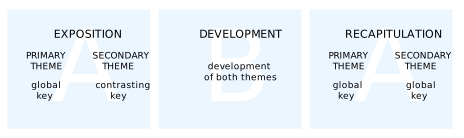
Sonata form became one of the most commonly used forms in the Classical and early Romantic Eras, where it was modified by composers to play upon listener's familiarity with the form. Some techniques were used often enough to be considered optional elements of the form itself:
- Repeats of the exposition and of the combined development and recapitulation, as with rounded binary form
- An introduction, played before the introduction of the primary theme
- A transition, used in the exposition to modulate into the contrasting key, but also sometimes included in the recapitulation, where no modulation is necessary
- A codetta, a closing section within the exposition and recapitulation which is not considered part of the secondary theme
- A coda, a closing section which occurs after the conclusion of the recapitulation.

Through-Composed Forms
Some pieces have sections that contrast one another, but which are not reprised later in the piece. Pieces of this form are called through-composed. Through-composed pieces can have clearly delineated sections — like Regimental March Form, which uses an IAABBCCDD form in which sections repeat only once without reprisal — or can have little or no discernable structure, like fantasias, toccatas, and improvisations.

Complex Forms
Popular Song Form: VCVCBVC
As rock music became popular in the 1950s, artists began expanding the repeated A sections of 32-bar form into two parts: a verse and a chorus. Lyrics of each verse in this form are usually different, often serving to advance the narrative of the song's story, while each chorus generally uses the same lyrics, presenting the primary theme or idea of the song.
In popular song form, the B section is referred to as the bridge, and might be a contrasting lyrical section, an instrumental section, or a combination of both. Songwriters will also commonly divide the verse further into a verse and a prechorus.

Refrain Forms
Refrain forms take the lyrical aspects of popular song form — varying verses interspersed with repeating choruses — and applies them musically: individually unique sections of music are each followed by a repeated section called the refrain.
A common refrain form in the Classical era is the rondo, which has the form ABACADA... with the number of contrasting sections varying from piece to piece.
A less common refrain form from the same period is sonata rondo, in which sonata form is altered to include a final repetition of the A theme in both the exposition and the recapitulation, creating the form ABACABA.
The danzón is a cuban dance form which features two main sections: the parte de la flauta and parte del violin, which traditionally feature the flute and violin, respectively. These sections are each preceded by a shorter section called the paseo, resulting in the refrain form ABAC. In some pieces, the paseo is played again at the end, creating an ABACA form, and a variety of the form called the danzón-mambo adds an improvisatory section at the end, yielding an ABACD or ABACAD form.
Cumulative Form
Cumulative pieces are generally strophic in nature, but include lengthening phrases with each repetition.
One of the most well-known examples of a cumulative piece is the traditional English song The Twelve Days of Christmas, in which each verse includes a cumulative list of all the gifts from the previous verses.
Large Forms: Summary
- Music can be analyzed for form by identifying large sections and how they relate to one another.
- Each section of a piece is labeled with a letter, like A.
- Repetitions or near-repetitions of a particular section are considered to be parallel, and are labeled with the same letter.
- Sections which are similar to a section are considered related, and are given the letter with a prime symbol, like A'.
- Sections which are different are considered contrasting and are given a new letter, like B.
- Unary forms are built around a single musical section.
- Strophic forms have a single section which is repeated, often with different lyrics.
- Theme and Variations feature repeated alterations of a single section.
- Binary forms include two sections which contrast one another.
- In baroque dance form both sections are repeated once, and feature modulations from tonic to dominant and from dominant to tonic, respectively.
- Ternary forms include two contrasting sections, with the first section repeated again at the end.
- Da capo aria and minuet and trio are common ternary forms in vocal and instrumental music, respectively.
- Rounded binary form is a variation on baroque dance form in which the second section is comprised of new material followed by a short reprise of the first section.
- 32-bar form is a ternary form in which the first section is repeated once before moving to the second section.
- Sonata form is an elaboration of ternary form which features the following:
- The first section, called the exposition, includes two themes: an A theme in the global key of the piece and a B theme in a contrasting key.
- The second section, called the development, may use elements of the two main themes, new musical passages, or a mixture of both.
- The final section, called the recapitulation, includes the two main themes, both presented in the global key.
- Through-composed forms have sections that contrast each other but which are not reprised later in the piece.
- Popular song form is built from 32-bar form, but divides the repeated sections into separate verses and choruses.
- Refrain forms feature contrasting sections alternating with a single, repeated section called a refrain.
- Cumulative pieces contain verses which grow in length with each repetition.