MASS SUBJECTS PERFORMERS (2000)
Aaron Allen
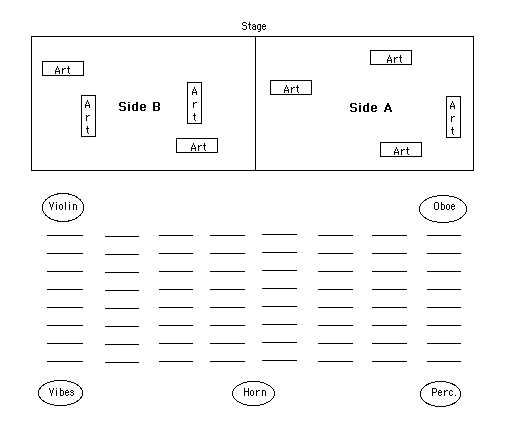
Object: To have the performers watch the audience, instead of the audience watching the performers.
Rules for MASS SUBJECTS PERFORMERS:
- The entire audience will be asked to come on stage to explore some artwork from up close and from many different angles. They will be told that the musicians will be providing background music. The audience should NOT be informed that they are going to be involved with the creation of the music.
- Each performer is to use the actions of the audience to create music. The performers may choose to describe the audience as a whole, or they can pick a smaller group of people (3 or more) on stage to describe. The people do not have to be in close proximity to be a group. The performers may change from one group to another as they like.
- Each performer will improvise on their instrument, based on the following instructions.
- Concert pitches A, C#, F#, and G# will be used when the majority of the observed group is on the "A" side of the stage. Concert pitches G, B, C, and F will be used when the majority of the observed group is on the "B" side. Non-pitched percussion players, likewise, will assign approximately half of their instruments for the "A" side, and assign the other half to the "B" side.
- The rhythm will be decided by the groups' enthusiasm. If the general activity is fairly stagnant, use long notes to describe the group. If the group is active and moving around the artwork, use short notes to describe them. The performer should stop playing if their group is motionless. Provide appropriate articulations to help describe the group.
- The volume of the instrument will be based on how a group is interacting with the artwork. If the people in the group are observing it carefully, play loudly. If they are ignoring it, play softly.
- When the majority of the group shifts from the "A" side to the "B" side, play a loud, but brief, trill using pitches from the "B" pitches, and vice versa. If the performer chooses a new group on a new side of the stage, play a loud, but brief, trill, using the "new side" pitches, and then continue as before.
- Playing begins when the third audience member steps on the stage, and ends when the third to last audience member steps off the stage.
- Each performer should NOT be concerned with what the other performers are playing. They should use their own perceptions to decide how to play, and not let the others influence them.
Copyright � 2008-2009 by Phillip Magnuson.
Content on this website is licensed under a Creative Commons License.