SOUND PATTERNS
A Structural Examination of Tonality, Vocabulary, Texture,
Sonorities, and Time Organization in Western Art Music
by PHILLIP MAGNUSON
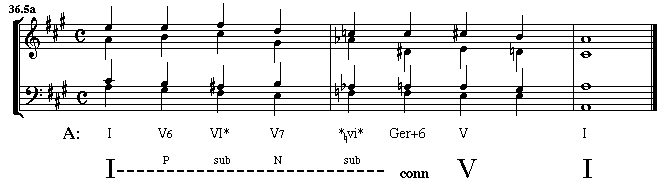
CHROMATIC PROCEDURES III
Chapter 36. Chromatic mediance
36.1 EXPANSION OF TONIC
The previous unit expanded connective areas: the borrowed chords on supertonic and subdominant, the Neapolitan 6, and the augmented 6th chords are all used primarily as connections. The previous chapter expanded dominance. This chapter expands tonic with closely related areas.
36.2 CHROMATIC MEDIANCE
Harmonic areas that are a 3rd away from tonic (mediant and submediant) generally serve as substitutions for tonic. CHROMATIC MEDIANCE (a general designation that refers to both the mediant and submediant triads) is a simple process of merely changing the quality of these two chords.
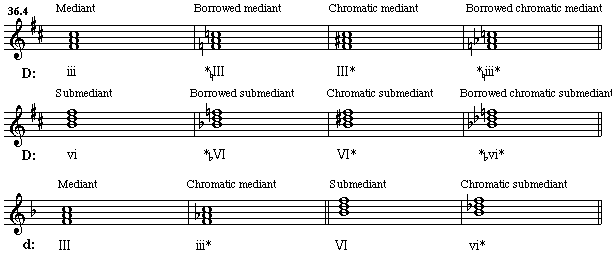
In major keys, the quality of both the mediant and submediant is minor; by raising the chordal third of each, the quality is now major. These harmonies are represented by changing the case of the Roman numeral and by adding as asterisk (*) to the right of the numeral (representing the process of chromatic mediance).

It is easy to confuse the representation of borrowed mediance and chromatic mediance. Placing the asterisk on the correct side is important, as is the accidental that represents the change of root.

In minor keys, the usual quality of both the mediant and submediant is major; by lowering the chordal third of each, the quality is now minor

There is no confusion of borrowed mediance and chromatic mediance in minor keys since the borrowing process does not apply. However, it should be noted that both the mediant and submediant triads in minor keys already have two possible qualities, depending on which versions of ^6 and ^7 are being used.

36.3 BORROWED CHROMATIC MEDIANCE
Another layer of complexity is added to chromatic mediance as parallel major and minor keys are mixed. It is possible to use a chromatic mediance in a major key that originates in the parallel minor key. Since this process uses steps from both borrowing and altering the quality, two asterisks need to be used. The asterisk to the left represents the borrowing process, the asterisk to the right represents the change of quality through the chromatic mediance process.

36.4 QUALITIES OF CHROMATIC MEDIANCE
Each of the many forms of mediants and submediants is always a major or minor triad. There are no tetrads that fit into this category, nor are there any diminished or augmented triads.
Therefore, there are four forms of mediant and four forms of submediant in every major key, and two forms of each for minor keys. It is extremely important to get the labelling symbols correct to avoid confusion among all these chords.
36.5 FUNCTIONS AND VOICE LEADING
As stated above, chromatic mediance is a technique to prolong tonic, and frequently is in close proximity to some
form of tonic as part of a tonic prolongation. It is generally found in a context in which adjacent harmonies use
similar altered scale degrees, as seen in the example below.
Chromatic mediances are unusual compared to other chromatic chords since they are more of a vertical harmonic
choice than a horizontal contrapuntal choice (one of the tell-tale omens signaling the inevitable demise of the
Common Practice Period). Scale degrees in chromatic mediance are about 50% raised and 50% lowered, but the
direction of resolution is not as consistent as with other chromatic chords. Notice in the example above that
although the A# in measure 1 resolves properly, neither the A-flat nor C-natural in the next measure do.
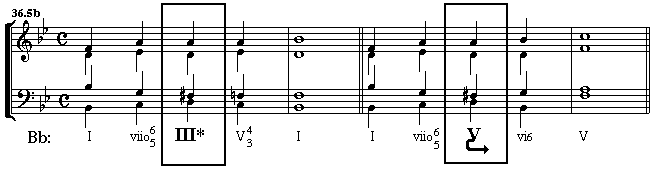
It can be easy to confuse some chromatic mediances with tonicizations; they might share exactly the same pitches, but are used quite differently. The only way to distinguish them is by a close examination of the context. Notice (in the example below) that the two chords in the boxes are identical, and have been preceded by the same harmony, but that the following chord completely changes the meaning.
One last important statement about chromatic mediance: these harmonic oddities are rather rare. It can be difficult to find them, and when they do appear, they tend to pass by quickly.
36.6 CHROMATIC HARMONIC ANALYSIS
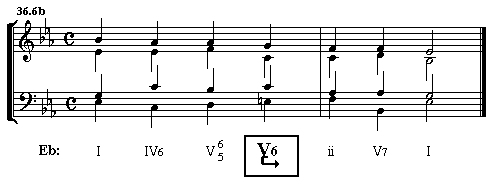
As in previous chapters, analyze the example in the box below:
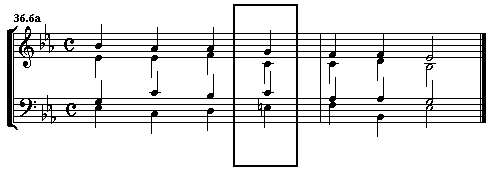
- The sonority is C - E - G
- The quality is major
- The scale degrees are La - Di - Mi
- The quality and scale degrees indicate a chromatic mediant or a tonicization
- The chord comes from a dominant and moves to supertonic with a leading tone motion
- It is a tonicization of the supertonic, in first inversion
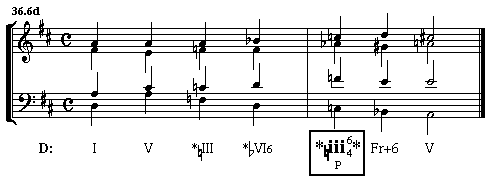
Do the same thing again with the following example:

- The sonority is F - Ab - C
- The quality is minor
- The scale degrees are Me - Se - Te
- These scale degrees imply borrowed harmony, but should be major
- The chord comes from borrowed scale degrees and moves to a connective area
- It is a borrowed chromatic mediant, in second inversion (passing)
CURRENT CHROMATIC VOCABULARY:

ASSIGNMENT:
ANALYSIS
Provide a Roman numeral and Schenkerian analysis for the following pieces in Music for Analysis:
- Schubert: Mass in G Major, Benedictus [#303] Listen to a performance
- Schubert: Die Allmacht, op.79, no.2 [#304] Listen to a performance
- Beethoven: God Save the King, variation VII and following Adagio [#359. p. 299] Listen to a performance (This performance is the entire set of variations, but it is well worth the time listening to a remarkable young lady.)
SYNTHESIS (Semester final project)
Compose two parallel 8-measure phrases in 4/4 time for piano, using the following graph:
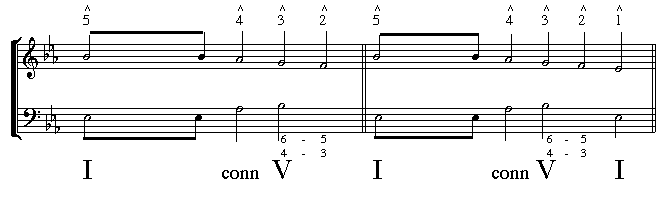
The two phrases should use similar/almost exact melodic material, and should maintain a consistent harmonic rhythm of two
changes per measure (half-notes). The half cadence should occur on beat one of measure 8, and the authentic cadence should
have the final tonic occur on beat one of the last measure. A good example of this is Mozart: Rondo, K.485
[Music for Analysis #71, CD track #9].
Steps:
Write a good melody that conforms to the soprano structure above. Create
a simple motive (see Chapter 17 about this
process) to provide unity as you transform the entire structure into an interesting and beautiful melody. Repeat
this melody for the second phrase, but adapting it for the new cadence. You may make minor alterations in the repetition.
Some tips for writing a good melody in the style of the Common Practice Period:
- Good melodies should primarily be stepwise (conjunct motion), with an individual and independent contour.
- Agogic stresses (longer notes, about one beat or more) should generally line up with metric stresses (strong beats).
- Longer notes (about one beat or more) should generally be considered chord tones.
- Fewer notes are generally better than lots of notes; remember, every note must be justified as either a chord tone or
a non-chord tone. Keep it simple.
- A variety of rhythms should be used.
Write a good (but simple) bass line with two half notes per measure which conform to the bass structure, and works
contrapuntally with the melody. See Chapter 24
to review this procedure. This bass line will be entirely chord tones; the soprano will be a combination of chord
tones and non-chord tones.
- Analyze the implied harmony between the bass and soprano; make sure it creates a logical structural progression.
Every note in the bass must be a chord tone. The soprano will consist of chord tones and justifiable embellishments
(passing tones, neighbor tones, suspensions, escape tones, and appoggiaturas). You may need to modify the soprano
line at this point.
Insert, where logical and appropriate, the following chromatic materials:
- Two completely different tonicizations with different goals
- Two completely different borrowed chords
- One Neapolitan 6
- One augmented 6th chord
- One altered dominance
You will have to modify the soprano and bass lines slightly as you do this.
Add alto and tenor above the bass line, in the left hand. Be sure they conform to the standard part-writing
process. These two lines will be entirely chord tones. Remember: all active and chromatic pitches
MUST resolve correctly to a chord tone in the next harmonic change, which is generally by half step in the direction
of the accidental. A little bit of doggerel to help you remember:
Notes with flats must all move down;
If they don't you'll see me frown.
Notes with sharps must always rise;
If they don't you'll hear my cries.
Naturals may go either way,
Depending on the key that day.
Write a bridge that connects the two phrases; this should be placed within the last measure of the first phrase (do NOT add a measure). Look at Mozart: Rondo, K.485 [Music for Analysis #71] again for an example of this.
Combine the bottom three voices in the left hand into a figuration; this figuration will stop with a block chord at the two cadences. Look at the following pieces
in Music for Analysis for examples:
- Beethoven: Six Variations [#52, CD track #7]
- Verdi: Rigoletto [#56]
- Haydn: Trio in C Major [#65]
- Beethoven: Sonatina in G Major [#76, CD track #9]
- Mozart: Sonata K.310 [#118, CD track #12]
- Haydn: Sonatina in C Major [#122, CD track #12]
Add to the soprano melody a 6-5 suspension over the half cadence and a 9-8 suspension over the tonic at the authentic cadence.
This project must be done on a computer notation program, and may not exceed one page in length. The layout should
be in four systems, with four measures for each system. Include a Roman numeral analysis below the bass, which may be
done by hand but must be in ink.
To prepare this writing assignment properly, use the notation guidelines appendix, located at
Basic Principles of Music Notation, Semester III.
The grading for this project:
- 15% for adherence to graph
- 15% for accuracy of harmonic analysis
- 15% for use of chromaticism
- 15% for accuracy of part writing
- 15% for quality of lines
- 15% for phrase design, cadences, bridge, and coherence
- 10% for clarity of notation and presentation
Links to chapters in this unit:
Link to previous unit: CHROMATIC PROCEDURES II: Modal Mixtures
Link to next unit: THREE ANALYSIS PROJECTS
Copyright � 2008-2009 by Phillip Magnuson.
Content on this website is licensed under a Creative Commons License.