SOUND PATTERNS
A Structural Examination of Tonality, Vocabulary, Texture,
Sonorities, and Time Organization in Western Art Music
by PHILLIP MAGNUSON
CHROMATIC PROCEDURES I
Chapter 20. Tonicizations
20.1 DEFINING TONICIZATIONS
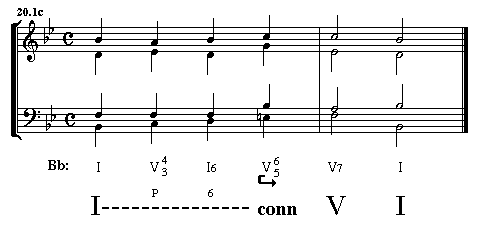
The following example is typical of the diatonic procedures examined thus far.

With one small change (beat 4 in the bass), the story has changed dramatically.

Beat 4 of the first measure is no longer a supertonic 7 in 1st inversion, since it has a pitch (E-natural) not in the key of B-flat major. This pitch gives strong emphasis to the next note (F), acting like a leading tone. This is an example of a TONICIZATION, temporarily emphasizing a harmonic area by making it as important as tonic through a dominant action.
As stated in Chapter 14, tonic is the most important harmonic function in any given key and it is possible to give this kind of status to other harmonic areas as well. Tonic achieves this importance due to the necessity of dominance to resolve, so the process of tonicizing a secondary area must therefore involve a SECONDARY DOMINANCE. Secondary dominance (the tonicizer) serves to tonicize the following chord (the toncizee).
The new analysis changes slightly. The Roman numeral on beat 4 requires a new label since it does not belong to the key of B-flat. It now has a relationship to the dominant instead. Stacking it up in thirds results in C - E-natural - G - Bb, which forms a Mm7 chord, a quality associated with dominant 7. Moreover, it is dominant 7 of F, not Bb.
To show this relationship, an arrow is attached to the secondary dominance to indicate two things:
- To distinguish it from the primary dominance, which occurs in both measures.
- To show that it is tonicizing the chord on the next beat.
Notice that the structural analysis does not change at all. This new chord still acts like a connection to the cadence.
20.2 SECONDARY DOMINANCE
Any harmonic area that contains a leading tone can serve as a secondary dominance.
| Chord | Quality | Root motion
|
|---|
| V | Major triad | Sol - Do (up a P4 / down a P5)
|
| V7 | Mm7 | Sol - Do (up a P4 / down a P5)
|
| viio | Diminished triad | Ti - Do (up a m2)
|
| viio7 | dm7 | Ti - Do (up a m2)
|
| viio7o | dd7 | Ti - Do (up a m2)
|
| III+ | Augmented triad | Down a m3 (this is seldom used
and will be discussed later)
|

 Learn more about secondary dominances
Please note that Dr. Rush uses different symbols to represent these tonicizations; avoiding the arrow,
he writes "V/V" (dominant of the dominant).
20.3 ANALYSIS OF TONICIZATIONS
Using the information above, analysis of a tonicization is a matter of following steps:
- Stack the sonority in thirds
- Identify the quality and position
- Identify the function from the quality
- Identify the expected resolution from the function
- Locate the actual resolution; if it is the same as the expected, label as tonicization and position
The example below shows how this works. Meas 1 beat 2 has a chromatic pitch (G-flat)
- Ab - C - Eb - Gb
- Quality is Mm7, 3rd inversion.
- Mm7 chords act like dominant 7
- Dominant 7 should resolve in Sol - Do motion; root is Ab, resolution should be Db
- The root of the next beat is Db, as expected: dominant 7 in 3rd inversion of the next chord

Meas 1 beat 4 has a chromatic pitch (E-natural)
- E-natural - G - Bb - Db
- Quality is dd7, root position
- dd7 chords act like leading tone 7
- Leading tone 7 should resolve in Ti - Do motion; root is E-natural, resolution should be F
- The root of the next beat is F, as expected: leading tone 7 of the next chord.

Meas 2 beat 2 has a chromatic pitch (D-natural)
- Bb - D-natural - F - Ab
- Quality is Mm7, 1st inversion
- Mm7 chords act like dominant 7
- Dominant 7 should resolve in Sol - Do motion; root is Bb, resolution should be Eb
- The root of the dominant following is Eb, as expected: dominant 7 in 1st inversion of the next chord

Note that the cadential 6/4 delays the arrival of dominant until beat 2 of the second measure, and does not negate the tonicization taking place...it only delays it.
20.4 STRUCTURAL ANALYSIS OF TONICIZATIONS
As stated before, tonicizations do not change structural analysis. The progression above with structural analysis:
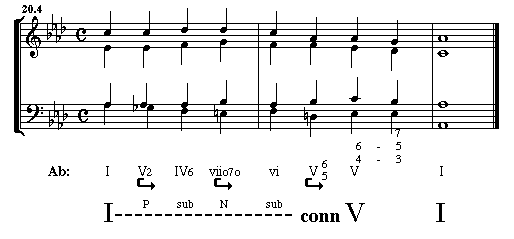
The bass line reveals the passing and neighboring functions of the first two tonicizations, and the connection is still identifiable in spite of the tonicization.
20.5 TONICIZATION GOALS
Any harmonic area in a key may be tonicized except for tonic (which already is tonicized) and leading tone triad (which is diminished and cannot provide any form of stability).

20.6 NON-TONICIZATION OF SUBDOMINANT
One misleading tonicization is the dominant of the subdominant. This secondary dominant is identical to tonic and is better expressed that way. However, if the 7th is added (or is another form of secondary dominance), the tonicization will work since it now contains a chromatic pitch. In minor keys, the problem is solved since tonic is minor and the secondary dominant is major.

20.7 DECEPTIVE RESOLUTION OF TONICIZATIONS
It is possible for a tonicization to resolve someplace other than the expected pitch. When this alternate resolution is the interval of a 3rd lower than expected, it is called a DECEPTIVE RESOLUTION of the tonicization, and works in exactly the same way that a deceptive cadence works; that is, a resolution to a substitute, which is a 3rd lower. To label, add the word "deceptive" near the arrow of the tonicization.

Note that beat 4 of measure 1 should have resolved to submediant, but went to subdominant instead. This deceptive resolution is usually a 3rd lower, but may, on rare occasions, resolve a 3rd higher than expected.
20.8 TONICIZATIONS IN CHAINS
Tonicizations can occur in chains, resolving to another tonicization rather than a diatonic harmony. The root motion, however, must remain the same (Sol-Do for dominants and Ti-Do for leading tone chords).

20.9 NON-CHROMATIC TONICIZATIONS
There are three tonicizations which do not require a chromatic pitch, and all are in minor keys.
- The subtonic (a major triad when lowered ^7 is used) is located a P5 above the mediant triad, and can act like a tonicization when it progresses to the mediant. It works as a tetrad (dominant 7 of the mediant) also.
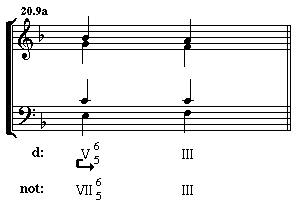
- The mediant (a major triad when lowered ^7 is used) is located a P5 above the submediant triad, and can act like a tonicization when it progresses to the submediant. It does not work as a tetrad (a M7 is formed).

- The subdominant, (a major triad when raised ^6 is used) is located a P5 above the subtonic triad, and can act like a tonicization when it progresses to the subtonic. It works as a tetrad (dominant 7 of the subtonic) also.

It is possible to place these three non-chromatic tonicizations in a row to create a chain of tonicizations:

20.10 BACKWARD RELATING TONICIZATIONS
On occasion, secondary dominances can follow a harmonic area (dominant after all can follow tonic). While this does not actually act as a tonicization, it is a possible situation.
To label, simply point the arrow backwards.

The backward relating tonicization in the example above is clearly acting as a passing chord, but does not provide a standard resolution of the chromatic pitch.
ASSIGNMENTS:
ANALYSIS
Describe the phrase design and provide a Roman numeral and structural analysis for the following pieces in Music for Analysis:
- Mozart: Rondo [#158]
- Mozart: Sonata, K.281 [#174, CD track #27]
- Schumann: Sonata, op.118, Andante (ignore all dotted eighth notes) [#180, CD track #30]
- Beethoven: Symphony No. 1, op.21 [#181] Listen to a performance
- Beethoven: Sonata, op.53 [#193, CD track #32]
- Chopin: Mazurka, op.67, no.2 [#201, CD track #33]
SYNTHESIS
Add soprano, alto, and tenor lines to this figured bass, and include, with eighth notes only, multiple passing tones, neighbor tones, and suspensions (never more than one in any given beat) in the upper three voices. Circle and label the non-chord tones and provide a Roman numeral and structural analysis:
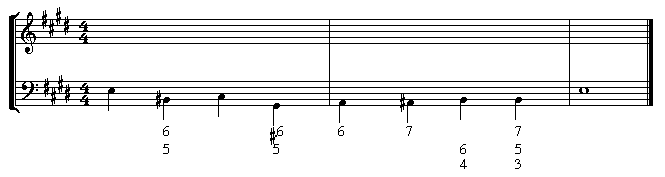
To prepare this writing assignment properly, use the notation guidelines appendix, located at
Basic Principles of Music Notation, Semester II.
Links to chapters in this unit:
Link to previous unit: DIATONIC PROCEDURES III: Substitutions
Link to next unit: THE ABC's OF CHORALE SETTING
Copyright © 2008-2009 by Phillip Magnuson.
Content on this website is licensed under a Creative Commons License.