Emotion in Music


Through intense rhythms and expressive techniques, music is often used portray deep, primal emotion and explore the broader human experience.
Primitivism
A common theme in music is a fascination with other cultures. Often, musical characteristics of another culture will be referenced or appropriated into an established style with varying levels of fidelity. In some cases, the culture being referenced is implied to be less developed or inferior. In music and other forms of art, this is called primitivism, and can be a element of cultural colonialism.
In Classical Music
In the 18th century, Vienna was a significant European cultural center, and composers working there were influenced by the musical traditions of cultures to the southeast. A popular technique in music of the Classical era was to evoke the percussion-heavy Janissary bands present during the 1683 siege of the city by the Ottoman Empire.
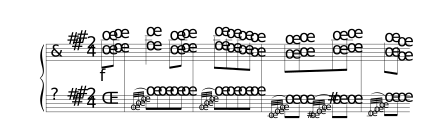
Composers in the Classical and Romantic eras were also enamored with the Romani culture, and often appropriated its musical styles into all types of works.
In Popular Music
Similar appropriations have occurred throughout the history of popular music. The Mikado, an 1885 operetta by the English composer/librettist team of Arthur Sullivan and W.S. Gilbert, features a stereotypical portrayal of Japanese culture as a comic conceit. Minstrelsy was a racist portrayal of Black culture involving music, drama and dance by white performers — often wearing blackface — that was common in early 19th-century America.
Primalism
A form of primitivism explored by some composers is primalism, art which portrays human behaviour or emotion that is unconstrained by societal norms. Relevant subject matter includes pre-civilized cultures, apocalyptic fiction, and psychological distress.
The Rite of Spring, a 1913 ballet by Russian composer Igor Stravinsky, portrays a fictional pagan culture participating in the ritual sacrifice of a young girl. The ballet, which utilizes intense, driving rhythms, unpredictably changing meters, and harsh dissonances, was controversial when it first premiered.

A similar evokation of primal emotion is portrayed in a more modern setting by American composer Leonard Bernstein in his 1956 opera Candide, which includes public execution by burning.
Expressionism
As represented in various types of art including painting, sculpture and cinema, expressionism involves the exaggerated portrayal of intense emotion through art. A well-known example of this movement is The Scream, an 1893 painting by Norwegian artist Edvard Munch.
German composer Arnold Schoenberg was a notable expressionist composer who combined strict atonality with expressive techniques like sprechstimme and klangfarbenmelodie. Schoenberg, his students and other composers writing in a similar style came to be known as the Second Viennese School.
However, expressionism as a musical idea can be seen to include many other works, many of which portray darker themes such as anger, fear, and societal decay. Notable works in this genre are German composer Kurt Weill's 1928 production The Threepenny Opera and American composer Stephen Sondheim's 1979 musical Sweeney Todd: The Demon Barber of Fleet Street, both of which are set amid lower-class, crime-ridden subcultures of Victorian England, and focus on hyper-realistic themes of destitution and murder.
Expressionism in Popular Music
The intense emotion which typifies expressionism can be found in a large cross-section of popular styles. Specific genres which are centered on these ideas include punk, which began as a reaction against the higher production levels of rock music but which coincided with a wider antiestablishment movement.
Metal
Perhaps the most prevalent form of expressionism in popular music is metal, which is characterized by intense, driving rhythms, overdriven electric guitars, energetic and distorted vocals including screaming and growling, and often violent lyrical themes. Even with these defining characteristics, metal has a large number of subgenres, ranging from commercially popular bands like Van Halen and Guns N' Roses to controversial death metal bands like Deicide.
Emotion in Music: Summary
- Primitivism describes music which focuses on a style or culture considered less developed or inferior.
- In the Classical era, composers were often inspired by cultures that felt foreign to them, such as those of southwest Asia.
- Primitivism is often considered racist, especially when different cultures are lampooned or stereotyped.
- Primalism is a type of primitivism which focuses on people or situations which are unrestrained by societal norms.
- Expressionism involves the exaggerated portrayal of intense emotion through art.
- Austrian composer Arnold Schoenberg was a well-known expressionist who used expressive techniques like sprechstimme, a vocal technique which blends signing with normal speech, and klangfarbenmelodie, the use of regularly changing timbres in a single melodic phrase.
- Expressionism is common in popular music, most notably in genres like punk, emo, and metal.