Third Relations & Pantriadicism
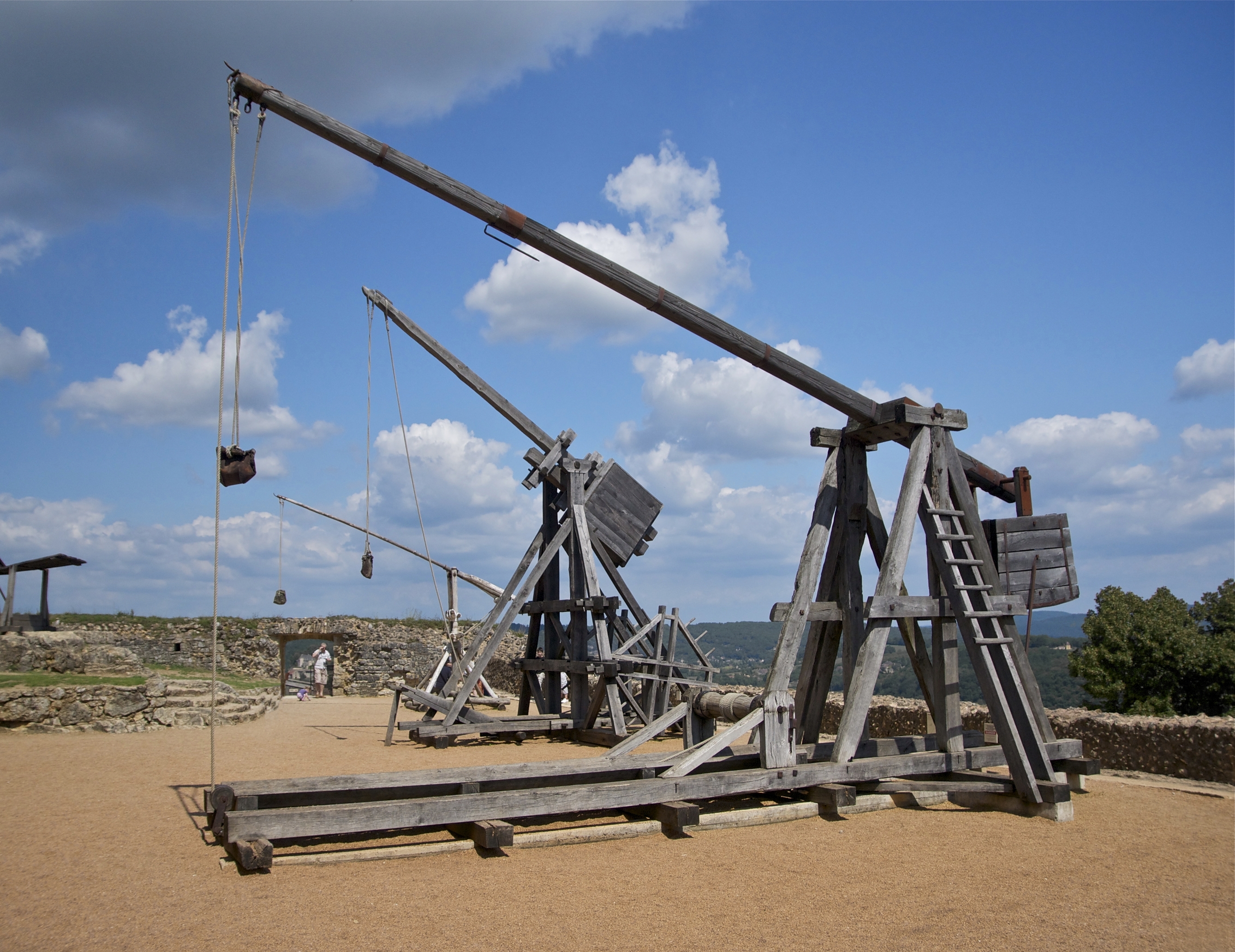
Three large wooden trebuchets sitting idly next to a low stone wall. Beyond the stone wall is a treetop and distant greenery, giving the impression that the foreground is atop a large castle. Trebuchets atop the Château de Castelnaud in Dordogne, France. Pantriadicism involves leaping large harmonic distances, much like the payload of these medieval machines.

Both diatonic and chromatic melodies can be effectively harmonized with chord progressions that deliberately avoid the common patterns of harmonic progression used in classical music.

Third Relations

In an otherwise tonal piece, a composer can create a temporary sense of freedom from a particular tonal center by moving through a string of chords whose roots are M3 or m3 apart. This technique, called third relations or chromatic mediants, gives the piece a sense of weightlessness, allowing a shift to an unrelated key.
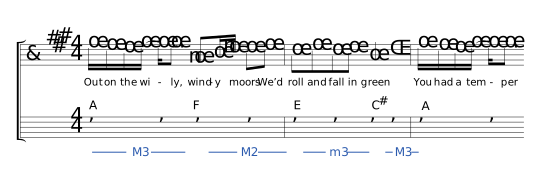
Measures 3 through 5 of `Wuthering Heights` by Kate Bush. Chords, which occur every two beats, start with A major, then move down a major third to F major, then down a major second to E major, then down a minor third to C sharp major, and finally down a major third to A major.
Figure 1: Measures 3-5 of the 1978 song Wuthering Heights by British singer-songwriter Kate Bush. The verse features third relations in a repeated sequence of E-C#-A-F.

Pantriadicism

The harmonic distance in a third relationships passage can be illustrated using the circle of fifths: a root movement of a m3 moves three steps away on the circle, and a root movement of a M3 moves four steps away.
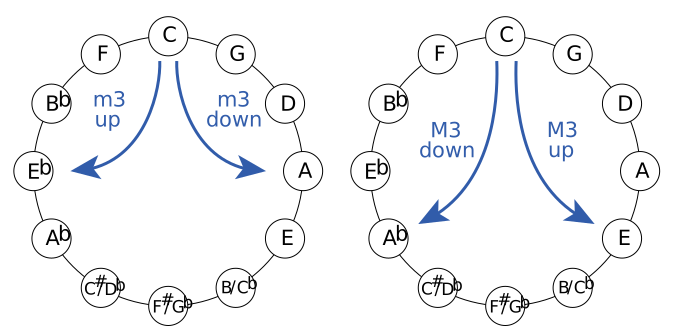
Two annotated circles of fifths, where notes or keys are placed around the circumference starting at the top and going clockwise: C, G, D, A, E, B or C flat, F sharp or G flat, C sharp or D flat, A flat, E flat, B flat, and F. On the left circle, arrows lead from C to E flat, a minor third up, and to A, a minor third down. On the right circle, arrows lead from C to A flat, a major third down, and to E, a major third up.
Figure 2: Root movements of minor thirds and major thirds diagrammed on the circle of fifths. Root movements of three or more degrees on the circle of fifths are generally not heard as traditionally functional, and are thus effective in pantriadic writing.

By juxtaposing unrelated chords — chords which are far from one another on the circle of fifths — composers can create a harmonic texture very different than the traditional harmonic patterns used in the Common Practice Period. This type of harmonic approach is called pantriadicism.
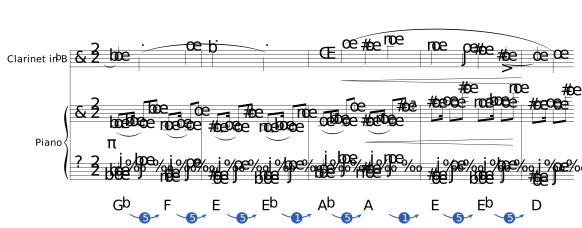
Measures 52 through 56 of Paul Hindemith's Clarinet Sonata. Chords happen on each beat: G flat major, F major, E major, E flat major, A flat major, A major, E major, E flat major, and D major. With the exception of E flat to A flat and A to E, which are one step away from each other, every chord is 5 steps on the circle of fifths from adjacent chords.
Figure 3: Measures 52-56 of the second movement of German composer Paul Hindemith's Sonata for Clarinet and Piano. This phrase includes a pantriadic accompaniment, with most chords 5 steps from one another on the circle of fifths.

Like third relations, pantriadicism can be effective in suspending tonality within a tonal work.
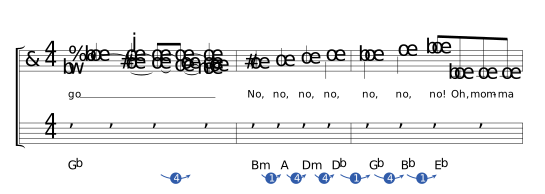
Measures 90 through 92 of Bohemian Rhapsody by Queen. Under the lyrics `go; No, no, no, no, no, no, no! Oh, momma` there is a G flat major triad under `go,`, then each `no` has a chord: B minor, A major, D minor, D flat major, G flat major, B flat major, and E flat major. A major, G flat major and E flat major are all approached by harmonic leaps of one step on the circle of fifths; the others are all approached by four steps on the circle.
Figure 4: Measures 90-92 of the 1975 song Bohemian Rhapsody by the British group Queen. This pantriadic phrase features three traditional harmonic movements and four leaps of four steps on the circle of fifths.

Pantriadic chord sequences can be effective in a chorale texture, and can include smooth voice-leading despite the chords' harmonic distance.

Neo-Riemannian Theory

Because pantriadic harmony specifically avoids tonal harmonic function, theorists do not use Roman numerals when analyzing these passages, even if the chords themselves might occasionally align with the global key area. Instead, theorists will generally label chords in a pantriadic section with harmonic macroanalysis, and track the harmonic distance between each chord.

A commonly used system for measuring how related one chord is to another is neo-Riemannian theory, named for German music theorist Hugo Riemann. Neo-Riemannian theory is based upon triad transformations, accomplished by changing one of a major or minor triad's three notes to create a different major or minor triad.

The three primary transformations in neo-Riemannian theory are:

  • Parallel transformation (P), accomplished by moving a triad's third by a half-step to change it from major to minor or vice versa;
  • Relative transformation (R), accomplished by moving a major triad's fifth up a whole step to create a minor triad, or vice versa;
  • Leading-tone Exchange (L), accomplished by moving a major triad's root down a half-step to crete a minor triad, or vice versa.
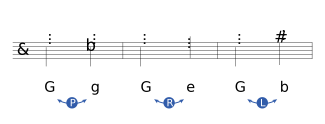
An illustration of each primary neo-Riemannian transformation on a G major triad. The P transformation results in a G minor triad, the R transformation results in an E minor triad, and the L transformation results in a B minor triad.
Figure 5: The three primary neo-Riemannian transformations.
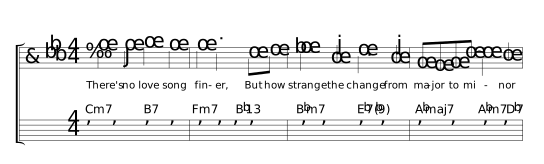
Measures 25 through 28 of `Ev'ry Time We Say Goodbye,` showing the lyrics `There's no love song finer, but how strange the change from major to minor.` The chords change every two beats as follows: C minor 7, B 7, F minor 7, B flat 13, B flat minor 7, E flat 7 flat 9, A flat major 7, A flat minor 7, with a change to D flat 7 on the last beat of measure 28.
Figure 6: Measures 25–28 of the American composer Cole Porter's 1944 song Ev'ry Time We Say Goodbye, performed here by American singer Ella Fitzgerald. In measure 28, following the lyrics, the harmony moves from Ab major to Ab minor, which can be analyzed as a P transformation.

The Tonnetz

Theorists using neo-Riemannian theory find it helpful to visualize chord relationships using triangles to represent triads, with its three notes at each corner. Triads which share two notes can then be shown as triangles which share a common side. Using this system, the three primary transformations, P, R and L, can be easily seen.

A diagram showing an equilateral triangle pointing downward with C at the upper left corner, E at the bottom corner, and G at the upper right corner. Three other triangles are situated so they each share a side with the first. The top triangle has C, E flat and G as the corners. The lower left triangle has A, C and E as the corners. The lower right triangle has E, G and B as the corners. The shared sides are each labeled to indicate that moving from the center triangle to the top triangle and back is a P transformation, moving from the center triangle to the lower left triangle and back is an R transformation, and moving from the center triangle to the lower right triangle and back is an L transformation.
Figure 7: A diagram showing triads as triangles with the component notes as points. When illustrated this way, the primary transformations can be seen as moving to and from a triangle with a shared side.

By continuing this pattern in each direction, a grid can be created which neo-Riemannian theorists call the Tonnetz. Like the circle of fifths, the Tonnetz can be extended indefinitely by using double sharps and double flats, triple sharp and triple flats, and so on, but by assuming enharmonic equivalence, only a limited section is necessary.
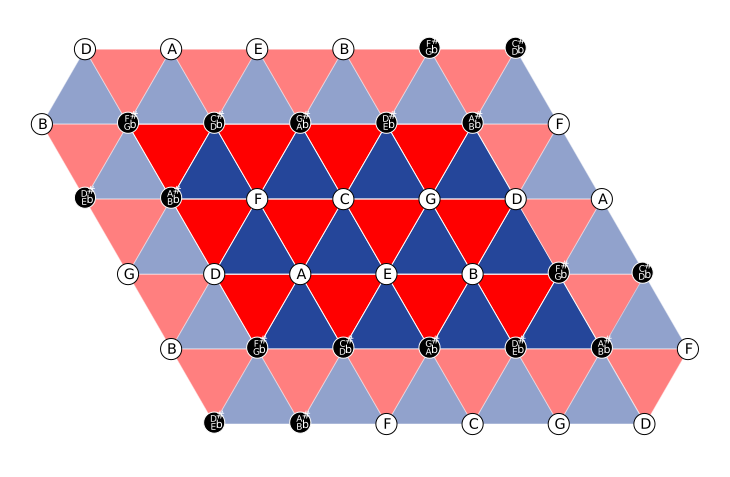
A diagram showing the pattern from Figure 6, expanded to include all possible triads. Following the verticies, notes move up by a perfect fifth as you move to the right, up by a minor third as you move to the top right, and up by a major third as you move to the bottom right. Upward-pointing triangles represent minor triads and downward-pointing triangles represent major triads.
Figure 8: The Tonnetz. Triads represented by triangles on the outer edge are repetitions of chords in the center of the diagram.

Neo-Riemannian Analysis

Any music which uses triadic harmony can be analyzed using neo-Riemannian theory by denoting the shortest number of transformations needed to move from one chord to another.
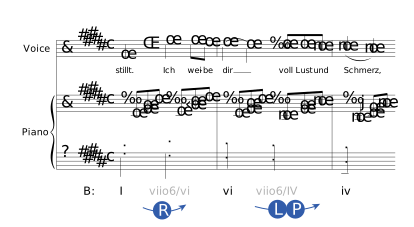
Measures 5 through 7 of `Du Bist Die Ruh` by Fanny Mendelssohn Hensel. The roman numeral analysis for this passage in B major goes from the tonic, to the diminished leading tone triad of the submediant, to the sub mediant, to the diminished leading tone triad of the subdominant, to the minor subdominant. Ignoring the diminished triads, from the tonic to submediant is an R transformation, and going from submediant to minor subdominant requires both an L transformation and a P transformation in that order.
Figure 9: Measures 5–7 of Du Bist Du Ruh, an 1846 song by German composer Fanny Mendelssohn Hensel. The major and minor triads in this piece illustrate a primary transformation (R) and a secondary tranformation (L followed by P).
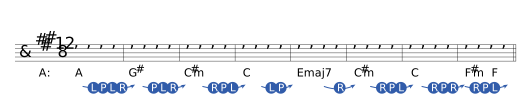
The chord progression of the first eight measures of `Wake Up Alone` by Amy Winehouse. The chords and transformations are as follows: A major does an L P L R transformation to G sharp major. Then a P L R transformation moves to C sharp minor. Then an R P L transformation moves to C major. Then an L P transformation moves to E major seven. Then an R transformation moves C sharp minor. Then an R P L transformation moves to C major. Then an R P R transformation moves to F sharp minor. Finally an R P L transformation moves to F major.
Figure 10: The chords for the first eight measures of Amy Winehouse's 2006 song Wake Up Alone, illustrating a pantriadic progression.

Three common secondary transformations used in neo-Riemannian theory involve the combination of multiple primary transformations:

  • Nebenverwandt (N), done by applying R, then L, then P
  • Slide (S), done by applying R, then P, then L
  • Hexatonic Pole (H), done by applying L, then P, then L again
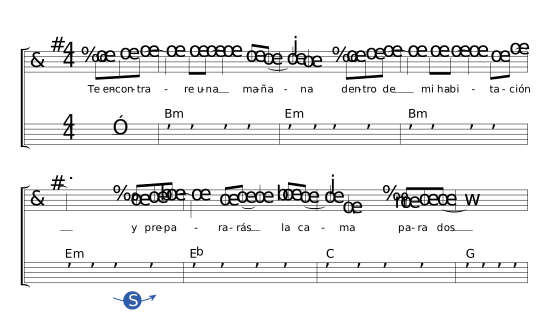
The chord progression of measures 17 through 23 of `Cancion Para Mi Muerte` by Sui Generis. The lyrics, `Te encontrare una mañana dentro de mi habitación y prepararás la cama para dos,` are accompanied with the chords B minor, E minor, B minor, E minor, E flat major, C major, G major. The movement from E minor to E flat major is marked with an S.
Figure 11: The chords for the measures 17–23 of the Argentine band Sui Generis's 1972 song Cancion Para Mi Muerte, illustrating a slide transformation.

Third Relations & Pantriadicism: Summary

  • Third relations involve moving chords by a consecutive root movements of a M3 or m3.
    • Third relations can create an effect of a suspension of tonality, allowing composers to drift out of one key and into another.
  • Pantriadicism involves the juxtaposition of chords which are three or more degrees apart on the circle of fifths.
    • Like third relations, pantriadicism can be useful in suspending a sense of tonality.
    • Pantriadicism can be used in a chorale texture with smooth voice leading.
  • Neo-Riemannian theory is a tool for measuring the relationship between two triads.
  • In neo-Riemannian theory we observe three primary transformations of a triad:
    • Parallel transformation (P): moving a triad's third by a half-step to change it from major to minor or vice versa
    • Relative transformation (R): moving a major triad's fifth up a whole step to create a minor triad, or vice versa
    • Leading-tone Exchange (L): moving a major triad's root down a half-step to create a minor triad, or vice versa
  • The Tonnetz is a useful diagram for envisioning neo-Riemannian transformations.
    • In the Tonnetz, each triad is represented by a triangle with the component pitches on each corner.
    • Transformations are shown on the Tonnetz by moving from one triangle to another triangle with a shared side.
    • Distant relationships between triads are illustrated through multi-step neo-Riemannian transformations.

Exercises

Exercise 1: Harmonizing a Melody

Exercise 2: Analyzing James Horner's "A Kaleidoscope of Mathematics"