Rhythmic Notation

Because musical works exist across spans of time, music notation must portray not only which pitches are being played but when they should be played and how long they should last.
Staff Notation
To show a note's duration, staff notation uses a system of symbols which has evolved from the European mensural notation of the 13th and 14th centuries, in which relative note length was shown by the length of a the horizontal stroke.

The current system uses a set of noteheads, stems and flags to represent different note lengths. Within a piece, these note values have consistent durational relationships with one another, but absolute values are determined by the piece's tempo marking; a quarter note in one piece may be longer or shorter than a quarter note in different piece.

Augmentation Dots
When a dot is placed to the right of a notehead, it increases the durational value of the note by an additional 50%. Thus, while a quarter note is equivalent in length to two eighth notes, a dotted quarter not is equivalent to three eighth notes.

While uncommon, notes can have multiple dots; in this case, each successive dot adds half of the duration added by the previous dot.

Ties
Two or more notes of the same pitch can be combined to form a single, longer note by connecting the noteheads with a tie, an arc placed between the two note heads.

When more than two notes are tied together, separate ties are used to connect each notehead.
Rests
In addition to indicating which notes to play or sing, music notation also indicates when a performer should pause, and for how long. Rests are symbols which indicate measured silence, and staff notation uses a set of rest symbols which correspond to each note value.

Augmentation dots added to rests have the same affect as they do with notes, adding half of the duration.
Percussion Notation
In the context of staff notation, percussion instruments which have definite pitches — such as marimbas, vibraphones and timpani — use one or more five-line staves with traditional clefs. Unpitched instruments, however, use a variety of different staff configurations based on the individual instrument.
When using staff notation for unpitched instruments, standard clefs are not necessary, and are often replaced with a percussion clef consisting of two short, broad vertical lines.
One-line Staves
Instruments which normally produce a single tone, such as claves or triangle, will often be notated on a single line to ease legibility.

Multiple-line Staves
Semi-pitched instruments — instruments which produce notes which differ in pitch with one another but do not align to a specific tonality — are generally notated on staves of two, three, four or five lines, with lines or spaces used to indicate relative pitches.

Drum Set Notation
Drum sets, which normally consist of several different drums and cymbals, are usually notated on a five-line staff with a percussion clef. While some details vary from piece to piece, the lowest space of the staff generally represents the bass drum, the second space from the top is the snare drum, and other lines and spaces on the staff show various toms. Cymbals are shown with X noteheads, with the hihat on the top line of the staff and other cymbals on spaces and ledger lines above it.
Braille Music Notation
In braille music notation, note lengths are indicated with the lower two dots in the braille cell, allowing a single cell to portray both pitch and duration.
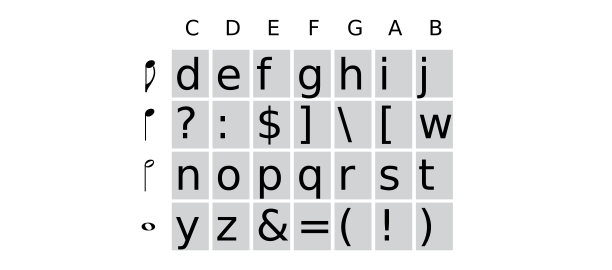
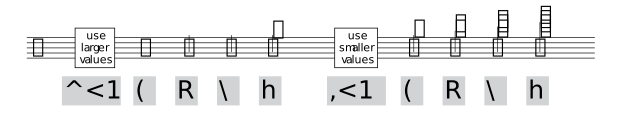
Because two dots allow for only four variations, the same sequence of symbols are used for shorter note values; when the durations aren't clear through context, special symbols are used to clarify.
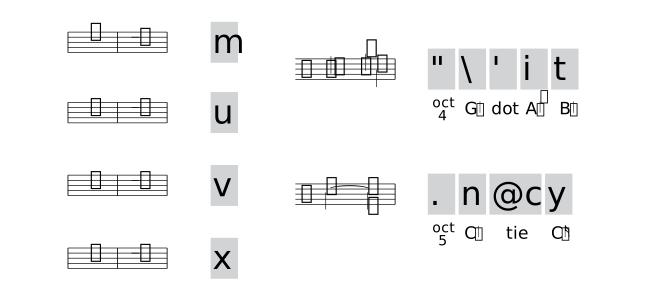
Specific braille symbols are used for rests, dots and ties.
Rhythmic Notation: Summary
- Staff notation indicates note duration using a system of different noteheads, stems, and flags.
- Placing an augmentation dot to the right of a notehead indicates the note's duration should be extended by half of it's regular value.
- Subsequent dots continue adding half the value added by the previous dot.
- The value of multiple note durations can be combined by connecting the notes with a tie.
- Rests indicate that the player should pause for a specific period of time.
- Unpitched percussion instruments are notated using staff notation, often with staves containing fewer than five lines.
- Drum set notation uses a five-line staff and displays each component of the drum set on a different line or space.
- Braille music notation uses a single braille character to indicate pitch and duration.
- The lower dots in the braille character indicate durations of whole, half, quarter or eighth notes.
- Smaller note values use the same characters; when the duration is not clear through context, a three-character sequence is used to indicate large or small durations.
- Rests, dots and ties are each represented with their own braille characters or character sequences.