Musique Concrète
Musique concrète is a French term meaning "concrete music". As opposed to more abstract concepts of music notation and sound waves, musique concrète refers to the manipulation of physical recordings of sound.
Physical Manipulation
Though musique concrète can be done with any type of recording media — a DJ scratching a record can be considered an example — it is most commonly associated with tape recordings.
Tape Recording
Tape recorders make use of long spools of plastic tape which are coated with a material which can be magnetized, such as iron oxide or chromium oxide. A recording head receives variations in electrical current and imprints them magnetically on the tape as it is spooled past; a playback head can detect the magnetized material from the passing tape and converts it back into an electrical signal.
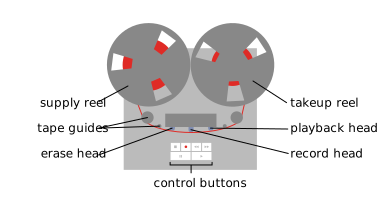
In the 1970s and 1980s, one of the most common formats for purchasing electronic music was the tape cassette: a spool of prerecorded tape permanently stored inside a plastic case. Prior to and during the popularity of cassette tapes for consumer music, however, reel-to-reel tape — where a single spool of tape is wound over playback or recording heads onto an empty spool — remained the most popular format for professional audio engineers.
Tape Manipulation
In standard operation, a tape is played back by moving it across the playback head in the same direction and at the same speed as it was moved over the recording head. By altering this process, however, the recorded audio can be affected in interesting ways, and even re-recorded to a connected second tape recorder.
Playback Speed
As with record players, changing the speed of the tape movement will affects the audio playback. Moving the tape more slowly causes the sound to play more slowly, and the pitch to be lowered accordingly; playing the tape at a higher speed plays the audio faster and at a higher pitch.
Playback Direction
A tape player's transport system — the motors which turn the spools and wind or unwind the tape — are designed to work in both directions: one direction to play the tape, spooling the tape onto an empty reel, and the opposite direction two rewind the tape back to the original spool after playback.
If the playback head is engaged while the tape is spooling backward, it will play back the reversed audio, which will usually have an unnatural, affected sound. This technique can be heard in the percussion part of The Beatles' 1967 song Strawberry Fields Forever, which combine both normal and reversed recordings of Ringo Starr's drum playing.
Splicing
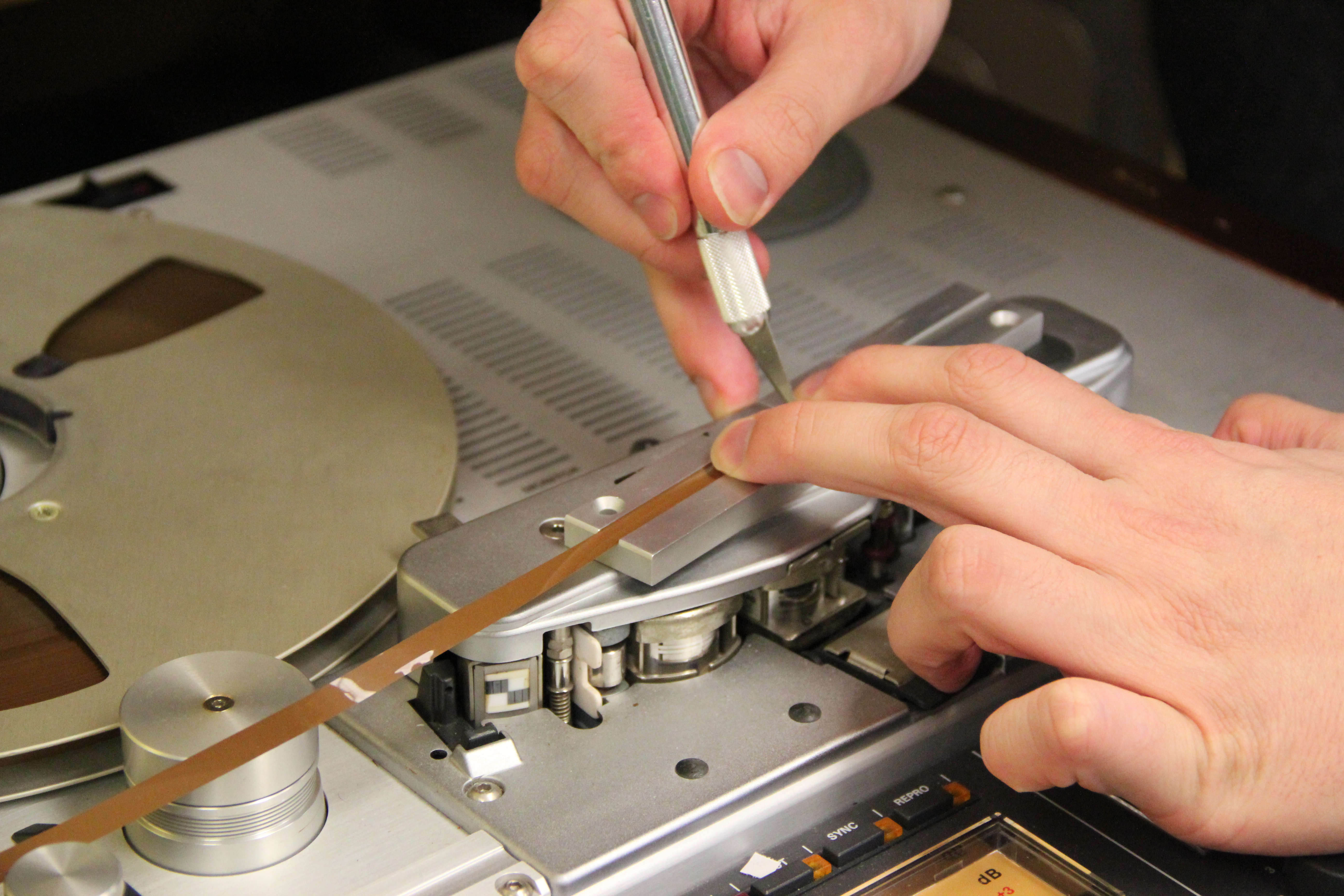
Because it carries information magnetically, tape recordings can be edited using splicing. Splicing is done by cutting the tape itself with a hobby knife and reattaching it using clear adhesive tape.
Through this process, sections of audio can be removed or reordered, and section of tape can be physically flipped so that portion of audio is reversed. By recording the edited audio with a second tape recorder, and perhaps repeating the process, sections of audio can be repeated, fragmented and reassembled in many ways.
Other Techniques
In addition to physically manipulating the recording medium, composers using musique concrète make use of other techniques to change the recorded audio, such as filters, audio effects, and reverb. Recorded audio can be combined with synthesized sounds or distorted using a variety of techniques and equipment, and individual unaltered recordings can be combined to create new sounds or textures.

Compositions
By combining these techniques, new sounds and soundscapes can be created from otherwise normal audio recordings. One of the earliest examples of musique concrète was 1944's "The Expression of Zaar" by Egyptian composer Halim El-Dabh, which used a recording of an ancient Muslim ceremony as its source.
Other well-known musique concrète works manipulate the source recordings more thoroughly, often obscuring their original characteristics. In 1958, Greek composer Iannis Xenakis used a recording of burning charcoal and through repeated fragmentation, speed variation, and overdubbing, created the piece Concret PH, a unique ambient work which was originally performed using more than 400 speakers located throughout the Philips Pavilion in Brussels, Belgium.
Works like Concret PH are considered acousmatic sound — sound in which the original source material is unrecognizable by the listener.
Digital Manipulation
Many musique concrète works required a significant amount of time and effort, as they were often the result of splicing, reattaching, recording and re-recording audio dozens or even hundreds of times. On modern computer systems, these same operations can be done electronically, where digital audio information is manipulated in place of physical media.
Digital audio editors, software applications which enable the creation and manipulation of audio files stored on a disk, can be found as standalone programs: Audacity, a free, open source digital audio editor available for Windows, macOS and Linux, is one of the most common standalone utilities used today. Digital audio editors are also available as embedded web applications, and are generally built in to larger digital audio workstation software packages like Ableton's Live and Apple's Logic.
Techniques
Digital audio editors often portray audio in a graphical format, as an approximate large-scale waveform where larger vertical strokes or curves represent louder sounds. When played, a vertical line usually acts as a cursor of virtual "playhead," showing the current location of the playback.

Operations which require the splicing, removal and re-recording of magnetic tape can be done virtually in a digital audio editor by placing the cursor in — or selecting a portion of — the waveform and using cut, copy, and paste functions.
Digital audio editors often allow for the manipulation of all or part of a digital audio file, providing not only common analog effects but capabilities that are unique to digital audio. For example, in addition to mimicking changes in tape reel speed — a process which normally changes both the tempo and the pitch of the sound — digital audio editors like Audacity can alter a sound's tempo or pitch independently.
Compositions
The digital manipulation of recorded audio is ubiquitous in today's music industry, and the concept of acousmatic sound is often moot, which listeners assuming that unfamiliar sounds are created by synthesizers or other electronic means.
However, there are notable cases where recorded sounds are used in creative and obscured ways. In her 2006 song Glittering Cloud — commissioned for a concept album in which each artist was assigned as a topic one of the biblical plagues of Egypt — British singer-songwriter Imogen Heap generated a percussion track using sounds adapted from the recording of a chirping locust.
Musique Concrète: Summary
- Musique concrète is the manipulation of recorded sound.
- One method of creating musique concrète is manipulating physical recording media.
- Tape recording, where soundwaves are magnetically imprinted on a metallic coating applied to a reel of plastic tape, is most commonly associated with physical musique concrète.
- Techniques include re-recording tapes played at different speeds and tapes played backward.
- Tape can easily be spliced — cut and reassembled in different ways — and re-recorded for further manipulation of the sound.
- A common technique in musique concrète is acousmatic sound, a sound whose source material has been obscured to the point where it is difficult or impossible to identify.
- Digitally recorded media can be subject to similar techniques.
- A digital audio editor is a software application which allows the manipulation of recorded sound.
- Speed, direction and splicing techniques can be accomplished in digital audio editors, as well as other techniques such as applying filters and other complex operations.