Chromatic Harmony

When music is written using a particular scale or key, the notes in that scale will be used much more often than other notes. When notes outside of the scale are used, they bring a certain sound and interest to the music, much like a swatch of rich color in a painting which primarily uses muted hues.
Diatonicism and Chromaticism
In tonal music, notes that are drawn from the current key are considered diatonic, and other notes are considered chromatic. In general, when a key signature is being used, chromatic notes can be identified by the use of an accidental.

However, there are some exceptions to this rule. For example, in a minor key, the raised leading-tone is considered a diatonic note, even though it is traditionally indicated with an accidental. Similarly, music written in a mode might use accidentals for notes that deviate from the nearest major or minor key.

Similarly, chords which use only the notes in the current key are diatonic. The most commonly used diatonic chords are shown in Figure 3.
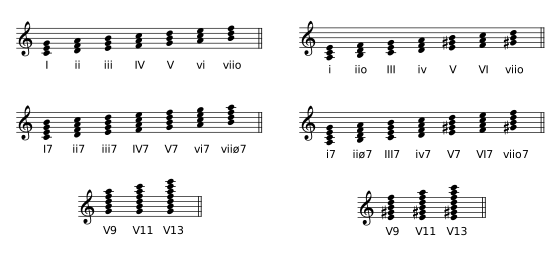
If a chord contains at least one note that is not in the key, we consider it to be a chromatic chord. Most chromatic chords in the Common Practice Period can be grouped into three categories: borrowed chords, secondary dominants, and augmented sixth chords.
Borrowed Chords
Borrowed chords are chords which are drawn from a parallel mode. The most common examples of borrowed chords are chords in a major key which are drawn from the parallel minor.
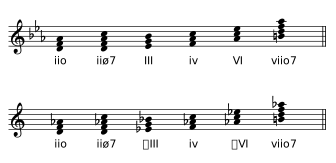
Two of these chords, bIII and bVI, are built on roots that are not in the key signature. These are sometimes called altered root chords, and are written with an accidental to the left of the roman numeral to show the alteration.
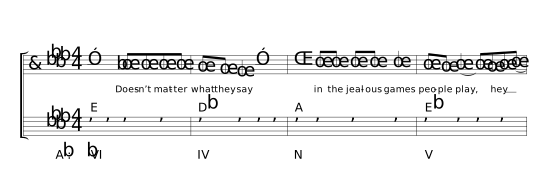
Borrowed chords can typically be used anywhere their diatonic counterparts would fit. For example, in the verse of Hallelujah, Leonard Cohen moves from the I chord to the diatonic vi chord and back.
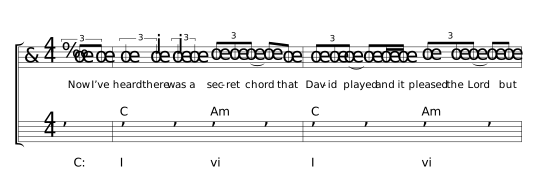
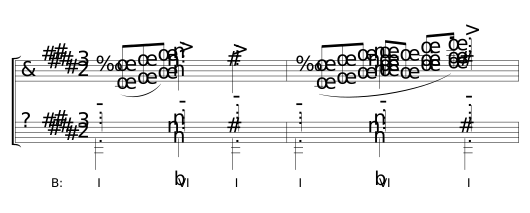
In Horn of Plenty from the soundtrack of The Hunger Games, James Newton Howard uses this same progression but substitutes the bVI chord, giving the piece an anthemic aura.
The Neapolitan Chord
Another frequently used altered root chord is a major triad on the lowered supertonic. While this could be analyzed as bII, it is commonly called the Neapolitan chord, and is notated with the symbol N. Like its diatonic counterpart, ii, the Neapolitan chord is frequently used before a dominant chord.
Though it has a similar sound due to use of lowered scale degrees, the Neapolitan chord is not generally considered a borrowed chord because the b2 scale degree is not present in minor. Thus is it commonly found in both major and minor contexts.
In music of the Baroque, Classical and Romantic eras, the Neapolitan chord was almost always used in first inversion.

Secondary Dominants
Composers will often tonicize chords by approaching them with a dominant function chord — a V or viio — from the key where the targeted chord would serve as tonic. For example, in C major, the ii chord — a D minor triad — can be preceded by an A major triad, the chord that serves as V in the key of D.
These chords, called secondary dominants, tonicizations, or applied chords, are labeled using two roman numerals separated by a slash. The first roman numeral shows how the chord would be analyzed in the related key. The second roman numeral shows how that key relates to the current key.
Thus, in the key of C major, an A major triad would be called V/ii (spoken as "five of two"), since A major is V of D, and D is ii in the key of C major.
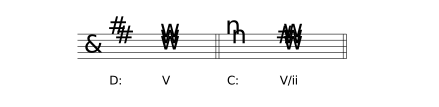
Secondary dominants usually resolve to the chord following the slash, or in other words, the diatonic chord that would be tonic in the related key.
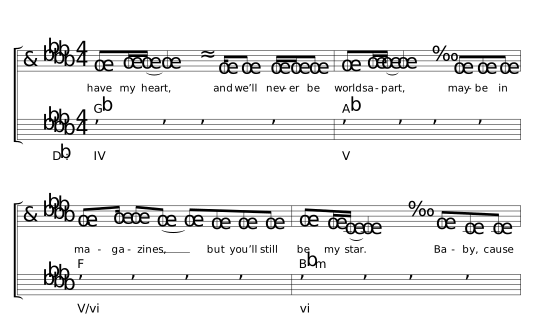
Any type of dominant function chord — V, V7, viio, viiø7, and viio7 — can be used. They may tonicize any diatonic chord except the leading-tone (which is too unstable to tonicize).
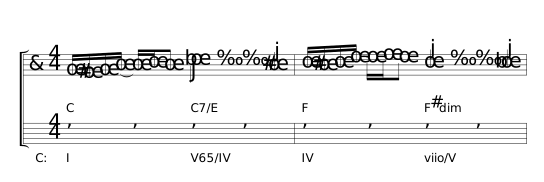
It is possible to even tonicize altered roots, as in a V/bVI or a V/N.
Augmented Sixth Chords
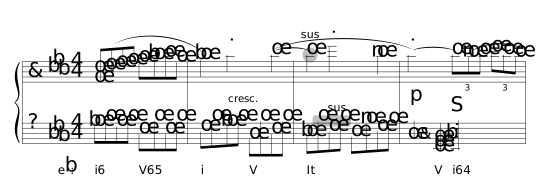
Augmented Sixth chords are created when an octave interval comprised of two 5s (usually in a I64 or V chord) is approached by half-steps in contrary motion.
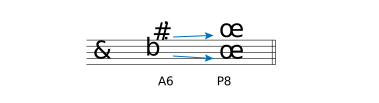
Adding 1 to this interval results in the Italian augmented sixth. From there, 2 can be added to create the French augmented sixth, or b3 can be used to build the German augmented sixth.
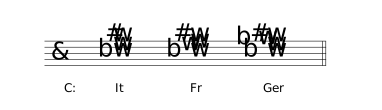
Because of the augmented sixth interval, which inverts to a diminished third, these chords do not fit into tertial harmony. As a result, they are not considered to have a root, and are not analyzed for position or inversion.
Augmented sixth chords are not often found popular music; they are most commonly associated with the Classical and Romantic eras.
Enharmonic Modulation
Chromatic chords can be used to create common chord modulations which allow access to harmonically distant keys.
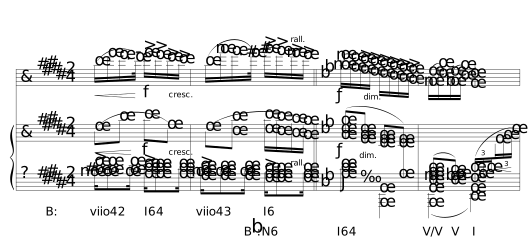
In common chord modulations, the chord type does not change; in Figure 15, for example, the pivot chord's role in the key changes but it is a major triad in both keys. Enharmonic modulations occur when the pivot chord's type or inversion changes as a result of enharmonic respelling.
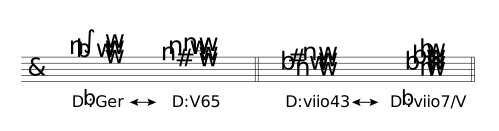
One example of this is uses the fully diminished seventh chord, which divides the octave into four equally-spaced intervals. This allows any note in the chord to be interpreted as the root.
Another type of enharmonic modulation takes advantage of the fact that the German augmented sixth chord can be respelled as a dominant seventh chord.
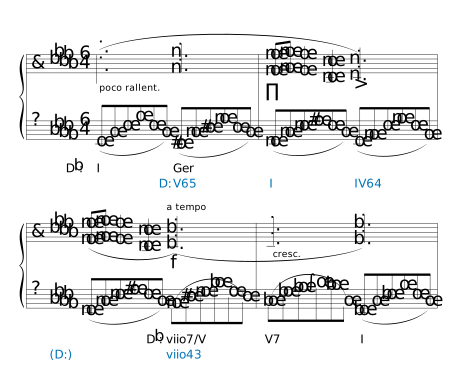
In either case, to modulate, a composer can reassign the root of the chord in order to shift toward a new key center. In his Nocturne, Op. 9, No. 1, Frédéric Chopin uses both types of enharmonic modulation in the space of three measures to move from Db major to D major and back.
Chromatic Harmony: Summary
- Chromaticism refers to using notes outside of the current key.
- Notes within the key — and the chords built from them — are called diatonic.
- A chromatic note is a note that is not in the key signature. Chromatic notes usually require accidentals.
- A chromatic chord is any chord that contains at least one chromatic note.
- Borrowed chords are chromatic chords that use notes from a parallel mode, usually the parallel minor.
- The Neapolitan chord is a major triad with b2 as the root.
- Secondary dominants are chromatic chords which have a dominant function in a related key.
- These chords are written with a slash and the roman numeral representing the related key.
- Augmented Sixth chords are built from the augmented sixth formed by b6 and 4, which both resolve to 5.
- The Italian Augmented Sixth adds only 1.
- The French Augmented Sixth adds 1 and 2.
- The German Augmented Sixth adds 1 and b3.
- Enharmonic Modulation occurs when a pivot chord is enharmonically respelled in the new key, changing either the inversion or the chord type.
- The German Augmented Sixth chord can be respelled as a major-minor seventh chord.
- Fully diminished seventh chords can be respelled with any other note as the root.